
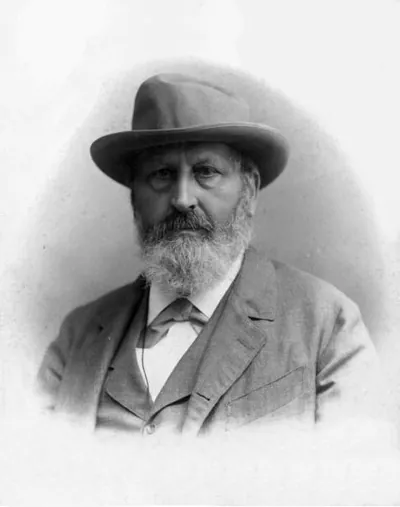
Karl Alfred von Zittel
German geologist and palaeontologist, author of the major treatise Handbuch der Palaeontologie · 1839–1904
- Born
- September 25, 1839
- Died
- January 5, 1904
- Country
- German Empire, Grand Duchy of Baden
- Section
- Earth sciences
Biography
Karl Alfred von Zittel was one of the most influential palaeontologists of nineteenth-century Germany. He is best remembered for his Handbuch der Palaeontologie, a five-volume survey of fossil life published between 1876 and 1893 that gathered the knowledge of his time into a single work. He is also remembered for building up the fossil and mineral collections of Bavaria into some of the finest in Europe.
Zittel was born in Bahlingen, in the Grand Duchy of Baden, into a family active in public life: his father, also called Karl, was a prominent cleric with liberal views. He studied at the universities of Heidelberg, Paris and Vienna. For a short time he worked for the Geological Survey of Austria and as an assistant in the mineralogical museum in Vienna, gaining hands-on experience with collections and fieldwork.
In 1863 he became a teacher of geology and mineralogy at the Polytechnic School in Karlsruhe. Three years later he succeeded Albert Oppel as professor of palaeontology at the University of Munich, where he also took charge of the state fossil collection. From 1869 until the end of his life he served as chief editor of Palaeontographica, a leading journal of the field.
His fieldwork included a notable expedition. In 1873 and 1874 he joined the explorer Gerhard Rohlfs on a journey to the Libyan Desert. The first results appeared in 1880, with fuller details in Palaeontographica in 1883, and they helped describe the geology of a region few Europeans had studied in detail.
Zittel worked methodically. To make the Handbuch as reliable as possible, he first studied each major group of organisms on its own, beginning with fossil sponges, on which he published a monograph between 1877 and 1879. In 1895 he issued a shorter summary of the larger work, titled Grundzüge der Palaeontologie. He also wrote about his own discipline's past: in 1899 he published a broad history of geology and palaeontology up to the end of the nineteenth century.
His earlier research included a monograph on Cretaceous bivalves from Gosau and an essay on the Tithonian stage, a late Jurassic interval linked to formations in England and Germany. In Munich his responsibilities grew: he received the geology chair in 1880 and eventually directed the natural history museum. In 1899 he became president of the Royal Bavarian Academy of Sciences, and in 1894 he received the Wollaston Medal of the Geological Society of London, one of the highest honours in the field. In 1903 he was elected an international honorary member of the American Academy of Arts and Sciences.
Zittel died in Munich on 5 January 1904. His legacy lives on in the Handbuch, which served generations of palaeontologists as a standard reference, and in the collections he helped organise. Some desert grasses bear his name in his honour.
Main contributions
- 1870Essay on the Tithonian stage, a late Jurassic interval linked to formations in England and Germany.
- 1876Handbuch der Palaeontologie: a major five-volume treatise on palaeontology, completed in 1893, that summarised the knowledge of fossils in his day.
- 1877Monograph on fossil sponges, a preliminary study of a major group that gave the Handbuch a firmer basis.
- 1880Geological study of the Libyan Desert: results of his 1873–1874 expedition with Gerhard Rohlfs, published in 1880 and expanded in 1883.
- 1895Grundzüge der Palaeontologie: a summary of his large work, aimed at readers who did not need the full treatise.
- 1899Geschichte der Geologie und Paläontologie: a history of the progress of geology and palaeontology up to the end of the nineteenth century.
Teachers and students
Trivia and anecdotes
A British medal
In 1894 he received the Wollaston Medal of the Geological Society of London, one of the most prestigious honours in geology.
Grasses named after him
Two desert grass species, Aristida zittelii and Stipagrostis zittelii, carry his name in his honour.
Their contemporaries
While Karl Alfred von Zittel was alive (1839–1904)…
Alive at the same time
Discovered or invented in those years
- 1846NeptuneThe eighth and most distant planet of the Solar System, an ice giant found through mathematical prediction before any direct sighting.
- 1859EvolutionThe process by which the heritable traits of living populations change over generations, explaining the diversity of life from common ancestors.
- 1869Periodic tableAn arrangement of the chemical elements into rows (periods) and columns (groups), ordered by atomic number, that reveals recurring chemical behaviour and lets scientists predict properties.
- 1876TelephoneA device that carries the human voice over distance by turning sound into electrical signals and back into sound at the other end of the line.
- 1884CarA road vehicle with four wheels and its own engine, mainly built to carry people.
- 1903AirplaneA fixed-wing aircraft, heavier than air, powered by engines or rockets, that stays aloft because its wings generate lift.
 Ferdinand von Richthofen1833–1905 · Earth sciences
 Paul Vidal de La Blache1845–1918 · Earth sciences
 Wladimir Köppen1846–1940 · Earth sciences
 Adolf Erik Nordenskiöld1832–1901 · Earth sciences
 Eduard Suess1831–1914 · Earth sciences
 William Morris Davis1850–1934 · Earth sciences
