
Luke Howard
British manufacturing chemist and amateur meteorologist who named the clouds · 1772–1864
- Born
- November 28, 1772
- Died
- March 21, 1864
- Country
- United Kingdom of Great Britain and Ireland
- Section
- Earth sciences
Biography
Luke Howard (London, 1772-1864) was a British manufacturing chemist with broad scientific interests, best known as the amateur meteorologist who devised the modern system for naming and classifying clouds. His 1802 proposal is still the basis of cloud nomenclature, and he is often called the Godfather of Clouds. He lived through the early industrial era, when weather observation was only beginning to be done systematically.
He was born in London into a Quaker family, a Protestant community that rejected titles and kept a plain, disciplined way of life. His father made tin plate. He attended a Quaker grammar school in Burford, Oxfordshire, where the headmaster was known for harsh punishment of slow pupils. He then trained with a pharmacist in Stockport, Cheshire, before opening his own shop in Fleet Street.
In 1798 he went into partnership with fellow Quaker William Allen, forming Allen and Howard, which built a factory on the marshes at Plaistow, east of London. The partnership ended in 1807, and Howard moved operations to Stratford. The business, renamed Howards and Sons in 1856, gave him financial security and the freedom to pursue science as a hobby. He had married Mariabella Eliot in 1796, and they raised seven children. Two sons, Robert and John Eliot, later ran the family firm, and John Eliot became a respected botanist.
His first interest was botany, and in 1802 he presented a paper on pollen to the Linnaean Society. Yet the sky held his attention. He watched clouds change as he travelled between home and factory. Borrowing the logic of Carl Linnaeus, who grouped plants and animals by shared features, he sought an order for something as fleeting as cloud. He presented his scheme to the Askesian Society in 1802 and published it the following year in On the Modification of Clouds. He identified three main types, cumulus, stratus and cirrus, and intermediate or compound forms such as cirrostratus and cirrocumulus, to capture the transitions between them. He used universal Latin and stressed that clouds are constantly changing.
He was not the first to try. The French naturalist Jean-Baptiste de Lamarck proposed a list of descriptive cloud terms in French around the same time, and several overlapped with Howard's. The two worked independently and apparently never met. Howard's system spread faster thanks to its Latin names, its systematic logic and its illustrations, although he had no formal artistic training, so the landscapes were painted by Edward Kennion.
Howard wrote on many other topics too. In The Climate of London, published between 1818 and 1820, he gathered daily readings of wind, pressure, temperature and rainfall, and he is regarded as a pioneer of urban climate study. He was among the first to describe the urban heat island: at night London was noticeably warmer than the surrounding countryside, and he linked this to the buildup of smog, which he called city fog. In 1837 he published Seven Lectures in Meteorology, one of the earliest textbooks of the field. He was elected a Fellow of the Royal Society in 1821. His ideas on cloud physics had limits. Like his friend John Dalton, he understood clouds as droplets of water, but he gave electricity too large a role in their formation.
His religious life also changed course. He left the Society of Friends in 1825 after a dispute over apocryphal texts and, after a further split, resigned for good in 1836. He was baptised into the Plymouth Brethren in 1837. From 1824 to 1852 he lived in Ackworth, Yorkshire, where his daughter Rachel founded a school.
His legacy was wide. Goethe encountered his system through a 1815 translation and wrote a series of poems in gratitude. Ralph Abercromby further developed and popularised it. It has been rumoured that he inspired Shelley's poem The Cloud, though there is no firm evidence. He died in Tottenham in 1864, aged 91, and a blue plaque on his house honours him as Namer of Clouds.
Main contributions
- 1802Cloud nomenclature system, presented to the Askesian Society: it distinguishes cumulus, stratus and cirrus, plus intermediate forms.
- 1803The essay On the Modification of Clouds, which describes and illustrates his classification in detail.
- 1818The Climate of London, a pioneering work on urban climate based on daily observations in the British capital.
- 1837Seven Lectures in Meteorology, one of the first textbooks of meteorology.
Trivia and anecdotes
A German poet's admiration
Goethe was so taken with Howard's classification that he wrote poems in gratitude. He also tried to get the painter Caspar David Friedrich to study clouds using it, though Friedrich declined.
A tribute at the stadium
In 2018, Tottenham Hotspur named its viewing areas after his cloud names; the club's ground is near his former home on Bruce Grove.
Their contemporaries
While Luke Howard was alive (1772–1864)…
Alive at the same time
Discovered or invented in those years
- 1774OxygenA colorless, odorless gas, symbol O and atomic number 8, that forms the dioxygen in air and is essential for respiration in most living things.
- 1803AtomThe basic unit of a chemical element: a nucleus of protons and usually neutrons surrounded by a cloud of electrons.
- 1821ElectricityThe set of physical phenomena linked to the presence and movement of electric charge, and one of the most versatile forms of energy in modern life.
- 1839PhotographyA technique for creating lasting images by recording light, either on a light-sensitive material or with an electronic sensor.
- 1846NeptuneThe eighth and most distant planet of the Solar System, an ice giant found through mathematical prediction before any direct sighting.
- 1859EvolutionThe process by which the heritable traits of living populations change over generations, explaining the diversity of life from common ancestors.
 Friedrich Mohs1773–1839 · Earth sciences
 Francis Beaufort1774–1857 · Earth sciences
 Christian Leopold von Buch1774–1853 · Earth sciences
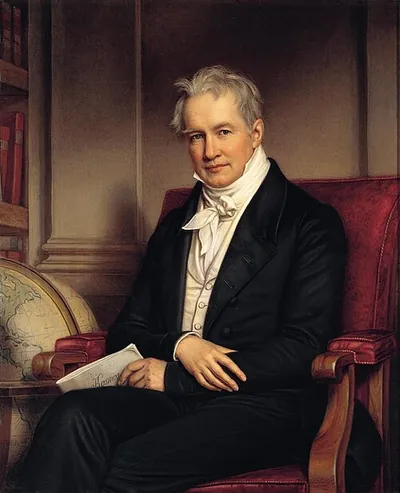 Alexander von Humboldt1769–1859 · Earth sciences
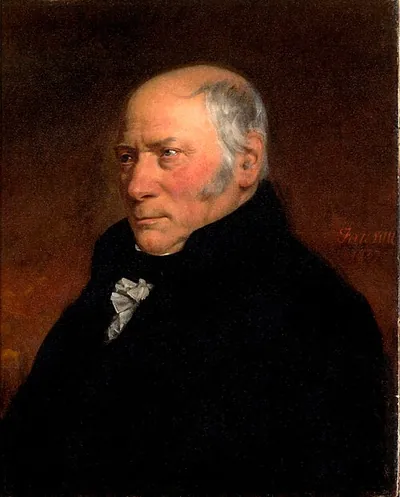 William Smith1769–1839 · Earth sciences
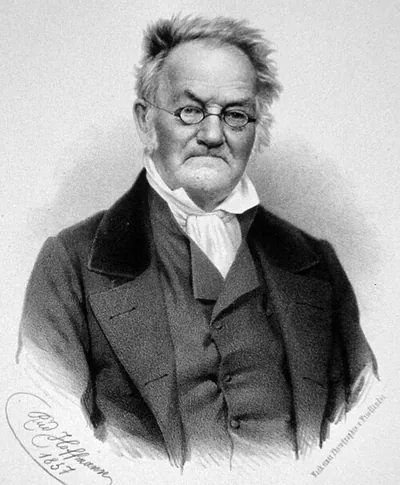 Carl Ritter1779–1859 · Earth sciences
