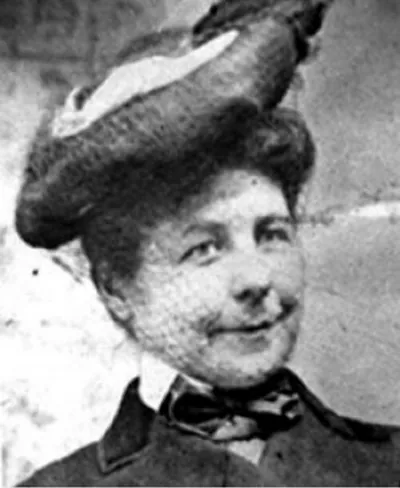
Mary Anderson
American real-estate developer, rancher and vintner, credited with inventing the windshield wiper · 1866–1953
- Born
- February 19, 1866
- Died
- June 27, 1953
- Country
- United States
- Section
- Transport
Biography
Mary Anderson (Greene County, Alabama, 1866 - Monteagle, Tennessee, 1953) was an American real-estate developer, rancher and winemaker who is credited with inventing the windshield wiper. She lived through the turn from the nineteenth to the twentieth century, a period of rapid industrial growth in the American South and of the first automobiles. Her device, operated from inside the vehicle, was among the first that really worked, and its basic principles shaped the systems that followed.
She was born on February 19, 1866, at a plantation in Greene County, Alabama, to John C. and Rebecca Anderson. She was one of at least two daughters, and she stayed close to her sister Fannie for the rest of her life. Her father died in 1870, but the estate allowed the family to live comfortably through her childhood. Little is documented about her schooling, and several biographical accounts simply say that her early education is unknown.
In 1889 she moved with her widowed mother and sister to Birmingham, Alabama, a city growing fast as an industrial center. Soon after arriving, the family financed and built the Fairmont Apartments on Highland Avenue, and Anderson took part in developing and managing the property. In 1893 she moved to Fresno, California, where she ran a cattle ranch and a vineyard for several years. Around 1898 she went back to Birmingham to look after a sick aunt and moved into the Fairmont with her mother, her sister and her sister's husband, G. P. Thornton. Later retellings claim that the aunt left a trunk of gold and jewelry that gave the household a comfortable life, though this story is legendary and cannot be confirmed.
The idea came on a trip to New York City in the depths of winter, usually dated to 1902 or 1903. Anderson rode a streetcar on a snowy day and watched the driver stop again and again, open the window or climb out to scrape the glass with his hands so he could see the road. She was a businesswoman rather than an engineer, yet she recognized both the problem and the opportunity: a rubber blade on an arm that a driver could work from inside. Back in Alabama she sketched the idea, hired a designer for a hand-operated device and asked a local company to build a working model.
The mechanism was simple. A lever inside the car drove, through springs, a metal arm carrying a rubber blade on the outside of the windshield, sweeping it back and forth. A counterweight kept the blade pressed against the glass, and the whole unit could be taken off when it was no longer needed. Similar devices had been tried before, but hers was the first that worked properly. On November 10, 1903, she received U.S. Patent No. 743,801, which gave her 17 years of protection.
Selling the invention proved hard. In 1905 she tried to sell the rights to a Canadian firm, which refused, judging that the device lacked enough commercial value. Cars were still rare, and some people feared that the lever would distract drivers. Meanwhile Henry Ford took an interest in the idea, apparently without any connection to Anderson, and tested it on his Model T cars. The patent expired in 1920 without bringing her any profit. By about 1922 Cadillac had become the first maker to fit wipers as standard, using designs built on the same basic principles, and by then they were common on many cars.
In her last years she continued to manage the Fairmont Apartments in Birmingham and was the longest-serving member of the Highland Presbyterian congregation in the southern part of the city. She died at her summer home in Monteagle, Tennessee, at the age of 87, and was buried in Elmwood Cemetery. In 2011, decades after her death, she was inducted into the National Inventors Hall of Fame for her contribution to transport safety. Her legacy is a simple idea that changed everyday driving and stayed for a long time in the shadow of others.
Main contributions
- 1889Fairmont Apartments in Birmingham, financed and built by the family shortly after they settled in the city.
- 1893Cattle ranch and vineyard in Fresno, California, which she ran until about 1898.
- 1903Manual windshield wiper patent: an interior lever moves a rubber blade on the outside of the windshield, with a counterweight keeping it pressed to the glass.
Trivia and anecdotes
A nod in The Simpsons
The invention is mentioned in season 17, episode 19 of The Simpsons, during a debate between Marge and Homer about gender equality.
A brief mention on British television
Anderson's windshield wiper is briefly mentioned in episode 16 of season 10 of the British quiz show QI.
The aunt's trunk
Later accounts describe a trunk of gold and jewelry left by an aunt, but this is a legend that cannot be confirmed.
Related discoveries and inventions
- 1903Windscreen wiperA rubber-edged arm that sweeps rain, snow and dirt off a vehicle's front window so the driver can see the road.
Their contemporaries
While Mary Anderson was alive (1866–1953)…
Alive at the same time
Discovered or invented in those years
- 1869Periodic tableAn arrangement of the chemical elements into rows (periods) and columns (groups), ordered by atomic number, that reveals recurring chemical behaviour and lets scientists predict properties.
- 1876TelephoneA device that carries the human voice over distance by turning sound into electrical signals and back into sound at the other end of the line.
- 1884CarA road vehicle with four wheels and its own engine, mainly built to carry people.
- 1903AirplaneA fixed-wing aircraft, heavier than air, powered by engines or rockets, that stays aloft because its wings generate lift.
- 1925TelevisionA system that sends moving pictures and sound over distance and shows them on a receiver, the television set.
- 1945ComputerA programmable machine that takes in data, processes it by following stored instructions, and produces results, able to switch tasks simply by running different software.
 Wilbur Wright1867–1912 · Transport
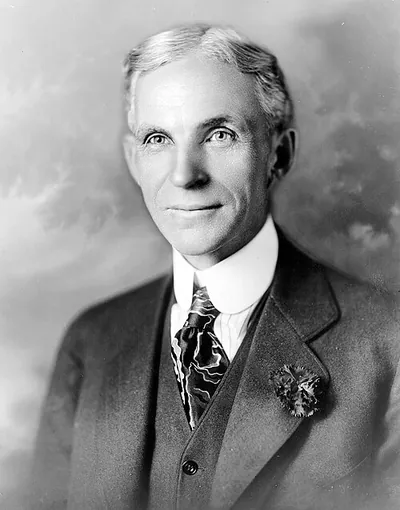 Henry Ford1863–1947 · Transport
 Henry Royce1863–1933 · Transport
 Orville Wright1871–1948 · Transport
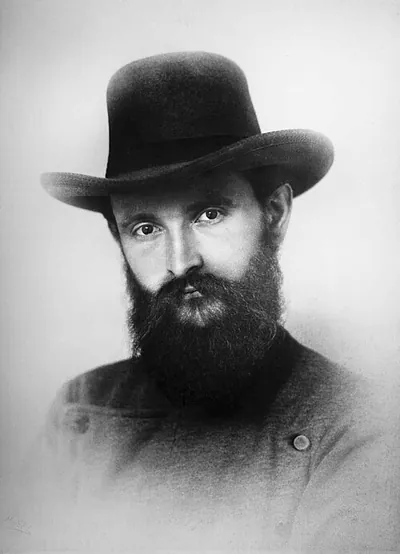 Robert Bosch1861–1942 · Transport
 Louis Blériot1872–1936 · Transport
