
Miles Joseph Berkeley
English clergyman and botanist, founder of British mycology and a pioneer of plant pathology · 1803–1889
- Born
- April 1, 1803
- Died
- July 30, 1889
- Country
- United Kingdom of Great Britain and Ireland
- Section
- Biology
Biography
Miles Joseph Berkeley (born at Biggin Hall, Northamptonshire, in 1803; died at Sibbertoft in 1889) was an English clergyman who devoted much of his life to the study of fungi, algae and mosses. He worked at a time when botany was becoming an established science in Britain, and his work laid the foundations for the study of fungi in the country and for plant pathology, the branch of biology that studies plant diseases.
Berkeley was the son of Charles Berkeley. He was educated at Rugby School and at Christ's College, Cambridge. After taking holy orders he served as incumbent of Apethorpe, and later as vicar of Sibbertoft, where he spent the last decades of his life. His first enthusiasm was for nature in general rather than for fungi: in his early years he worked as a field naturalist and collector, and between 1828 and 1836 he published papers on molluscs and other branches of zoology.
His move into mycology came gradually, through close work at the microscope. He drew the smaller algae and fungi with great accuracy and dissected mosses and liverworts with notable care. His major reference works, including his contribution to Sir William Jackson Hooker's British Flora in 1836, his Introduction to Cryptogamic Botany in 1857 and his Outlines of British Fungology in 1860, organised what was known about the country's fungi. Sources credit him with some 5,300 described species over his career, though other figures given in the reference material are somewhat lower.
Berkeley also turned his attention to crop diseases. He studied the potato blight caused by what is now called Phytophthora infestans, and the grape powdery mildew to which he gave the name Oidium tuckeri. He investigated wheat rust, hop mildew and various ailments of cabbages, pears, coffee, onions and tomatoes. Much of this appeared in the Gardener's Chronicle from 1854 onwards, and it helped explain the life cycles of these pests when very little was understood about them. He did all of this without the equipment or training of a modern laboratory, which makes his achievement all the more striking.
He collaborated with many naturalists, among them Moses Ashley Curtis, Camille Montagne, Christopher Edmund Broome and Mordecai Cubitt Cooke, with whom he co-wrote several studies of fungi from distant regions. He received the Royal Society's Royal Medal in 1863, was made a Fellow of the Royal Society in 1879, and was elected to the German Leopoldina in 1857. He married Cecilia Emma Campbell, and their daughter Ruth Ellen Berkeley became a scientific illustrator; Berkeley named a mushroom, Agaricus ruthae, after her.
His herbarium at the Royal Botanic Gardens, Kew, containing around 9,000 specimens according to the reference material, remains one of the most extensive fungal collections in the world. He is remembered today as the founder of British mycology and one of the pioneers of plant pathology.
Main contributions
- 1836Contribution to Hooker's British Flora, the first systematic account of the country's native fungi.
- 1854A series of articles on plant diseases in the Gardener's Chronicle, explaining how fungi affect crops.
- 1857Introduction to Cryptogamic Botany, a manual explaining the biology of non-flowering plants such as algae, mosses and fungi.
- 1860Outlines of British Fungology, a catalogue of over a thousand fungal species from the British Isles.
- Studies of potato blight, caused by Phytophthora infestans, one of the most damaging crop fungi.
- Description of grape powdery mildew, which he named Oidium tuckeri.
Trivia and anecdotes
A mushroom named after his daughter
Berkeley named Agaricus ruthae, now Pleurotus ruthae, after his daughter Ruth Ellen, a scientific illustrator.
Genera named in his honour
The fungal genus Berkleasmium bears his name, as does Sarcostroma berkeleyi, named by Cooke in 1871.
Their contemporaries
While Miles Joseph Berkeley was alive (1803–1889)…
Alive at the same time
Discovered or invented in those years
- 1803AtomThe basic unit of a chemical element: a nucleus of protons and usually neutrons surrounded by a cloud of electrons.
- 1846NeptuneThe eighth and most distant planet of the Solar System, an ice giant found through mathematical prediction before any direct sighting.
- 1859EvolutionThe process by which the heritable traits of living populations change over generations, explaining the diversity of life from common ancestors.
- 1869Periodic tableAn arrangement of the chemical elements into rows (periods) and columns (groups), ordered by atomic number, that reveals recurring chemical behaviour and lets scientists predict properties.
- 1876TelephoneA device that carries the human voice over distance by turning sound into electrical signals and back into sound at the other end of the line.
- 1884CarA road vehicle with four wheels and its own engine, mainly built to carry people.
 Charles Darwin1809–1882 · Biology
 Theodor Schwann1810–1882 · Biology
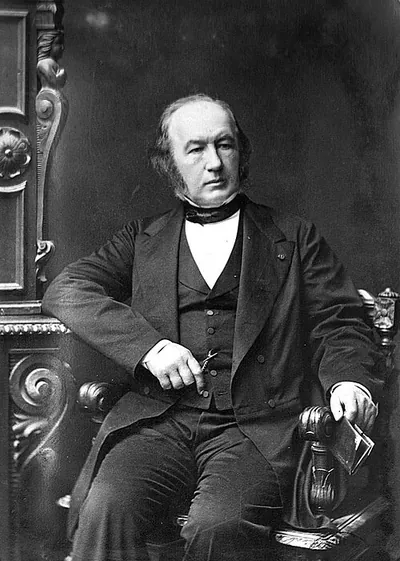 Claude Bernard1813–1878 · Biology
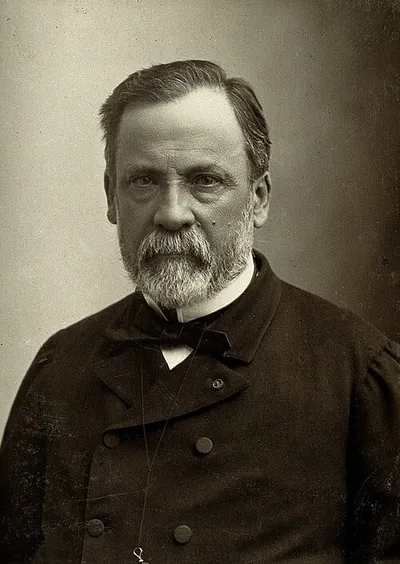 Louis Pasteur1822–1895 · Biology
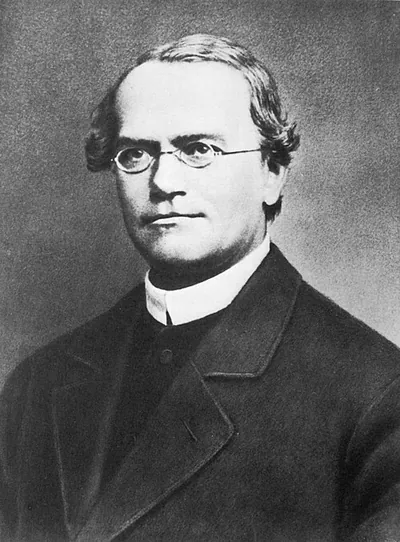 Gregor Mendel1822–1884 · Biology
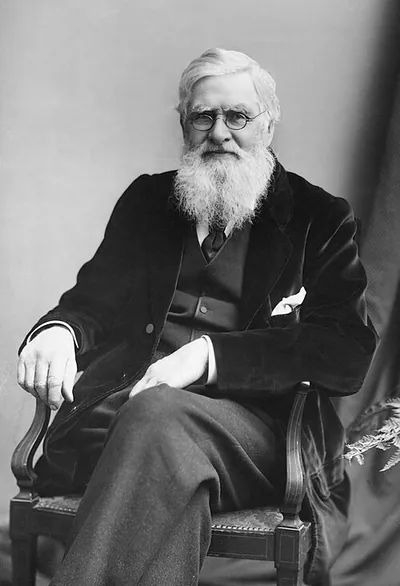 Alfred Russel Wallace1823–1913 · Biology
