
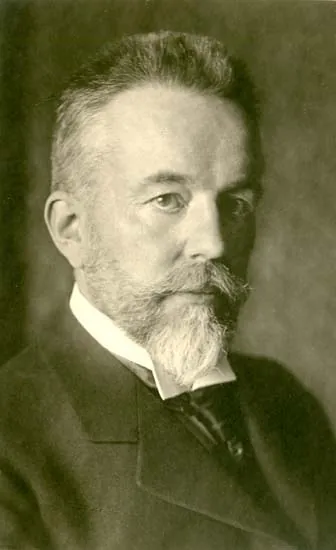
Richard Mollier
German physicist and engineer from Trieste, pioneer of experimental thermodynamics and creator of the enthalpy-entropy charts · 1863–1935
- Born
- November 30, 1863
- Died
- March 13, 1935
- Country
- Austria, Germany
- Section
- Energy
Biography
Richard Mollier (Trieste, 1863 – Dresden, 1935) was a German professor of Applied Physics and Mechanics who measured and tabulated how water, steam and moist air behave as their temperature and pressure change. His work gave engineers of the late nineteenth and early twentieth centuries graphical tools that are still used to design power plants, turbines and refrigeration systems, so his name remains present in everyday engineering practice.
He was born in Trieste, then part of the Austro-Hungarian Empire, and attended school there. He then began studying mathematics and physics at the University of Graz in Austria, and continued at the Technical University of Munich. His first publications grew out of his work on theoretical mechanics, a subject he taught as an outside lecturer. After a brief stay in Göttingen, he succeeded Gustav Zeuner in 1897 as Professor of Mechanical Engineering at the Technische Hochschule in Dresden, a post he held until his retirement in 1931.
His main contribution was to make the calculation of thermodynamic processes far simpler. These are the exchanges of heat and work that take place inside machines such as steam turbines. Mollier plotted enthalpy, the total energy content of a fluid at constant pressure, against entropy, a quantity that measures disorder or energy that cannot be turned into useful work. His 1904 booklet New Graphs for Technical Thermodynamics greatly eased these calculations. Two years later came his best-known work, the tables and diagrams for water vapour, which went through six further editions up to 1932 as new findings emerged.
The name Mollier graph was formally adopted in 1923, when a thermodynamics conference in Los Angeles agreed to apply it to any thermodynamic diagram with enthalpy on one of its axes. His h-x chart for moist air is equivalent to the psychrometric chart widely used in the United States and Britain.
His early work included a study of the entropy of heat, published in 1895, and research on carbon dioxide. His legacy lives on in energy engineering, where the diagrams bearing his name remain a standard way to visualise the working cycles of heat engines.
Main contributions
- 1895The Entropy of Heat (Die Entropie der Wärme): an early study of entropy, the quantity measuring energy in a system that cannot be turned into useful work.
- 1904New Graphs for Technical Thermodynamics: charts that greatly simplify calculations of thermodynamic processes.
- 1906New Tables and Diagrams for Water Vapor: a reference work on the properties of steam, issued in six editions up to 1932.
- 1923Mollier diagram: name agreed in Los Angeles for any thermodynamic chart with enthalpy on one axis.
Teachers and students
Studied under:
Taught:
Trivia and anecdotes
A diagram named after him
Mollier did not name his charts himself; the 1923 Thermodynamics Conference decided to honour him in this way.
Their contemporaries
While Richard Mollier was alive (1863–1935)…
Alive at the same time
Discovered or invented in those years
- 1869Periodic tableAn arrangement of the chemical elements into rows (periods) and columns (groups), ordered by atomic number, that reveals recurring chemical behaviour and lets scientists predict properties.
- 1869Deoxyribonucleic acidA double-stranded molecule that carries the genetic instructions of nearly all living things and many viruses.
- 1876TelephoneA device that carries the human voice over distance by turning sound into electrical signals and back into sound at the other end of the line.
- 1884CarA road vehicle with four wheels and its own engine, mainly built to carry people.
- 1903AirplaneA fixed-wing aircraft, heavier than air, powered by engines or rockets, that stays aloft because its wings generate lift.
- 1925TelevisionA system that sends moving pictures and sound over distance and shows them on a receiver, the television set.
 Charles Proteus Steinmetz1865–1923 · Energy
 Aurel Stodola1859–1942 · Energy
 Rudolf Diesel1858–1913 · Energy
 Mihajlo Pupin1858–1935 · Energy
 William Stanley1858–1916 · Energy
 Kálmán Kandó1869–1931 · Energy
