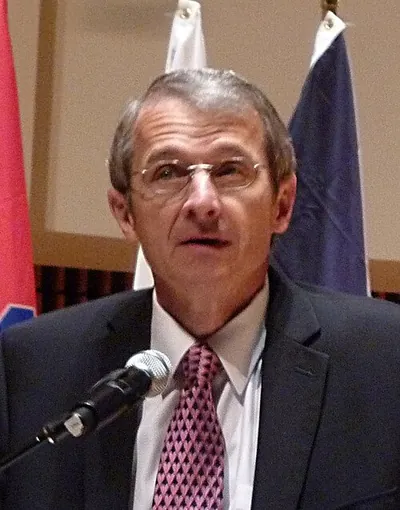
Richard R. Schrock
American chemist, 2005 Nobel Prize laureate in Chemistry for work on olefin metathesis · 1945
- Born
- January 4, 1945
- Country
- United States
- Section
- Chemistry
- Awards
- Nobel Prize in Chemistry
Biography
Richard Royce Schrock is an American chemist who shared the 2005 Nobel Prize in Chemistry with Yves Chauvin and Robert H. Grubbs for developing olefin metathesis, a reaction in which the parts of two organic molecules are rearranged to form new ones. His work, carried out mainly from the 1970s onward, turned a reaction once used almost by trial and error into a tool designed with molecular precision, and it remains central to modern organic chemistry.
Schrock was born on January 4, 1945, in Berne, Indiana, into an Amish family. He attended high school in Pacific Beach, near San Diego, and earned his bachelor's degree in 1967 at the University of California, Riverside. He then moved to Harvard University, where he completed his PhD in 1971 under John A. Osborn. After that he did postdoctoral research at the University of Cambridge with Jack Lewis, which deepened his training in inorganic chemistry, the branch that studies compounds built around metals.
In 1972 DuPont hired him, and he worked at the company's experimental station in Wilmington, Delaware, in the group led by George Parshall. In 1975 he joined the Massachusetts Institute of Technology, becoming a full professor in 1980. He held the Frederick G. Keyes Professorship of Chemistry from 1989 and is now professor emeritus there.
His research centered on catalysts, substances that speed up a chemical reaction without being used up. In 1974 he discovered what is called the alpha hydrogen abstraction reaction, a process that turns alkyl groups bonded to a metal into alkylidene complexes, and alkylidenes into alkylidyne complexes. At MIT he was the first to work out the structure and mechanism of olefin metathesis catalysts, which had been treated as "black boxes" because they worked without anyone fully understanding how. He showed that by changing the ligands, the molecules bonded to the metal, chemists could prepare molybdenum or tungsten catalysts in many varieties and design them for a specific purpose.
He also gathered evidence that metallacyclobutanes are the key intermediates in olefin metathesis, while metallacyclobutadienes play that role in alkyne metathesis. Beyond metathesis, he studied how dinitrogen, the stable form of nitrogen gas, can be fixed, and he developed single-molecule catalysts that produce ammonia from nitrogen, mimicking the nitrogenase enzymes found in living organisms. The catalysts that carry his name, known as Schrock catalysts, are now sold commercially and are widely used in laboratory and industrial synthesis.
His work earned many honors before the Nobel, including American Chemical Society awards in organometallic and inorganic chemistry. In 2008 he was elected a foreign member of the Royal Society. In 2018 he returned to the University of California, Riverside, his alma mater, as a distinguished professor, stressing his interest in mentoring junior faculty and students. In his personal life, he married Nancy Carlson in 1971; they have two children and live in Winchester, Massachusetts.
His legacy lies in how he changed olefin metathesis. A process that was hard to control became a reliable synthetic method, now used in making drugs, materials and other chemical products. The Schrock carbenes, a family of compounds named after him, show how thoroughly his work entered the vocabulary of the field.
Main contributions
- 1974Alpha hydrogen abstraction reaction: a process that turns alkyl groups into alkylidene complexes, and alkylidenes into alkylidyne complexes.
- 2005Nobel Prize in Chemistry, shared with Yves Chauvin and Robert H. Grubbs for olefin metathesis.
- Molecularly designable molybdenum and tungsten olefin metathesis catalysts, known as Schrock catalysts.
- Evidence that metallacyclobutanes are the key intermediates in olefin metathesis.
- Single-molecule catalysts that produce ammonia from nitrogen, mimicking nitrogenase enzymes.
Teachers and students
Trivia and anecdotes
Amish origins
He was born into an Amish family in Berne, Indiana.
Catalysts bearing his name
The metathesis catalysts he developed are sold commercially as Schrock catalysts, and Schrock carbenes are also named after him.
Their contemporaries
While Richard R. Schrock was alive (1945–)…
Alive at the same time
Discovered or invented in those years
- 1945ComputerA programmable machine that takes in data, processes it by following stored instructions, and produces results, able to switch tasks simply by running different software.
- 1957Artificial satelliteAn artificial satellite is a human-made object placed in orbit around a celestial body, usually Earth, to collect information, relay signals, or carry out a specific task.
- 1969InternetA global network of interconnected computer networks that communicate using the TCP/IP protocol suite.
- 1971EmailA network service that lets users send and receive digital messages through addressed mailboxes, much like postal mail but electronic.
- 1973Mobile phoneA handheld wireless phone that lets people make and receive calls while moving across a cellular network area.
- 1989World Wide WebA system of linked documents and resources, connected by hyperlinks and accessed over the Internet with web browsers.
 Ahmed Zewail1946–2016 · Chemistry
 Mario Molina1943–2020 · Chemistry
 Richard Smalley1943–2005 · Chemistry
 Karl Barry Sharpless1941 · Chemistry
 Venkatraman Ramakrishnan1952 · Chemistry
 Alan J. Heeger1936 · Chemistry
