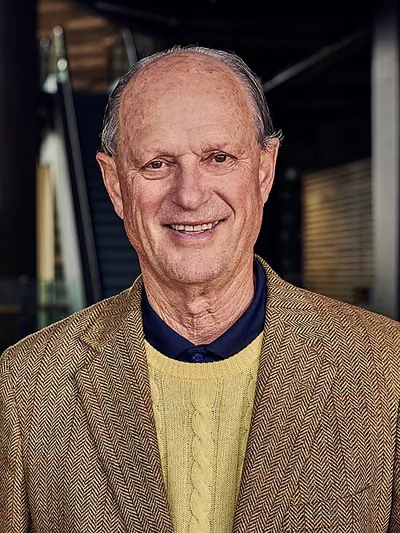
Robert Ballard
American oceanographer and deep-sea explorer, discoverer of the wreck of the Titanic · 1942
- Born
- June 30, 1942
- Country
- United States
- Section
- Earth sciences
Biography
Robert Ballard is an American oceanographer who became world famous in 1985 for finding the wreck of the RMS Titanic. He belongs to a generation of scientists who, from the middle of the twentieth century, used submersibles and advanced sonar to explore the seafloor. His work has changed how researchers understand both marine geology and the archaeology of shipwrecks.
Ballard was born on June 30, 1942, in Wichita, Kansas. When he was two, his family moved to southern California, where his father worked as a flight test engineer. Ballard later credited his early fascination with the ocean to the 1954 film 20,000 Leagues Under the Sea, based on Jules Verne's 1870 novel. While still in high school, his father introduced him to oceanographers at the Scripps Institution of Oceanography, and he joined several short research expeditions.
He studied at the University of California, Santa Barbara, graduating in 1965 with degrees in chemistry and geology, and completed the army's officer training program. Starting in 1962 he had worked part-time for a group at North American Aviation that studied ocean systems. He earned a master's degree in geophysics in Hawaii in 1966. When he was called to active duty in 1967, he asked to serve in the navy instead. The navy assigned him as a liaison between the Office of Naval Research and the Woods Hole Oceanographic Institution in Massachusetts, where he began working with the submersible Alvin. After leaving active duty, he stayed connected to Woods Hole and in 1974 received a doctorate in marine geology and geophysics from the University of Rhode Island. He retired from the navy as a commander in 1995.
His early expeditions focused on marine geology. In 1974 he took part in Project FAMOUS, which explored the central rift valley of the Mid-Atlantic Ridge. In 1977, an Alvin expedition near the Galápagos found hydrothermal vents, chimneys on the seafloor that release hot, mineral-rich water. Living communities surrounded them, drawing energy from chemistry rather than sunlight. The discovery mattered greatly for biology, although the team had only geologists aboard, since no one expected life there. In 1979, on the East Pacific Rise, Ballard observed the so-called black smokers, vents that discharge water above 350 degrees Celsius.
His interest in shipwrecks grew out of his navy work on small robotic submersibles tethered to a surface ship and equipped with lights, cameras and mechanical arms. In 1982 he proposed his deep-sea vehicle, Argo, and a search for the Titanic to the navy. The navy agreed to finance the 1985 expedition on condition that he first investigate two sunken nuclear submarines, the USS Scorpion and the USS Thresher, in secret. Those wrecks had imploded under pressure and scattered debris across the seabed, which made them easier to find. Ballard reasoned that the Titanic, which had also been destroyed by pressure, should have left a similar trail, so he had Argo sweep the seafloor in lines. On September 1, 1985, observers saw first pockmarks, then debris, then a boiler and finally the hull. The ship had broken in two, and the stern was in worse condition than the bow. Ballard regarded the site as a graveyard and refused to remove objects. In 1986 he returned with Alvin and the small vehicle Jason Junior, which could enter narrow openings.
His work went well beyond the Titanic. In 1989 he located the German battleship Bismarck more than 4,790 meters down, lying almost intact. In 1998 he found the aircraft carrier USS Yorktown, and in 2002, with the National Geographic Society, he located a torpedo tube from John F. Kennedy's PT-109. He founded the Institute for Exploration in the 1990s and is also the driving force behind the JASON Project, an internet-based science program for schoolchildren. His legacy combines the discovery of ecosystems that do not depend on sunlight with a method for finding shipwrecks by following the debris they leave behind.
Main contributions
- 1974Took part in Project FAMOUS, which explored the central rift valley of the Mid-Atlantic Ridge, a large fracture in the seafloor.
- 1977Discovery of hydrothermal vents near the Galápagos, surrounded by organisms that obtain energy from chemistry.
- 1979Observation of black smokers on the East Pacific Rise, vents discharging water above 350 degrees Celsius.
- 1985Location of the wreck of the RMS Titanic, sunk in 1912, by following the trail of debris left as it broke apart.
- 1989Discovery of the German battleship Bismarck more than 4,790 meters deep, lying almost in one piece.
- 1998Discovery of the US aircraft carrier USS Yorktown, sunk during the Battle of Midway.
- 2002Recovery of a torpedo tube from John F. Kennedy's PT-109 boat, sunk in 1943 in the Solomon Islands.
Trivia and anecdotes
A secret navy mission
The 1985 voyage was financed by the US Navy, which asked Ballard to examine two sunken nuclear submarines first. The Titanic search came afterwards.
A trail of debris
Ballard applied what he had learned from the submarines to the Titanic: a ship that breaks apart leaves debris across the seabed, which is easier to follow than searching for the hull directly.
The rescuers of PT-109
The 2002 expedition brought attention to the islanders Biuku Gasa and Eroni Kumana, who helped the survivors of Kennedy's boat and received little recognition.
Their contemporaries
While Robert Ballard was alive (1942–)…
Alive at the same time
Discovered or invented in those years
- 1945ComputerA programmable machine that takes in data, processes it by following stored instructions, and produces results, able to switch tasks simply by running different software.
- 1957Artificial satelliteAn artificial satellite is a human-made object placed in orbit around a celestial body, usually Earth, to collect information, relay signals, or carry out a specific task.
- 1969InternetA global network of interconnected computer networks that communicate using the TCP/IP protocol suite.
- 1971EmailA network service that lets users send and receive digital messages through addressed mailboxes, much like postal mail but electronic.
- 1973Mobile phoneA handheld wireless phone that lets people make and receive calls while moving across a cellular network area.
- 1989World Wide WebA system of linked documents and resources, connected by hyperlinks and accessed over the Internet with web browsers.
 James E. Hansen1941 · Earth sciences
 Rajendra K. Pachauri1940–2020 · Earth sciences
 W. Jason Morgan1935–2023 · Earth sciences
 Sylvia A. Earle1935 · Earth sciences
