
Rudolf Kohlrausch
German physicist of the nineteenth century, known for his work on the discharge of capacitors and for his experiment with Wilhelm Weber linking electricity and light · 1809–1858
- Born
- November 6, 1809
- Died
- March 8, 1858
- Country
- Kingdom of Hanover
- Section
- Physics
Biography
Rudolf Kohlrausch was a German physicist of the mid-nineteenth century, best remembered for his studies of how capacitors discharge and for an experiment with Wilhelm Weber that brought electricity and magnetism closer to the nature of light. His output was short, but it came at a time when electricity was beginning to be measured carefully and physicists were trying to understand what light really is.
He was born in Göttingen in 1809, the son of Friedrich Kohlrausch, director general of schools for the Kingdom of Hanover. He grew up, then, in a household tied to education and public administration. The sources available do not detail his teachers or his university training, so we know little about the years before his teaching career began.
His first profession was teaching mathematics and physics in secondary schools, first in Lüneburg, then in Rinteln, Kassel and Marburg. Classroom teaching occupied much of his working life and gave him steady contact with simple experiments and the basic concepts of the subject. In 1853 he became an associate professor at the University of Marburg and, four years later, in 1857, a full professor of physics at the University of Erlangen.
His first major contribution came in 1854, when he described what he called relaxation phenomena. When a Leyden jar, an early capacitor made of a glass vessel lined with metal foil, discharged, the charge did not vanish in a simple, regular way. To describe this decline he proposed a modified exponential function, one that falls off more slowly than a plain exponential and fits the observed data more closely.
His best-known work came from an experiment carried out in 1855, published in 1857, together with Wilhelm Weber. The two compared two ways of measuring electric charge: the electrostatic unit, based on forces between charges at rest, and the electromagnetic unit, based on electric currents. The ratio between them turned out to be very close to the speed of light, and they called the constant c. Kirchhoff later showed that the ratio was in fact √2 times the speed of light, but the finding was decisive all the same. It helped lead Maxwell to conjecture that light is an electromagnetic wave.
The collaboration with Weber was recorded in Elektrodynamische Maaßbestimmungen, published in 1857. Its title refers to electrodynamic measurements and to tying the measurement of current intensity to mechanical units. The sources do not record any notable controversy surrounding his work.
In his personal life, he was the father of the physicist Friedrich Kohlrausch, who carried the family tradition in the discipline forward. He died in Erlangen in 1858 at the age of 48, only a year or so after taking up his chair there.
His legacy has two strands. One is the concept of relaxation and the function that bears his name, still used to describe slow processes in various systems. The other is the constant c and the link he drew between electrical measurements and the speed of light, a bridge that helped prepare Maxwell's electromagnetic theory.
Main contributions
- 1854Relaxation phenomena: the discharge of a Leyden jar does not follow a simple decline, and he proposed a modified exponential function to describe it.
- 1857Comparative measurement of electrical units with Wilhelm Weber: the ratio between electrostatic and electromagnetic units approaches the speed of light, a value they called c.
- 1857Elektrodynamische Maaßbestimmungen, a work written with Weber on measuring current intensity in mechanical units.
Trivia and anecdotes
A constant with a simple name
The letter c that Kohlrausch and Weber gave their ratio is the same one we use today for the speed of light, although Kirchhoff later corrected the exact value of the ratio.
An instrument of another era
The Leyden jar, the capacitor he used in his relaxation studies, was one of the basic devices of electrical science in his time.
Their contemporaries
While Rudolf Kohlrausch was alive (1809–1858)…
Alive at the same time
Discovered or invented in those years
- 1811MoleculeAn electrically neutral group of at least two atoms held together by chemical bonds in a defined arrangement.
- 1821ElectricityThe set of physical phenomena linked to the presence and movement of electric charge, and one of the most versatile forms of energy in modern life.
- 1825AluminiumA light, silvery metal, very abundant in Earth's crust, with symbol Al and atomic number 13, mainly obtained from bauxite ore.
- 1838ProteinLarge biomolecules made of chains of amino acids that carry out structural, catalytic, transport, defensive and regulatory functions in living things.
- 1839PhotographyA technique for creating lasting images by recording light, either on a light-sensitive material or with an electronic sensor.
- 1846NeptuneThe eighth and most distant planet of the Solar System, an ice giant found through mathematical prediction before any direct sighting.
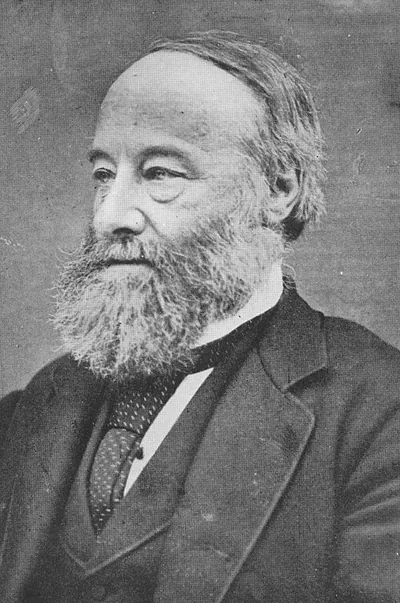 James Prescott Joule1818–1889 · Physics
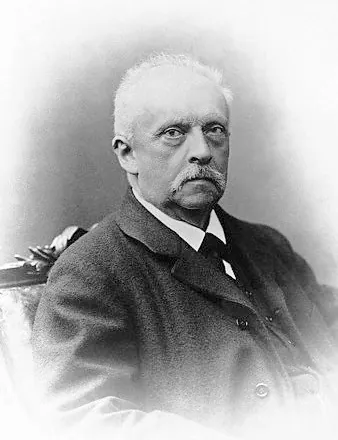 Hermann von Helmholtz1821–1894 · Physics
 Gustav Kirchhoff1824–1887 · Physics
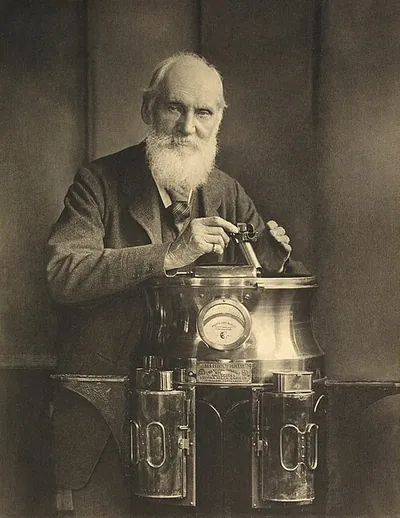 William Thomson, 1st Baron Kelvin1825–1907 · Physics
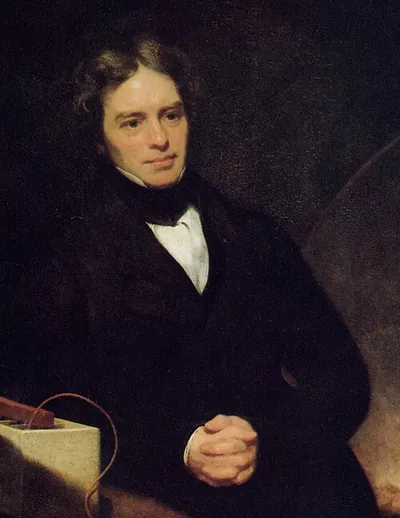 Michael Faraday1791–1867 · Physics
 James Clerk Maxwell1831–1879 · Physics
