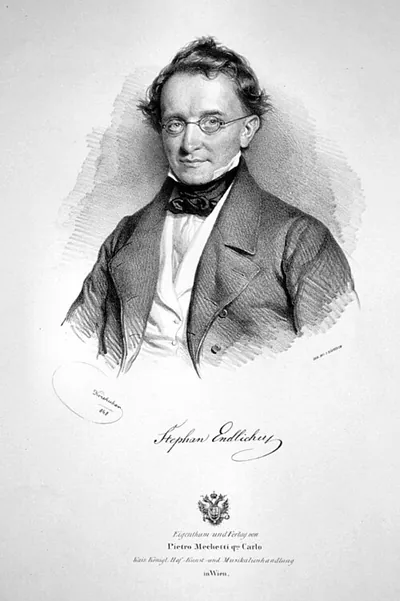
Stephan Endlicher
Austrian botanist, numismatist, politician and sinologist of Hungarian birth, director of the Vienna Botanical Garden · 1804–1849
- Born
- June 24, 1804
- Died
- March 28, 1849
- Country
- Austrian Empire
- Section
- Biology
Biography
Stephan Ladislaus Endlicher (Pressburg, now Bratislava, 1804 – Vienna, 1849) was a botanist whose work shaped plant science in Vienna in the first half of the nineteenth century. Besides directing the botanical garden of the University of Vienna, he was a numismatist, a language scholar and a liberal politician, a combination of interests that reflects the breadth of his curiosity. His significance lies mainly in his attempt to arrange the plant world according to a natural system, grouping plants by their overall resemblances rather than by a single feature, and in the many genera he named and described.
Endlicher was born into a family in old Hungary and studied theology, receiving minor orders, the first steps toward the priesthood. His early career was that of a librarian: in 1828 he joined the Austrian National Library to reorganise its manuscript collection. At the same time he devoted himself to natural history, especially botany, and to the languages of East Asia, a field in which he wrote the foundations of Chinese grammar. In 1836 he was placed in charge of the imperial cabinet of natural history, and in 1840 he became professor and director of the botanical garden of the University of Vienna.
His most ambitious botanical undertaking was the Genera Plantarum, published between 1836 and 1850, in which he set out a classification system built on a hierarchy of categories, from large regions down to the genus. It was a broad description of the plant kingdom arranged according to a natural principle, and for its time it was remarkably thorough. Endlicher also argued that illustrations should appear within the text itself rather than apart from it, which made the work easier to consult. It was issued together with a new edition of Franz Unger's Grundzüge der Botanik. He also founded the journal Annalen des Wiener Museums der Naturgeschichte in 1835, which carried much of his own work and that of his colleagues.
Among his best-known contributions is the description of many new genera. The most discussed is Sequoia, which includes the California coast redwood. Endlicher never explained where the name came from. Later writers have suggested he may have been inspired by Sequoyah, the Cherokee linguist who devised the syllabary for his language, though recent scholarship favours another idea: that the name combines the Latin sequi, meaning to follow, with the numerical sequence of seeds per cone among related genera. The question remains debated. He also worked on the flora of Australia and Brazil, often with other naturalists, and in 1847 he published the Synopsis Coniferarum, devoted to conifers.
His public life was tied to the founding of the Imperial Academy of Sciences in Vienna. Endlicher was one of its main promoters, but he was disappointed when Baron Joseph Hammer von Purgstall was chosen as president instead of him, and he ended up resigning after a quarrel. A well-known liberal, he was asked to act as a mediator during the revolution of 1848, but was eventually forced to leave Vienna for a time. That same year he sat in the Frankfurt Parliament and in the assembly at Kroměříž. He died in Vienna in 1849, at the age of 44.
Endlicher's legacy is twofold. His classification system and his many genus descriptions formed part of the foundations of nineteenth-century systematic botany. The genus Endlicheria, in the laurel family, also bears his name in his honour.
Main contributions
- 1835Annalen des Wiener Museums der Naturgeschichte: a scientific journal founded by Endlicher to publish natural history research.
- 1836Genera Plantarum: a multi-volume work proposing a natural system for classifying plants, organised in nested categories.
- 1837Iconographia Generum Plantarum: a collection of plates illustrating plant genera.
- 1838Grundzüge einer neuen Theorie der Pflanzenerzeugung: an account of a new theory of how plants are produced.
- 1842Die Medicinal-Pflanzen der österreichischen Pharmakopöe: a handbook for doctors and pharmacists on medicinal plants listed in the Austrian pharmacopoeia.
- 1845Anfangsgründe der chinesischen Grammatik: an introduction to Chinese grammar written in German.
- 1847Synopsis Coniferarum: a systematic summary of the conifers, the evergreen cone-bearing trees such as pines.
Trivia and anecdotes
The origin of the name Sequoia
Endlicher never explained why he chose the name. Some authors link it to Sequoyah, while recent studies propose a numerical reason.
A fish named after him
The African fish Polypterus endlicherii, described in 1847, was named in his honour, apparently because Endlicher found the species in the fish collection of the Natural History Museum in Vienna.
Their contemporaries
While Stephan Endlicher was alive (1804–1849)…
Alive at the same time
Discovered or invented in those years
- 1811MoleculeAn electrically neutral group of at least two atoms held together by chemical bonds in a defined arrangement.
- 1821ElectricityThe set of physical phenomena linked to the presence and movement of electric charge, and one of the most versatile forms of energy in modern life.
- 1825AluminiumA light, silvery metal, very abundant in Earth's crust, with symbol Al and atomic number 13, mainly obtained from bauxite ore.
- 1838ProteinLarge biomolecules made of chains of amino acids that carry out structural, catalytic, transport, defensive and regulatory functions in living things.
- 1839PhotographyA technique for creating lasting images by recording light, either on a light-sensitive material or with an electronic sensor.
- 1846NeptuneThe eighth and most distant planet of the Solar System, an ice giant found through mathematical prediction before any direct sighting.
 Charles Darwin1809–1882 · Biology
 Theodor Schwann1810–1882 · Biology
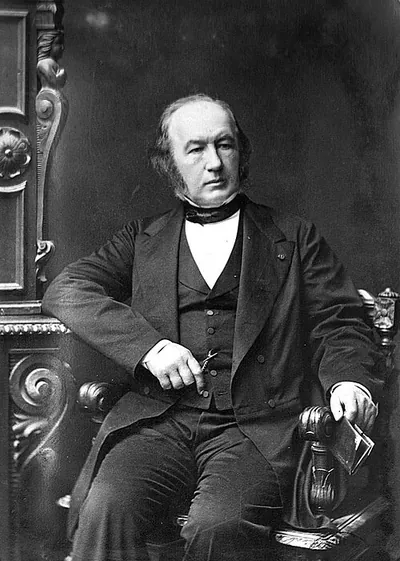 Claude Bernard1813–1878 · Biology
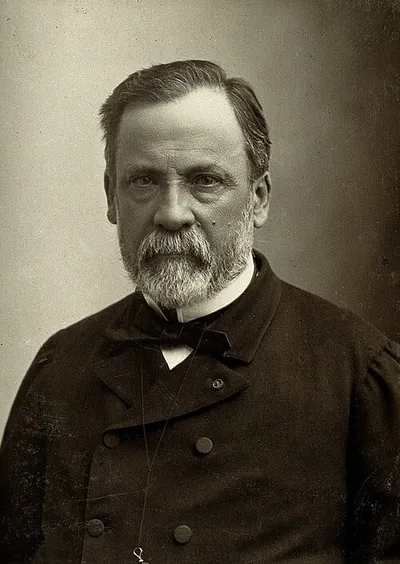 Louis Pasteur1822–1895 · Biology
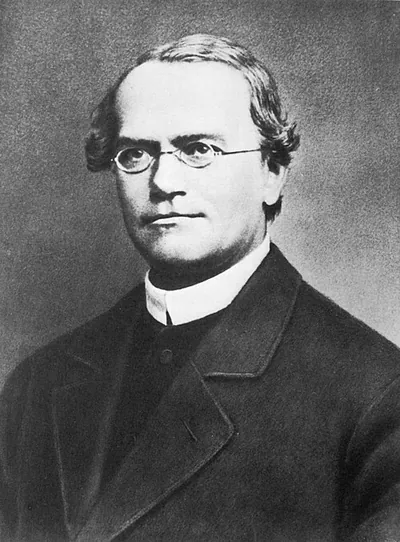 Gregor Mendel1822–1884 · Biology
 Alfred Russel Wallace1823–1913 · Biology
