
Thaddeus S. C. Lowe
American aeronaut, scientist and inventor, father of US military aerial reconnaissance · 1832–1913
- Born
- August 20, 1832
- Died
- January 16, 1913
- Country
- United States
- Section
- Transport
Biography
Thaddeus Sobieski Constantine Lowe (1832-1913), also known as Professor T. S. C. Lowe, was an American aeronaut, scientist and inventor. Largely self-taught in chemistry, meteorology and aeronautics, he is regarded as the father of military aerial reconnaissance in the United States. During the Civil War he used balloons to watch enemy positions from the air.
Lowe was born on August 20, 1832, in Jefferson, New Hampshire, to Clovis and Alpha Green Lowe. His father began as a cobbler and later became a merchant, and he also took an interest in local politics. The boy's first name probably came from a character in Thaddeus of Warsaw, an 1803 novel by the Scottish writer Jane Porter. Farm work left him only three months of schooling a winter, but he read eagerly, borrowing books from his teacher and reading them by the fireplace in the evenings.
He left home at fourteen and worked in Boston. At eighteen he fell ill, and while recovering he attended a lecture on gases lighter than air, especially hydrogen, given by a Professor Reginald Dinkelhoff. He volunteered from the audience, and the professor hired him as an assistant on tour. When Dinkelhoff retired, Lowe bought the show and kept lecturing, which earned him enough money to study on his own. He first tried medicine, as his grandmother had wished, but his real interest was flight.
By the late 1850s he was a well-regarded balloon builder. American balloons were filled with coal gas and made of silk without rigid frames, unlike the early French balloons, which were cotton stretched over a frame and inflated with hot smoke. In 1857 he built and flew his first balloon on a tether, at a farm in Hoboken, New Jersey. His larger ambition was to cross the Atlantic using high-altitude winds, later called the jet stream, a very fast air current high above the ground. He studied John Wise's book A System of Aeronautics and in 1859 began building the enormous City of New York. He won support from Joseph Henry of the Smithsonian Institution.
The transatlantic attempts failed. The balloon, renamed Great Western on the advice of the journalist Horace Greeley, made a successful flight from Philadelphia to New Jersey on June 28, 1860. In September a wind tore it open, and on a later attempt a repaired patch gave way as the balloon was inflated. A further flight, with the smaller Enterprise, left Cincinnati on April 19, 1861, two days after Virginia left the Union. It drifted to Unionville, South Carolina, where he was held as a suspected Yankee spy until he could prove he was a man of science. The war ended his plan.
Lowe offered his services to the Union. On June 16, 1861, he sent a telegraph message from the air to the White House, and that July President Lincoln named him chief aeronaut of the Union Army Balloon Corps. His work was useful, though not every officer valued it. Disputes over his operations and his pay led him to resign in 1863.
Back in private business, he turned to hydrogen production. He invented the water gas process, which made large quantities of hydrogen from steam and coke, and he also patented ice-making machines. These patents made him rich. In 1887 he moved to Los Angeles, founded a bank and settled in Pasadena. There he met the civil engineer David J. Macpherson, and in 1891 they set up the company that built a mountain railway into the hills above Altadena. It opened on July 4, 1893, but its rapid and costly construction ruined him, and by 1899 he had lost the railway to Jared S. Torrance.
He spent his last years at his daughter's home in Pasadena, where he died in 1913 at the age of eighty. His legacy has two parts: he pioneered military aerial reconnaissance, and he left a mountain railway above Los Angeles that is still remembered.
Main contributions
- 1857First balloon he built and flew on a tether, at a farm in Hoboken, New Jersey.
- 1860Flight of the Great Western balloon from Philadelphia to New Jersey on June 28, the first step of his transatlantic project.
- 1861Telegraph message sent from a tethered balloon to President Lincoln in a demonstration of aerial reconnaissance.
- 1861Chief aeronaut of the Union Army Balloon Corps, which used balloons to observe enemy positions.
- 1893Opening of the Mount Lowe Railway, a mountain railway above Altadena.
- Water gas process, which produced large quantities of hydrogen from steam and coke.
- Ice-making machines, which he patented and which were a main source of his fortune.
Trivia and anecdotes
A literary name
His name probably came from a character in an 1803 novel, though this cannot be confirmed with certainty.
A renamed balloon
The City of New York was renamed Great Western on the advice of the journalist Horace Greeley, to rival the attention given to the steamship Great Eastern.
Their contemporaries
While Thaddeus S. C. Lowe was alive (1832–1913)…
Alive at the same time
Discovered or invented in those years
- 1846NeptuneThe eighth and most distant planet of the Solar System, an ice giant found through mathematical prediction before any direct sighting.
- 1859EvolutionThe process by which the heritable traits of living populations change over generations, explaining the diversity of life from common ancestors.
- 1869Periodic tableAn arrangement of the chemical elements into rows (periods) and columns (groups), ordered by atomic number, that reveals recurring chemical behaviour and lets scientists predict properties.
- 1876TelephoneA device that carries the human voice over distance by turning sound into electrical signals and back into sound at the other end of the line.
- 1884CarA road vehicle with four wheels and its own engine, mainly built to carry people.
- 1903AirplaneA fixed-wing aircraft, heavier than air, powered by engines or rockets, that stays aloft because its wings generate lift.
 Gottlieb Daimler1834–1900 · Transport
 Sandford Fleming1827–1915 · Transport
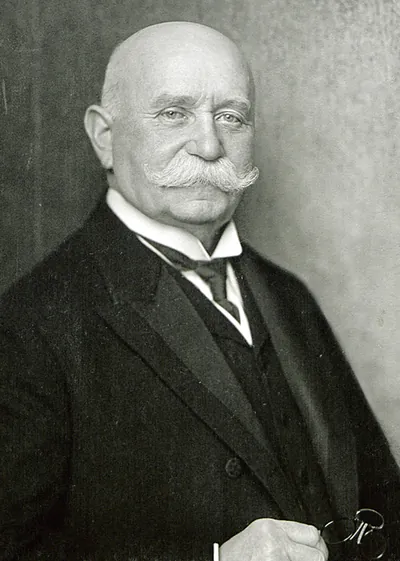 Ferdinand von Zeppelin1838–1917 · Transport
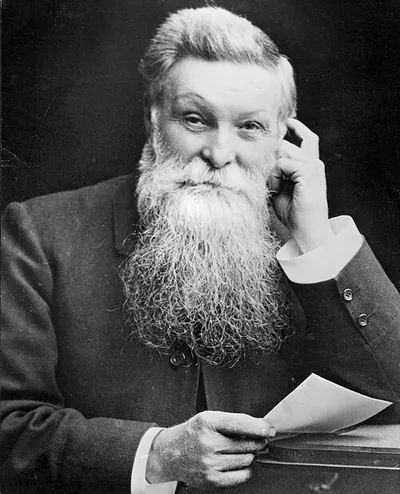 John Boyd Dunlop1840–1921 · Transport
 Clément Ader1841–1925 · Transport
 Carl Benz1844–1929 · Transport
