
William Berryman Scott
American vertebrate paleontologist and authority on fossil mammals · 1858–1947
- Born
- February 12, 1858
- Died
- March 29, 1947
- Country
- United States
- Section
- Earth sciences
Biography
William Berryman Scott (Cincinnati, Ohio, February 12, 1858 – Princeton, New Jersey, March 29, 1947) was an American paleontologist who studied fossil vertebrates, and he became one of the leading authorities on extinct mammals. For much of his career he taught geology and paleontology at Princeton University, and he was the principal author of the monographs on the White River Oligocene, one of the most complete accounts of mammal life in North America during that period. His work belongs to the late nineteenth and early twentieth centuries, when vertebrate paleontology was taking shape as a discipline with its own methods.
Scott was born into a Presbyterian family. His father, William McKendree Scott, was a minister of that church, and his mother was Mary Elizabeth Hodge Scott. He was the youngest of three sons; his brother Hugh Lenox Scott later became superintendent of the United States Military Academy at West Point and Army Chief of Staff. Shortly after the family moved to Princeton, New Jersey, in 1861, his father died, and the Scotts went to live with his maternal grandfather, also a Presbyterian minister and an instructor at the Princeton Theological Seminary. In that setting his early education centred on theology, philosophy and the classics, in preparation for a career in the church.
That plan changed when he entered Princeton University in 1873 at the age of fifteen. There he became interested in geology, psychology and chemistry. The turning point came in a course taught by the Swiss geologist Arnold Guyot, a respected figure in physical geography, which led him to rethink his professional goals. He graduated in 1877 and received a doctorate from the University of Heidelberg in 1880, where he was trained in the European scientific tradition, a long way from the religious teaching of his childhood. He returned to the United States well prepared to research fossils.
His work focused on fossil vertebrates, especially mammals. His studies of the Oligocene, a geological epoch running from roughly 34 to 23 million years ago, rested on detailed examination of remains found in the White River valley, in South Dakota and Nebraska. Describing a fossil means comparing its bones and teeth with those of known species to work out relationships and probable ways of life, and Scott devoted decades to this task with a precision that won wide respect. He also studied the osteology of Protoceras, an extinct mammal, and he led Princeton University expeditions to Patagonia between 1896 and 1899, whose reports continued to appear for more than thirty years.
Scott was also a popular writer and a theorist. In 1887 he published an article on American elephant myths, examining popular beliefs about the bones of mammoths and mastodons. In 1913 he issued a history of land mammals in the Western Hemisphere, illustrated by Bruce Horsfall, and in 1920 a book on the theory of evolution focused on the evidence that supports it, at a time when the debate over evolution was still active in science and society. He served as president of the Geological Society of America in 1925 and had been a member of the American Philosophical Society since 1886. He married Alice Adeline Post in 1883.
His contributions earned numerous honours: the Wollaston Medal of the Geological Society of London in 1910, the Mary Clark Thompson Medal of the National Academy of Sciences in 1930, the Penrose Medal of the Geological Society of America in 1939, and the Daniel Giraud Elliot Medal of the National Academy of Sciences in 1940. In 1939 he published his memoir, Some Memories of a Palaeontologist, reviewing his career. He died in Princeton in 1947. His legacy lives on in the collections and studies of the North American Oligocene, and in the name of a cichlid fish from the Uruguay River, Crenicichla scottii, which honours him.
Main contributions
- 1880Doctorate from the University of Heidelberg, completing his scientific training in Europe.
- 1895Study of the osteology and relationships of Protoceras, an extinct mammal.
- 1913A History of Land Mammals in the Western Hemisphere, illustrated by Bruce Horsfall.
- 1920The Theory of Evolution, a book focused on the evidence that supports it.
- 1937Description of Apataelurus kayi, a fossil mammal.
Trivia and anecdotes
A brother in the Army
His brother Hugh Lenox Scott later became Chief of Staff of the United States Army.
A fish named after him
The cichlid fish Crenicichla scottii, described by Eigenmann in 1907, was named in his honour.
Their contemporaries
While William Berryman Scott was alive (1858–1947)…
Alive at the same time
Discovered or invented in those years
- 1859EvolutionThe process by which the heritable traits of living populations change over generations, explaining the diversity of life from common ancestors.
- 1869Periodic tableAn arrangement of the chemical elements into rows (periods) and columns (groups), ordered by atomic number, that reveals recurring chemical behaviour and lets scientists predict properties.
- 1876TelephoneA device that carries the human voice over distance by turning sound into electrical signals and back into sound at the other end of the line.
- 1884CarA road vehicle with four wheels and its own engine, mainly built to carry people.
- 1925TelevisionA system that sends moving pictures and sound over distance and shows them on a receiver, the television set.
- 1945ComputerA programmable machine that takes in data, processes it by following stored instructions, and produces results, able to switch tasks simply by running different software.
 Andrija Mohorovičić1857–1936 · Earth sciences
 Henry Fairfield Osborn1857–1935 · Earth sciences
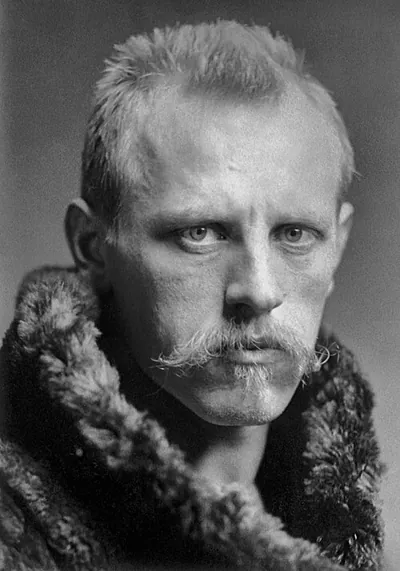 Fridtjof Nansen1861–1930 · Earth sciences
 Vilhelm Bjerknes1862–1951 · Earth sciences
 Vladimir Vernadsky1863–1945 · Earth sciences
 Vladimir A. Obruchev1863–1956 · Earth sciences
