
William Edward Ayrton
English physicist and electrical engineer who designed electrical measuring instruments and taught in Tokyo and London · 1847–1908
- Born
- September 14, 1847
- Died
- November 8, 1908
- Country
- United Kingdom of Great Britain and Ireland
- Section
- Physics
Biography
William Edward Ayrton (1847-1908) was an English physicist and electrical engineer who spent much of his career training the first generation of telegraph engineers in Japan and shaping how electricity was taught in London. He lived at a time when electricity was moving from the laboratory into everyday infrastructure such as telegraphs, lighting and transport. His importance lies in linking theory with the making of instruments that allowed these phenomena to be measured.
He was born in London to Edward Nugent Ayrton, a barrister, and Anna Sophia Cubitt. He developed an early interest in mathematics and studied at University College School and University College, graduating in 1867. He then spent a year in Glasgow studying telegraphic techniques under William Thomson, later Lord Kelvin, a grounding that shaped his later work.
In 1868 he went to Bengal to work for the telegraph department of the Indian Government. There he devised a way of locating faults in telegraph lines, a method that proved very useful in keeping the overland communications network running. Back in England he helped Thomson and Fleeming Jenkin with engineering work on the Great Western Telegraph Cable in 1872 and 1873. In the same period he married his cousin Matilda Chaplin, one of the Edinburgh Seven, the first group of women to matriculate as undergraduates at a British university, who campaigned for medical education open to women.
In 1873 he accepted a post in Tokyo as professor of natural philosophy and telegraphy at the new Imperial College of Engineering. He advised the college's architect on laboratories and demonstration rooms, and he is credited with bringing the electric arc light, which produces light from a sustained spark between two electrodes, to Japan in 1878. His main task, though, was to train the first generation of Japanese telegraph engineers, including staff of the new government Telegraph Department. Alongside this he worked with his colleague John Perry, a mechanical engineering professor, on original electrical research. In 1880 he spent several months in Freetown, Sierra Leone, advising on engineering matters in the colony.
Back in London he became professor of applied physics at the Finsbury College and in 1884 professor of electrical engineering at the Central Technical College in South Kensington, a post he held until his death. He published many papers on physics and electricity, both alone and with colleagues. Together with Perry he gave his name to a long series of electrical measuring instruments, including the spiral-spring ammeter and the wattmeter, which measures the electrical power being used. The pair also studied railway electrification, built a dynamometer and an electric tricycle, and Ayrton worked on the electric searchlight.
In 1885 he married for a second time, to Phoebe Sarah Marks, who became known as Hertha Ayrton and worked with him on research. They first studied the electric arc together to prepare one of his lectures for the 1893 Chicago International Exhibition, and by mutual agreement Hertha then made the arc her own field. In 1899 he backed her bid to become the first woman member of the Institution of Electrical Engineers. Ayrton also strongly supported women's suffrage and the aims of the Women's Social and Political Union. The couple acted as guardians of the artist and suffragette Ernestine Mills after her mother died in 1893.
He was elected a Fellow of the Royal Society in 1881 and served as president of the Institution of Electrical Engineers in 1892. The Royal Society awarded him its Royal Medal in 1901 for his extensive research in electrical science. He died in London in 1908 and is buried in Brompton Cemetery. His legacy lies in the measuring instruments that bear his name and in the generations of engineers he taught in Japan and Britain.
Main contributions
- 1868A method for locating faults in telegraph lines in India, useful for keeping the communications network running.
- 1878Introduction of the electric arc light to Japan, a lamp that produces light from a sustained spark between two electrodes.
- 1892Presidency of the Institution of Electrical Engineers, Britain's leading association of electrical engineers.
- 1901The Royal Medal of the Royal Society, awarded for his research in electrical science.
- The spiral-spring ammeter, an instrument for measuring electric current, developed with John Perry.
- The wattmeter, a device that measures the electrical power being consumed, developed with John Perry.
- A dynamometer and an electric tricycle, built with John Perry during their research on electrification.
Teachers and students
Trivia and anecdotes
An early idea
Among his writings is a description that notably anticipates the concept of mobile telephony, although it was an idea he never built.
A posthumous honour
In 2019 the University of Edinburgh awarded his wife Matilda Chaplin an honorary medical degree, after her death.
Their contemporaries
While William Edward Ayrton was alive (1847–1908)…
Alive at the same time
Discovered or invented in those years
- 1859EvolutionThe process by which the heritable traits of living populations change over generations, explaining the diversity of life from common ancestors.
- 1869Periodic tableAn arrangement of the chemical elements into rows (periods) and columns (groups), ordered by atomic number, that reveals recurring chemical behaviour and lets scientists predict properties.
- 1869Deoxyribonucleic acidA double-stranded molecule that carries the genetic instructions of nearly all living things and many viruses.
- 1876TelephoneA device that carries the human voice over distance by turning sound into electrical signals and back into sound at the other end of the line.
- 1884CarA road vehicle with four wheels and its own engine, mainly built to carry people.
- 1903AirplaneA fixed-wing aircraft, heavier than air, powered by engines or rockets, that stays aloft because its wings generate lift.
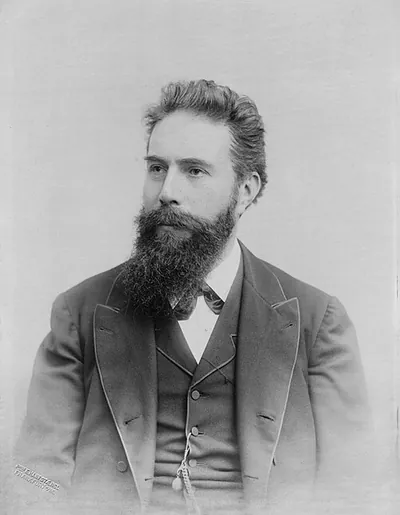 Wilhelm Röntgen1845–1923 · Physics
 Ludwig Boltzmann1844–1906 · Physics
 Antoine Henri Becquerel1852–1908 · Physics
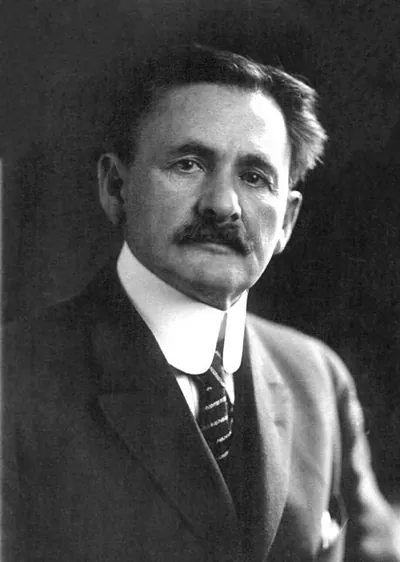 Albert Abraham Michelson1852–1931 · Physics
 John William Strutt1842–1919 · Physics
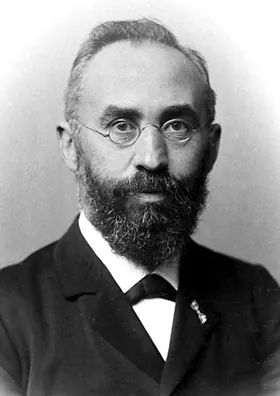 Hendrik Lorentz1853–1928 · Physics
