
Automatic Computing Engine
A British electronic computer design by Alan Turing, dating from around 1945, and one of the first complete plans for a machine that stores its programs in memory.
- Year
- 1945
- People involved
- Alan Turing
- Section
- Computing
History
The Automatic Computing Engine, known as ACE, was an electronic computer design developed by Alan Turing at the end of the Second World War. Its key feature was that it kept its programs inside the machine's own memory, just as it kept its data there, instead of having to be rewired with cables and switches each time a new task began. A useful comparison is a recipe written on the kitchen wall versus one you must memorise and rebuild every time you cook. That idea underlies almost every computer in use today, which is why ACE holds an important place in the history of computing.
Before this, electronic calculators were programmed by plugging in cables and setting switches, a slow process that meant rebuilding the set-up for every new problem. The machines of the period used thermionic valves, which are glass vacuum tubes that act as very fast electronic switches, yet their instructions still lived outside the machine. Turing had a theoretical foundation. In his 1936 paper On Computable Numbers he described what he called a universal computing machine, now known as the universal Turing machine, which could in principle carry out any calculation described as a set of instructions. During the war he had also worked at Bletchley Park, where the Colossus computers had succeeded in breaking German military codes. That experience gave him a practical sense of what electronics could achieve at high speed.
The project grew out of the National Physical Laboratory (NPL) in Britain. John R. Womersley, superintendent of its Mathematics Division, brought Turing in, and Turing started work there on 1 October 1945. By the end of that year he had completed an outline of his design, titled the Proposed Electronic Calculator. The word Engine in the name paid tribute to Charles Babbage and his two machines, the Difference Engine and the Analytical Engine, nineteenth-century mechanical projects that were never completed but are regarded as ancestors of modern computing. Turing's document is generally seen as the first reasonably complete design for a stored-program computer. It was on a far larger scale than the machine that was eventually built, yet it anticipated most of its essential features.
Secrecy shaped how the work was received. Because of the Official Secrets Act and the long-lasting secrecy around Bletchley Park, Turing was not allowed to explain that he knew his ideas could be applied to an electronic device. He presented a detailed document to the NPL's Executive Committee on 19 February 1946, but he could not reveal everything he knew. At the same time, John von Neumann's First Draft of a Report on the EDVAC, dated 30 June 1945, described a similar stored-program machine, and Von Neumann knew of Turing's theoretical work. His paper attracted far more publicity, even though it was imprecise and did not clearly credit the sources of some of its ideas. Today the two proposals are seen as having emerged almost at the same time, and Turing's share of the credit remained less visible for years.
Turing's report on the ACE, written in late 1945, contained detailed logic circuit diagrams and a cost estimate of £11,200. He believed that speed and memory size were decisive. He proposed a high-speed memory of what would now be called about 25 kilobytes, accessed at a speed of 1 MHz, and he argued that memory was the main constraint on the design: if the storage problem could be solved, the rest would be relatively straightforward. Unlike the EDVAC, the ACE implemented subroutine calls, meaning reusable pieces of a program that can be called whenever they are needed. It also used Abbreviated Computer Instructions, an early form of programming language that made orders easier to write than raw binary code.
At first it was planned that Tommy Flowers, the engineer at the Post Office Research Station at Dollis Hill in north London who had built the Colossus machines, would also build the ACE. However, the secrecy surrounding his wartime achievements and the pressure of postwar work made this impossible. Turing left the NPL for Cambridge in 1947, and his colleague Jim Wilkinson, who had worked on the logical design, was appointed to lead the ACE group. Turing's colleagues at the laboratory, unaware of the Colossus work, judged that engineering a complete ACE was too ambitious. The first version built was therefore the Pilot ACE, a smaller version of Turing's original design.
The Pilot ACE used mercury delay lines for its main memory. Each of its twelve lines held 32 instructions or data words of 32 bits, with signals travelling along a column of mercury until they were needed. It ran its first program on 10 May 1950, and at that moment it was the fastest computer in the world. The production versions, sold as the English Electric DEUCE, were delivered in 1955, and 33 were sold. Another implementation was MOSAIC, the Ministry of Supply Automatic Integrator and Computer, built by Allen Coombs and William Chandler, who had worked with Tommy Flowers on the Colossus machines. It was installed at Malvern, at the Radar Research and Development Establishment, which later merged into the Royal Radar Establishment. Its first trial program ran in late 1952 or early 1953, and it was used to calculate aircraft trajectories from radar data. It occupied four rooms and was described as the largest of the early British computers.
The principles of the ACE also reached the United States. The Bendix Corporation built the G-15, whose engineering design was led by Harry Huskey, who had spent 1947 in the ACE section at the NPL and later contributed to the hardware designs of the EDVAC. The first G-15 ran in 1954. It was a relatively small machine for a single user, and some historians consider it the first personal computer, although that label is debated. Other derivatives of the ACE include the EMI Electronic Business Machine and the Packard Bell PB 250.
The ACE was never built in its full form, but its significance is mainly conceptual. The idea of storing the program in the same memory as the data, and of organising work through subroutines and an instruction language, is part of how computers, phones and other devices operate today. Turing also showed that a general-purpose machine could be set to very different tasks simply by changing its program, which seems obvious now but was a new proposal at the time. His work links the mathematical theory of computation with practical engineering, and its legacy persists in every system that runs stored instructions.
Timeline
- 1936Turing publishes On Computable Numbers, describing a universal computing machine.
- 1945Turing joins the National Physical Laboratory on 1 October and completes his Proposed Electronic Calculator design by the end of the year.
- 1946On 19 February Turing presents a detailed document to the laboratory's Executive Committee.
- 1950The Pilot ACE runs its first program on 10 May, when it was the fastest computer in the world.
- 1954The first Bendix G-15, derived from ACE principles, begins operation.
- 1955The first production versions of the Pilot ACE, sold as the DEUCE, are delivered.
Trivia and anecdotes
A tribute to Babbage
The word Engine in the name honours Charles Babbage and his Difference Engine and Analytical Engine, nineteenth-century mechanical projects that were never completed.
A design he could not explain
Because of wartime secrecy, Turing could not reveal that his ideas could be applied to an electronic device, which limited how widely his work spread.
The first personal computer?
The Bendix G-15 of 1954 was small and built for a single user, and some regard it as the first personal computer, although that label is debated.
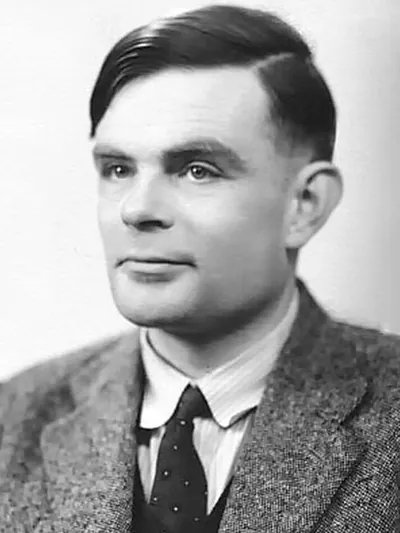 Alan Turing1912–1954 · Computing
