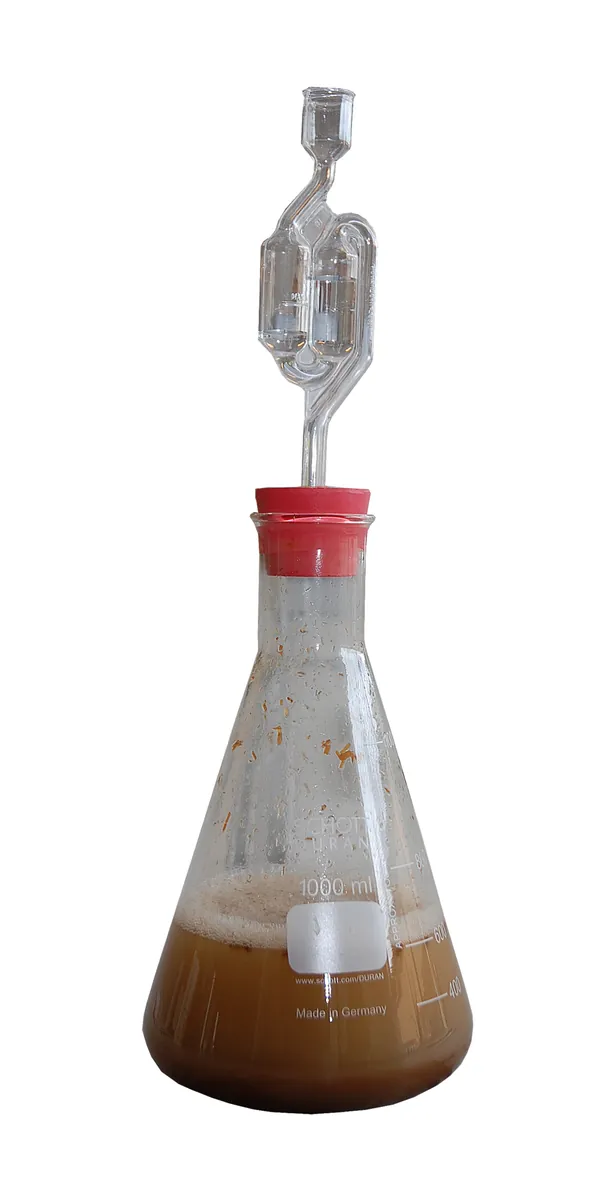

Ethanol fermentation
A biological process in which yeasts and other microorganisms convert sugars into ethanol and carbon dioxide without needing oxygen.
- Year
- 5000 BC
- Section
- Biology
History
Ethanol fermentation is the process by which certain microorganisms, mainly yeasts, turn sugars into ethanol, the alcohol found in wine and beer, and into carbon dioxide, the gas that makes those drinks fizz. It happens without oxygen, which is why it is called anaerobic, and it is one of the biological processes people used for the longest time before understanding how it worked. Today it supports everything from drink production to bread making and biofuels.
Long before anyone knew the mechanism, people were making fermented drinks: beer from cereals and wine from grapes pressed into must. The approximate date of around 5000 BC should be read as an estimate, since there was never a single moment of discovery. The Greeks credited the god Dionysus with the find, a myth rather than a historical record. Distillation, which separates alcohol by heating, appears in the Middle Ages within alchemy. The name of Arnau de Vilanova is linked to it around 1150, although that date is doubtful, as the Catalan physician lived somewhat later.
In the eighteenth century chemists began to study the gas given off. In 1764 MacBride identified the carbon dioxide produced by fermentation, and in 1766 Cavendish described it and estimated it at roughly 57 per cent of the sugar used. In 1789 Lavoisier measured the amounts of carbon, oxygen and hydrogen involved. In 1815 Gay-Lussac managed to produce ethanol from glucose, yet the mechanism remained unclear.
The debate centred on whether fermentation was a purely chemical reaction or depended on something alive. In the 1830s Berzelius and Liebig defended a mechanistic explanation, while Pasteur, around 1857, backed a vitalist theory. In 1875 Pasteur showed that the process does not need oxygen. Earlier, in 1837, Schwann and Kützing had linked yeasts to fermentation. In 1897 Eduard Buchner showed that the final agent was an enzyme, zymase, and he received the Nobel Prize in Chemistry for it. In 1904 Harden and Young found that the process also required a small molecule, cozymase, which was not fully characterised until 1935. In 1929 Warburg and von Euler-Chelpin pointed to the role of NAD, a helper molecule that works alongside the enzymes.
From the mid-twentieth century onward, attention shifted to industrial improvement: choosing better yeast strains, finding the best temperature and running continuous bioreactors. The bacterium Zymomonas mobilis, whose full genome was published in 2005, is of interest for its high tolerance to ethanol. Fermentation competes with the industrial chemical route that starts from ethylene, but it can use crops such as sugarcane, maize or sugar beet. Its present impact is wide, covering drinks, bread, fuel blended into petrol and by-products used as animal feed.
Timeline
- 5000 BCAround this date fermented drinks were already being made, although the figure is only an approximate estimate.
- 1764MacBride identifies the carbon dioxide released during fermentation.
- 1789Lavoisier measures the amounts of carbon, oxygen and hydrogen involved in the process.
- 1815Gay-Lussac produces ethanol from glucose, though the mechanism is still not understood.
- 1875Pasteur shows that fermentation is anaerobic and does not need oxygen.
- 1897Buchner discovers that the final agent is an enzyme, zymase, and wins the Nobel Prize in Chemistry.
- 2005The complete genome of the bacterium Zymomonas mobilis is published.
Trivia and anecdotes
Dionysus and the myth
The Greeks credited the god Dionysus with discovering fermentation. It is a legend rather than historical evidence.
Fermenting fish
Some fish, including goldfish and carp, also undergo alcoholic fermentation, alongside lactic acid fermentation, when oxygen is scarce.
Recycled bread
In bread dough, yeast produces the gas that makes it rise. A group in Germany has done the opposite, turning stale bread into ethanol.