Euler equations
A set of equations describing the motion of an ideal fluid with no viscosity or heat conduction, expressing conservation of mass, momentum and energy.
- Year
- 1757
- People involved
- Leonhard Euler
- Section
- Physics
History
The Euler equations describe how a fluid moves when the effects of viscosity, the internal friction that slows a fluid down, and of heat transport are neglected. They are a simplified form of the Navier–Stokes equations, which include those effects, and they are useful when the fluid's inertia dominates over friction, as is common in many large-scale flows of air and water. They are named after Leonhard Euler, the Swiss mathematician who worked mainly in Saint Petersburg and Berlin, and who derived them from Newton's laws applied to a continuous fluid.
Work on fluid motion existed before Euler, including contributions from the Bernoulli family and from Jean le Rond d'Alembert. Euler presented his ideas to the Berlin Academy in 1752 and published them in 1757 in the article «Principes généraux du mouvement des fluides», in the academy's memoirs. In his original work only two of the modern equations appeared: conservation of mass and the momentum balance, that is, the balance of the fluid's motion. Those two alone were not enough to determine the system in general, so an extra equation was needed. Pierre-Simon Laplace supplied in 1816 an adiabatic condition that completed the set for compressible flows. During the second half of the nineteenth century it was recognised that the energy equation must always be kept for compressible flows, and that Laplace's condition follows from the fundamental laws when solutions are smooth.
In its simplest form, the incompressible case with constant density, the equations reduce to two: one describes how the fluid's velocity changes from point to point, and the other requires that the fluid not compress, so that what flows into a region equals what flows out. Pressure appears as a quantity adjusted to satisfy that constraint. This is a very useful teaching model and has great value in mathematical analysis, although its physical scope is limited. The compressible versions, which describe gases and high-speed flows, add energy conservation and form a hyperbolic system of conservation equations.
Today the Euler equations play a central role in computational fluid dynamics, where they are used to simulate airflow around aircraft, rockets and cars, the behaviour of shock waves, and the formation of storms. Many numerical methods are built on their conservation form, which suits simulations well. Fundamental questions about their mathematics remain open: in three dimensions it is not known with certainty whether smooth solutions can develop singularities in finite time, a problem that remains important in the mathematical analysis of fluids.
Timeline
- 1752Euler presents his ideas on fluid motion to the Berlin Academy.
- 1755Euler first presents these equations, according to the source.
- 1757The article «Principes généraux du mouvement des fluides» is published in the Berlin Academy's memoirs.
- 1816Pierre-Simon Laplace supplies the adiabatic condition that completes the system.
- During the second half of the nineteenth century it is recognised that the energy equation must be kept for compressible flows.
Trivia and anecdotes
A shared name
Although Euler derived only the mass and momentum equations, fluid dynamics literature often calls the full compressible set, including the energy equation, the Euler equations.
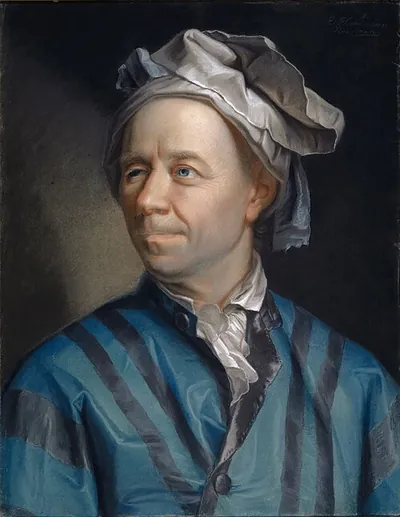 Leonhard Euler1707–1783 · Mathematics