
Pierre-Simon Laplace
French mathematician, astronomer and physicist, known as the French Newton and author of the Celestial Mechanics · 1749–1827
- Born
- March 23, 1749
- Died
- March 5, 1827
- Country
- France
- Section
- Mathematics
Extended biography
Childhood and training
Pierre-Simon Laplace was born on 23 March 1749 in Beaumont-en-Auge, a rural village in lower Normandy in northwestern France. For a long time he was described as the son of a poor farmer, but later research gave a more nuanced picture: his family worked the land and had some means, and his father also traded in cider and served as syndic of the town. Many details of his youth are lost. Family records were burned in 1925 at the château of Saint-Julien-de-Mailloc, and other papers had already been destroyed when his house at Arcueil was looted in 1871.
His family expected him to join the Church. At sixteen he was sent to the University of Caen to study theology, but there he met two mathematics teachers, Christophe Gadbled and Pierre Le Canu, who awakened a passion that outweighed his religious vocation. Before he finished his studies he wrote a memoir on the calculus of finite differences, a mathematical tool for handling quantities that change in steps rather than smoothly. The paper reached Lagrange, who was thirteen years older and already well known in Turin, and the two men began a scientific correspondence that lasted for decades.
Laplace concluded that he had no vocation for the priesthood and resolved to become a professional mathematician. With a letter of introduction from Le Canu, he went to Paris and called on Jean le Rond d'Alembert, then one of the most powerful figures in French science. The best-known story says that d'Alembert handed him a dense mathematics book and asked him to come back once he had read it, and that the young man returned a few days later having understood it. Versions of this tale differ, and no document confirms the details, so it should be read as a traditional account rather than a verified event. What is clear is that d'Alembert was impressed and helped him obtain a teaching post at the École Militaire in Paris.
Paris, the Academy and the laboratory
The teaching post gave Laplace a secure income and a light workload, which left him free for research. For about seventeen years, from 1771 to 1787, he produced much of his original work in astronomy. His ambition was large: he wanted to take Newton's mechanics, the theory that explains how bodies move under gravity, and turn it into a precise tool able to predict the positions of the planets.
His entry into the Academy of Sciences was not easy. By 1771 he felt he deserved membership, but the seats went to other candidates, and his frustration was such that he considered a post in Berlin, through d'Alembert and Lagrange. In the end, thanks to Condorcet, who became permanent secretary of the institution, he was elected an associate member in 1773. From then on the Academy became the centre of his working life.
Between 1780 and 1784 he also collaborated with the chemist Antoine Lavoisier. Together they designed their own apparatus to measure the specific heat of different substances, meaning how much heat each one needs to raise its temperature by a given amount, and they studied how metals expand when heated. In 1783 they published a joint memoir on heat that discussed the kinetic theory of molecular motion, the idea that heat is linked to the disordered movement of tiny particles. These experiments were a small part of his output, but they show that he did not work only with calculations.
In 1788 he married Marie-Charlotte de Courty de Romanges, a young woman from a respected family in Besançon. They had a son, Charles-Émile, and a daughter, Sophie-Suzanne. His private life was discreet and was closely tied to the Academy and to his work, which absorbed most of his energy.
The stability of the Solar System
One of the central problems Laplace tackled was the stability of the Solar System. Newton had shown that the laws of motion and gravitation explain planetary orbits, but his methods were geometric and poorly suited to calculating the subtle effects planets exert on one another. Newton himself came to doubt that the system could hold together without periodic divine correction. Setting aside that divine hypothesis became one of the main goals of Laplace's scientific life.
The most striking case involved Jupiter and Saturn. Observations seemed to show Jupiter speeding up and Saturn slowing down, and the Moon also showed unexplained irregularities. If these trends went on indefinitely, Saturn would eventually fall into the Sun, Jupiter would escape the system, and the Moon would crash into the Earth. Euler and Lagrange had attempted the problem without success, largely because they simplified the equations by discarding small terms.
Laplace showed that those small terms, though tiny individually, add up to significant effects when integrated over time, and that the analysis had to be carried to higher orders. With this method he concluded that the anomalies of Jupiter and Saturn were periodic, with cycles of about a thousand years. What looked like a continuing drift was in fact an oscillation. In 1785 he attributed these variations to the relative positions of the two planets with respect to the Sun. In 1787 he showed that the apparent acceleration of the Moon was also oscillatory and came from second-order effects in the three-body system of Sun, Earth and Moon. He is said to have obtained some of these results when he was only about twenty-three, although the exact dates of his early work should be treated with caution.
The general conclusion was reassuring: the disturbances balance out over the long run, and the system is stable and self-regulating. It should be added that Laplace's methods alone cannot prove absolute stability. Today the Solar System is understood to be chaotic at very fine scales, although it remains reasonably stable over long periods.
Celestial mechanics and the nebular hypothesis
Laplace's great work was the Treatise on Celestial Mechanics, published in five volumes between 1799 and 1825. His aim was a complete account of how the bodies of the Solar System move, using analytical methods, that is, calculus rather than geometric constructions. This allowed far more complicated problems to be handled and made predictions match observations much more closely. Astronomical tables computed from his theory were considerably more accurate than earlier ones.
The first volume dealt with methods for calculating planetary motion, the shape of the planets and the problem of tides. The next volumes applied these methods to particular cases and included tables. The fifth volume was largely historical and presented results from his most recent research. Historians of science point out that the treatise draws heavily on the work of other writers, often without acknowledging them. Laplace tended to skip detailed proofs. According to his collaborator Jean-Baptiste Biot, when Laplace was convinced a conclusion was correct but could not quickly reconstruct the reasoning, he was content to write that it was easy to see that the result held, a phrase that became something of a joke.
In 1796 he published the Exposition of the System of the World, a version without calculations aimed at a wider readership. In it he set out the nebular hypothesis, an account of how the Solar System might have formed. The idea was that the Sun and planets came from a vast rotating cloud of gas and dust. As the cloud cooled and contracted, rings might have broken off its outer edge, and these rings, condensing in turn, formed the planets, while the centre became the Sun.
The idea was not wholly new. Emanuel Swedenborg had sketched something similar earlier, and Immanuel Kant had proposed a version in 1755 with more detail. Laplace developed and refined it, and it explained two observed features in a natural way: the planets all orbit the Sun in the same direction, and their orbits lie roughly in one plane. Modern theories of star and planetary system formation keep some central ideas from this picture, though with many corrections. Laplace also argued that the more distant planets should be older than those closer to the Sun, a conclusion that follows from his cooling model.
Probability, chance and determinism
In statistics, Laplace was one of the founders of the analytic theory of probability. His major book on the subject, the Analytic Theory of Probabilities, appeared in 1812. Its starting point was simple: when all outcomes are equally possible, the probability of an event is the number of favourable cases divided by the total number of possible cases. This principle, known as Laplace's model, works well for dice, coins or cards. He went much further, however, by using calculus to reason about causes from observed effects.
In his Philosophical Essay on Probabilities of 1814 he set out a system of inductive reasoning that we would now recognise as Bayesian. The central idea is to update the probability of a cause as new data arrive. Put simply, he explained how to change one's view in a consistent way in light of evidence. He did not always meet the rigorous standards of later mathematicians, and his arguments sometimes move between different interpretations of probability, but his basic conclusions have held up well.
One frequently cited result is the rule of succession. If an event has occurred a given number of times in past trials, the probability that it will happen on the next trial can be calculated with a simple formula that takes that history into account. Laplace illustrated it with an example that has become famous and that critics have mocked: he calculated the probability that the Sun would rise tomorrow from the number of times it had risen before. In its simplified form the result looks absurd as a real-world calculation. Laplace himself, however, made clear that the figure was not a certainty, and that the rule is only sensible as an estimate when very few samples are available.
Laplace also developed the method of least squares, a technique for fitting a curve to experimental data that contain measurement errors. Legendre had published it in 1805 without linking it to probability, and Gauss justified it shortly afterwards using the normal distribution. In 1810 and 1811 Laplace showed that the central limit theorem gave a probabilistic basis for the method. That theorem says, roughly, that the sum of many small independent variations tends to follow a bell-shaped distribution.
In 1814 Laplace described what is now called Laplace's demon: a hypothetical intellect that, knowing at one instant all the forces and positions in the universe, could calculate both the future and the past. It is a clear statement of scientific determinism, the belief that each state of the world follows from the states before it. Laplace did not use the word demon, which was a later label. The idea also had precursors, such as Maupertuis and the Jesuit scientist Boscovich. Modern physics has shown that such an intellect is impossible in principle: quantum mechanics and Heisenberg's uncertainty principle limit what can be measured with perfect precision.
Tides, transforms and sound
Laplace's work extended well beyond astronomy and probability. In the case of tides, Newton had explained the forces that produce them and Bernoulli had described the static response of the waters, but neither had captured how the ocean actually moves. In 1775 Laplace developed a dynamic theory of tides that took account of friction, resonance and the natural periods of ocean basins. On this view the ocean responds to the pull of the Moon and Sun in a far more complex way than a simple rise of water toward the body. Later measurements, including satellite observations, confirmed that the dynamic theory describes real tides much better than the equilibrium theory, which predicted heights of only about half a metre where observed tides can reach several metres.
In mathematics he made many contributions. These include his work with Vandermonde in 1772 on the general theory of determinants, and the transform that now bears his name. This tool turns certain differential equations into simpler ones that are easier to solve. Euler and Lagrange had begun looking for solutions of this type around 1744, and in 1785 Laplace took the decisive step of using the transformation as a general method. The modern form of the Laplace transform, however, is mainly due to Gustav Doetsch in the 1920s. He is also credited with Laplace's method for approximating integrals and with the Laplace equation, a partial differential equation that appears in many branches of physics.
In acoustics, Laplace was the first, in 1816, to point out that the speed of sound in air depends on the ratio of the specific heats of the gas. This ratio describes how the temperature of a gas changes when it is compressed without exchanging heat with its surroundings. Newton's original theory gave too low a value because it ignored this local warming during compression, and the correction improved the calculation of sound speed considerably.
In surface tension, the force that makes a liquid surface behave like a stretched elastic skin, Laplace built on the qualitative ideas of Thomas Young. The result is the Young-Laplace equation, which relates the pressure difference across a curved surface to its radius of curvature and explains phenomena such as water rising in a narrow tube. These contributions share a pattern: he took a practical problem and sought a mathematical formulation that could give checkable results.
Politics, honours and later years
In his early years Laplace tried to keep clear of politics and to devote himself to the Academy. He withdrew from Paris during the most violent phase of the French Revolution, and his principal loyalty was to science. After the coup of 18 Brumaire in 1799, however, Napoleon Bonaparte, who had once been his student at the École Militaire, appointed him Minister of the Interior. The post lasted only about six weeks before passing to Lucien Bonaparte, Napoleon's brother. Historians generally agree that Laplace was a prestigious appointment with no governing experience, and that once Napoleon had consolidated power he no longer needed him.
Napoleon nonetheless continued to reward him. In 1805 Laplace received the Legion of Honour, in 1806 he became a Count of the Empire, and he was given a seat in the Senate. He thanked the emperor in the third volume of the Celestial Mechanics with a note praising the peacemaker of Europe. After the Bourbon Restoration, that note was removed from copies sold later, yet Laplace adapted without difficulty to the new regime and was named a marquis in 1817. His ability to change allegiance without losing standing has drawn criticism from some historians.
In 1806 he bought a house in Arcueil, then a village outside Paris. His neighbour there was the chemist Claude Louis Berthollet, and their gardens were not separated. Together they formed the nucleus of an informal circle of scientists, later known as the Society of Arcueil, which met regularly and encouraged closer links between physics, chemistry and mathematics. Their closeness to Napoleon gave them considerable influence over appointments and recognition in the scientific establishment, and the group is remembered as a patron of applied research in France.
In 1816 he was elected to the Académie française, an unusual honour for a scientist. His Exposition of the System of the World was admired as literature as well as science, although its history of astronomy is considered less reliable for the more recent periods it covers. Laplace died in Paris on 5 March 1827, at the age of seventy-seven, a few weeks before he would have turned seventy-eight.
A famous reply is attributed to him in a conversation with Napoleon, who supposedly asked why God did not appear in his book on the system of the universe. According to the story, Laplace answered that he had had no need of that hypothesis. The line is widely repeated, but its origin rests on tradition rather than a direct record. A similar anecdote links Lagrange to the remark that God is a beautiful hypothesis that explains many things, to which Laplace supposedly replied that it does not allow anything to be predicted. Both stories should be treated as oral tradition.
Legacy
Laplace's legacy is broad and spans several disciplines. In astronomy, his analysis of perturbations and of the stability of the Solar System laid foundations for modern celestial mechanics. His Treatise remained a reference for a long time, and his analytical methods influenced generations of astronomers and mathematicians. Some historians have compared him with Newton and called him the Newton of France, although the comparison is usually offered as general praise rather than a precise judgement.
In probability and statistics, his Analytic Theory was for much of the nineteenth century the most influential text on the subject. His ideas on Bayesian reasoning, the method of least squares and the central limit theorem are now part of the toolkit used by scientists and engineers. The rule of succession is still used as an estimate when samples are scarce, although his Sun example has become a warning about how not to interpret it.
In physics and applied mathematics he left instruments that remain in use. Laplace's equation, the Laplacian operator, the Laplace transform and the Young-Laplace equation all carry his name. His studies of tides, sound and surface tension showed that mathematical theory could account for everyday phenomena with precision. His nebular hypothesis, refined by many later researchers, provided a starting point for modern theories of how planetary systems form.
He also left a lasting philosophical discussion. The demon that bears his name is still used to explain what determinism means and where its limits lie. Twentieth-century physics showed that perfect prediction is not possible at the most fundamental level, but the idea remains useful for thinking about causation.
His name is commemorated in the asteroid (4628) Laplace, in a feature on the Moon called Cape Laplace in Mare Imbrium, and among the seventy-two scientists whose names are inscribed on the Eiffel Tower. The European Space Agency also chose Laplace as the name of its mission to the Jupiter system. He is, in the end, remembered as a mathematician who brought calculus into astronomy, probability and physics, and whose ideas remain part of present-day science.
Quotes
“Life's most important questions are, for the most part, nothing but problems of chance.”
“Given for one instant an intelligence which could comprehend all the forces by which nature is animated and the respective situation of the beings who compose it, an intelligence sufficiently vast to submit these data to analysis, it would embrace in the same formula the movements of the greatest bodies of the universe and those of the lightest atom; for it, nothing would be uncertain and the future, as the past, would be present to its eyes.”
“All the phenomena of nature are only the mathematical results of a small number of immutable laws.”
“The theory of chance consists in reducing all the events of the same kind to a certain number of cases equally possible”
Main contributions
- 1785Showed that the irregularities of Jupiter and Saturn are periodic and do not grow without limit, explained by the planets' relative positions.
- 1787Showed that the Moon's anomalous motion is also oscillatory, supporting the stability of the Solar System.
- 1796In the Exposition du système du monde he set out the nebular hypothesis, in which the Sun and planets formed from a rotating cloud of gas and dust.
- 1799Began publishing the Traité de mécanique céleste, a five-volume work completed in 1825 that gathered the astronomy of his time using analytical methods.
- 1812Published the Théorie analytique des probabilités, which included the method of least squares and the Moivre–Laplace theorem.
- 1816Pointed out that the speed of sound in air depends on adiabatic compression, correcting the too-low value given by Newton's theory.
Teachers and students
Trivia and anecdotes
The reply to Napoleon
According to the most widely repeated anecdote, Napoleon asked why God was absent from his great book, and Laplace replied that he had never needed that hypothesis. It is a famous story, though its authenticity is doubtful.
A formula for the sunrise
He proposed the rule of succession, which estimates the probability that the Sun rises tomorrow as (d+1)/(d+2), where d is the number of days it has already risen. It is still used to estimate probabilities from few samples.
Tributes
An asteroid bears his name, as does a cape on the Moon. His name is also among the seventy-two scientists inscribed on the Eiffel Tower.
Related discoveries and inventions
- 1755Nebular hypothesisA model explaining how the Sun, the planets and other bodies formed from a cloud of gas and dust spinning around the young star.
Their contemporaries
While Pierre-Simon Laplace was alive (1749–1827)…
Alive at the same time
Discovered or invented in those years
- 1766HydrogenThe lightest and most abundant chemical element in the universe, atomic number 1, which under normal conditions is a colourless, odourless and highly flammable gas.
- 1772NitrogenChemical element with atomic number 7, a colourless, odourless gas that makes up about 78% of Earth's air and is an essential part of proteins and nucleic acids.
- 1774OxygenA colorless, odorless gas, symbol O and atomic number 8, that forms the dioxygen in air and is essential for respiration in most living things.
- 1781UranusThe seventh planet from the Sun, an ice giant discovered by William Herschel in 1781, the first planet found with a telescope.
- 1803AtomThe basic unit of a chemical element: a nucleus of protons and usually neutrons surrounded by a cloud of electrons.
- 1821ElectricityThe set of physical phenomena linked to the presence and movement of electric charge, and one of the most versatile forms of energy in modern life.
 Gaspard Monge1746–1818 · Mathematics
 Adrien-Marie Legendre1752–1833 · Mathematics
 Joseph-Louis Lagrange1736–1813 · Mathematics
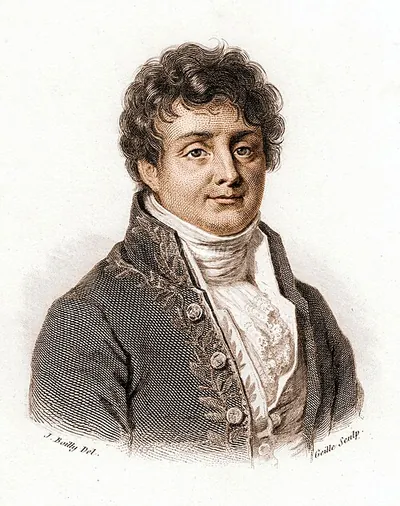 Joseph Fourier1768–1830 · Mathematics
 Sophie Germain1776–1831 · Mathematics
 Carl Friedrich Gauss1777–1855 · Mathematics
