Euler's four-square identity
An algebraic identity stating that the product of two sums of four squares is again a sum of four squares.
- Year
- 1748
- People involved
- Leonhard Euler
- Section
- Mathematics
History
Euler's four-square identity says that the product of two numbers, each of which is a sum of four squares, is itself a sum of four squares. It may look like a game with numbers, yet it matters a great deal in number theory, because it helps reason about how whole numbers break down into squares. It is a polynomial identity: whatever values the eight variables take, the two sides always agree. It can be checked with elementary algebra by expanding the brackets and regrouping the terms.
Before Euler, identities with two squares were already known: the product of two sums of two squares is again a sum of two squares, a fact tied to multiplying complex numbers. Euler sought a four-square version, a question that interested him because of its link to the way integers decompose. He reported the result to Christian Goldbach in a letter dated 4 May 1748, using a sign convention different from the one used today. He returned to the subject in a letter of 12 April 1749, where the identity appears in a form close to the modern one.
The identity has a useful algebraic and geometric meaning. For real numbers, it expresses the fact that the size of a product of two quaternions equals the product of their sizes, much as happens with complex numbers. Quaternions are an extension of complex numbers with four components, introduced by William Rowan Hamilton in the nineteenth century, after Euler's time. The identity holds not only for real numbers but in any commutative ring, such as the integers or the rationals.
Its most famous consequence was Lagrange's four-square theorem, which states that every positive whole number is a sum of at most four squares. Thanks to the identity, it is enough to prove this for prime numbers, and the general case follows. Hurwitz later showed that identities of this kind are possible only for one, two, four or eight squares, which places Euler's identity in a very restricted family.
Today the idea remains present in number theory, in the study of quadratic forms and in quaternion algebra, which is used in computer graphics and in describing the orientation of objects in three dimensions, for example in guiding spacecraft and drones. In a sense, the identity is the algebraic seed of those applications.
Timeline
- 1748Euler reports the identity to Goldbach in a letter dated 4 May.
- 1749Euler writes to Goldbach again on 12 April with the modern form of the identity.
- 1770Lagrange uses the identity to prove his four-square theorem.
- 1843Hamilton introduces quaternions, whose multiplication reflects the identity.
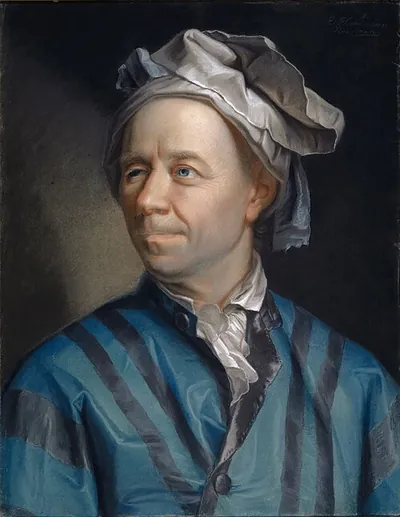 Leonhard Euler1707–1783 · Mathematics