Christian Goldbach
Prussian mathematician known for Goldbach's conjecture and for his role at the St Petersburg Academy of Sciences · 1690–1764
- Born
- March 18, 1690
- Died
- November 20, 1764
- Country
- Kingdom of Prussia, Russian Empire
- Section
- Mathematics
Biography
Christian Goldbach (Königsberg, 1690 - Moscow, 1764) was a Prussian mathematician who spent much of his life serving the St Petersburg Academy of Sciences and the Russian court. He lived in the first half of the eighteenth century, when number theory was becoming a field with its own problems. He is remembered today mainly for a statement that, almost three centuries later, still has not been proved: Goldbach's conjecture.
He was born in Königsberg, capital of the Duchy of Prussia, the son of a Protestant pastor. He studied law, languages and mathematics at the university in his home city. Between 1710 and 1724 he travelled through Germany, England, the Netherlands, Italy and France, and on the way he met Leibniz, Euler and Nicholas I Bernoulli, which sparked his interest in mathematics. He is also said to have spent a short time at Oxford in 1713, where he supposedly studied with John Wallis and Isaac Newton. The chronology makes this account doubtful, since Wallis died in 1703. His travels also fed his interest in philology, archaeology, medicine and ballistics. Between 1717 and 1724 he published his first papers, modest in scope but revealing his ability.
In 1725 he joined the newly founded St Petersburg Academy of Sciences as professor of mathematics and historian of the institution, on a five-year contract. In his early years there he recorded the academy's meetings. He worked alongside Euler, Daniel Bernoulli, Johann Bernoulli and d'Alembert, and played a part in Euler's decision to pursue mathematics rather than medicine. In 1728, when Peter II became emperor, he became tutor to the young ruler and to his cousin Anna, and he followed the court to Moscow when it moved there in 1729. After Peter II died in 1730 he stopped teaching but continued to assist Empress Anna. In 1732 he returned to the Academy as corresponding secretary, and in 1737 he shared its leadership with J. D. Schumacher. In 1742 he entered the Russian Ministry of Foreign Affairs and stepped away from the Academy once more. He kept his influence at court after Anna's death and under Elizabeth, received land and a higher salary, and in 1760 drew up guidelines for the education of the royal children that stayed in use for a century.
His best-known contribution is the letter he sent Euler in 1742. In it he proposed that every even number greater than 2 can be written as the sum of two prime numbers, that is, numbers divisible only by 1 and by themselves. For example, 10 = 3 + 7. Euler could neither prove nor disprove it, and no one has since found a counterexample or a complete proof. It is known to hold for all numbers below 10^18. Goldbach also proved that there are infinitely many primes, studied perfect powers and made contributions to analysis; a theorem about Fermat numbers bears his name. His correspondence with Euler, 196 letters over 35 years, was decisive. He was the main influence on Euler's interest in number theory. Around 1729 he posed problems about sequences that Euler solved, and he came close to the Basel problem, which led Euler to its solution. The weak conjecture, which says that every large odd number is a sum of three primes, was attacked in 2013 by Harald Helfgott, who proved it for odd numbers above 10^30 and checked smaller ones by computer. At the time this biography was written, his work was still under peer review.
Main contributions
- 1729De transformatione serierum: a study of how to rewrite infinite sums of terms to make them easier to compute.
- 1732De terminis generalibus serierum: work on the general formula that describes the terms of a series.
- 1742Goldbach's conjecture: every even number greater than 2 is the sum of two primes. It remains unproven.
- 2013Proof of the weak Goldbach conjecture for large odd numbers, by Harald Helfgott.
- Proof that there are infinitely many prime numbers: no finite list contains all of them.
- The Goldbach-Euler theorem on perfect powers, developed together with Euler.
- Goldbach's theorem on Fermat numbers, a result about numbers of the form 2 raised to a power of 2, plus 1.
Trivia and anecdotes
A doubtful stay at Oxford
It is said that he studied with Wallis and Newton at Oxford, but Wallis died in 1703, which makes such a meeting unlikely at that date.
A correspondence lasting 35 years
He exchanged 196 letters with Euler over 35 years, written in Latin, German and French.
Multilingual by necessity
He kept his diary in German and Latin, wrote letters in German, Latin, French and Italian, and used Russian, German or Latin for official documents.
Their contemporaries
While Christian Goldbach was alive (1690–1764)…
Alive at the same time
Discovered or invented in those years
- 1700PianoA keyboard instrument in which each key sets a felt-covered hammer moving to strike a tensioned string, letting the player control loudness through touch.
- 1712Steam engineAn engine that turns the heat energy of water vapour into mechanical motion, using a piston that moves back and forth inside a cylinder.
- 1735CobaltA bluish-white metal with atomic number 27 and symbol Co, known for its deep blue pigments and its role in modern batteries.
- 1745CapacitorAn electronic component that stores electric charge and energy between two conductors separated by an insulator.
- 1751NickelA silvery-white, corrosion-resistant metal with atomic number 28 and symbol Ni, mostly used today in stainless steel.
- 1755MagnesiumMagnesium is a light, shiny gray-white metal with atomic number 12 and symbol Mg, found in many minerals, seawater and living organisms.
 Daniel Bernoulli1700–1782 · Mathematics
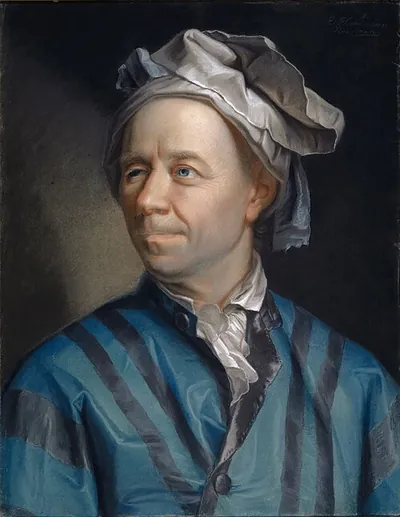 Leonhard Euler1707–1783 · Mathematics
 Johann Bernoulli1667–1748 · Mathematics
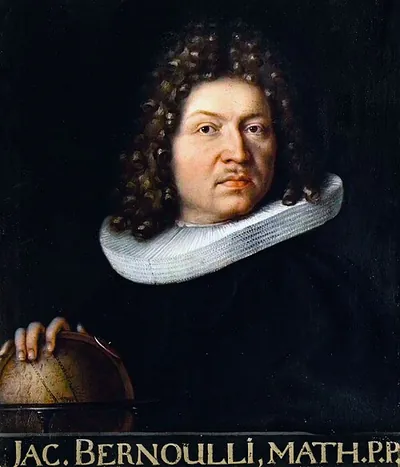 Jacob Bernoulli1654–1705 · Mathematics
 Gottfried Wilhelm Leibniz1646–1716 · Mathematics
 Joseph-Louis Lagrange1736–1813 · Mathematics