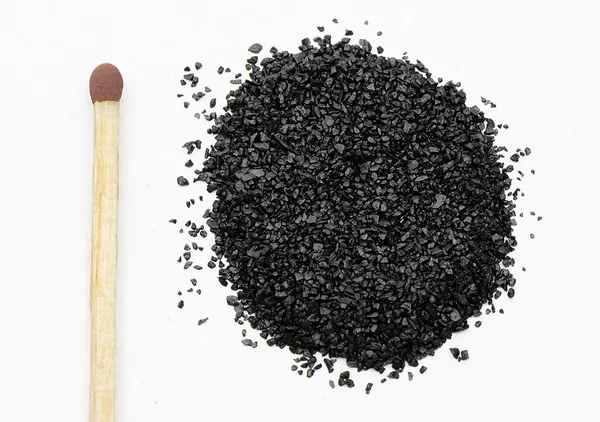

Gunpowder
A mixture of sulfur, charcoal and potassium nitrate that burns very fast and, when confined, propels projectiles or causes explosions. It is the oldest known chemical explosive.
- Year
- 900
- People involved
- Berthold Schwarz
- Section
- Chemistry
History
Gunpowder is a mixture of sulfur, charcoal and potassium nitrate, known as black powder to distinguish it from modern smokeless powders. It is the oldest known chemical explosive, and for centuries its story is tied to that of firearms. It does not detonate; it deflagrates, meaning it burns very quickly without producing the shock wave of high explosives. That relatively slow burn makes it well suited to pushing a projectile out of a barrel, though it is poor at shattering rock or walls.
Before gunpowder, armies relied on muscle power, bows, spears and incendiaries based on substances such as naphtha. Its ingredients were known separately long before. In China saltpeter was used in medicinal remedies from before the common era, and alchemists learned to recognise it by the purple flame it gave off when burning. Taoist texts seeking the elixir of immortality describe mixtures that, heated with honey, produced smoke and flames strong enough to burn hands and houses. The Chinese name for gunpowder, huoyao, means fire medicine, reflecting this origin. A formula from 808, recorded in a Tang dynasty Taoist text, combines six parts sulfur, six parts saltpeter and one part of a plant of the birthwort family, from which charcoal was obtained.
The first documented military use dates to 904, in the form of incendiary projectiles. Under the Song dynasty, the court produced hundreds of thousands of fire arrows for its garrisons. The oldest surviving recipe, in the Wujing Zongyao written between 1040 and 1044, contained so little saltpeter that it produced more fire than explosion, and there is little evidence it had an immediate effect on warfare. Around the 12th century came the so-called fire lances, tubes first made of paper and later of metal that launched projectiles with the force of expanding gases. The earliest chronicle of their use describes the siege of De'an in 1132. By the late 13th century these tubes had become true hand cannons, with a metal barrel, a powder chamber and a touch hole for lighting the charge.
The prevailing view is that gunpowder was invented in China, spread through the Middle East and Near East, and reached Europe by that route. How exactly it travelled is still debated. The Mongols played an important part in spreading it across Asia, although how systematically they used it outside China is disputed. In the Near East, the Syrian writer Hasan al-Rammah wrote 107 gunpowder recipes and 22 rocket recipes between 1240 and 1280, with proportions almost identical to modern ones. He called saltpeter Chinese snow and rockets Chinese arrows, which hints at where his knowledge came from. Ahmad al-Hassan argues that the Mamluks used a cannon at the Battle of Ain Jalut in 1260, but other historians treat this claim with caution.
In Europe, the first written reference to making gunpowder appears in a text by Roger Bacon around 1267. Recipes were recorded in the Liber Ignium between about 1280 and 1300. Berthold Schwarz, a German monk credited with its invention, is a doubtful and probably legendary figure, although he may have been among the first to use it to propel a projectile. Production existed in Italy by about 1326, in England by 1334, and in what is now Germany by 1340. Around the late 14th century, corning spread: the powder was dried into small grains to improve burning and consistency. In 1343 the chronicle of King Alfonso XI of Castile describes its use at the siege of Algeciras, and some historians believe Arabs had already used it in defending Niebla in 1262. In 1403 an attempt was made to mine the walls of Pisa with gunpowder.
From the 16th century, gunpowder production became a state monopoly in most countries. In 1540 Vannoccio Biringuccio's treatise De la pirotechnia was published posthumously; he wrote in the vernacular what master gunpowder makers had kept secret. By the mid-17th century fireworks were used for entertainment across Europe on an unprecedented scale, and a German manual of 1748 described their making so precisely that it was called an exact science.
Black powder lost its central role in weapons at the end of the 19th century, when smokeless powder, based on nitrocellulose, replaced it. It produces less smoke, leaves fewer corrosive residues in the barrel and burns more evenly. In industry, such as quarrying, it has been displaced by more powerful explosives, though it remains in fireworks, blank cartridges and signal rockets. Its lasting legacy is a deep change in warfare, mining and the way societies understood the power of chemical force.
Timeline
- 808A gunpowder formula appears in a Chinese Taoist text, the first confirmed reference to such a mixture.
- 904Its first military use is dated, in the form of incendiary projectiles.
- 1044The Wujing Zongyao records the earliest known chemical formula, though with too little saltpeter to explode forcefully.
- 1132During the siege of De'an, the first chronicle of fire lances is recorded.
- 1267Roger Bacon describes gunpowder in a text, the earliest European written reference to its making.
- 1343The chronicle of Alfonso XI of Castile describes its use at the siege of Algeciras.
- 1403For the first time gunpowder is used to mine a fortification's walls, at the siege of Pisa.
Trivia and anecdotes
A recipe with honey
According to Taoist texts, some mixtures heated with honey produced flames that burned the hands of those preparing them and even an entire house.
A thirteenth-century torpedo
Al-Rammah's book includes an illustration of what is considered the earliest torpedo: a vessel filled with gunpowder meant to glide across the water, called the egg which moves itself and burns.
A doubtful name
The figure of Berthold Schwarz, credited with its invention, is doubtful and probably legendary, so it should be treated with caution.