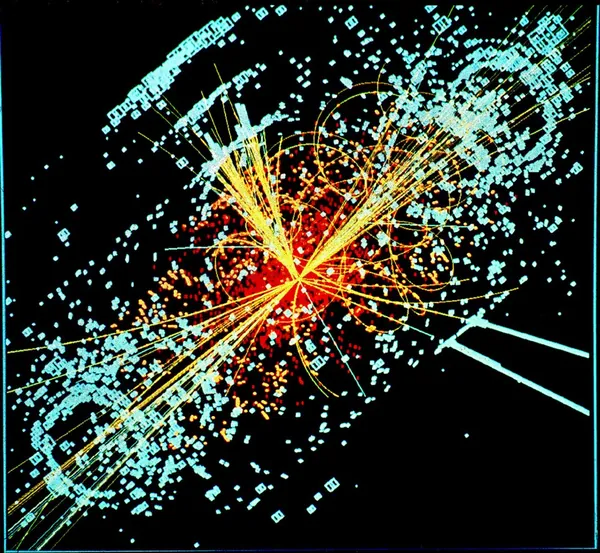
Higgs mechanism
The mechanism by which elementary particles of the weak interaction acquire mass through interaction with a field that fills all of space.
- Year
- 1964
- People involved
- François Englert, Peter Higgs
- Section
- Physics
History
The Higgs mechanism is the process that, within the Standard Model of particle physics, gives mass to gauge bosons, the particles that carry the fundamental forces. Without it, the W and Z bosons, which mediate the weak nuclear force, would be massless like the photon, and the weak force would have infinite range. The core idea is that a field, the Higgs field, pervades all of space; particles that interact with it become heavier, while those that do not, such as the photon, remain massless.
Before 1964, physicists knew of a similar effect in superconductivity. A superconductor expels magnetic fields from its interior, the Meissner effect, which means electromagnetism becomes short-range inside the material. Theories from Ginzburg and Landau in 1950 and the BCS theory in 1957 explained this through a condensate of charged particles that fixes a preferred phase. Yoichiro Nambu linked this idea to the structure of the vacuum in particle physics, and in 1962 Philip Warren Anderson proposed that broken gauge symmetry could give mass to bosons, although his work was limited to non-relativistic theory. Julian Schwinger had noted in 1961 that breaking gauge symmetries did not necessarily produce massless particles, but he did not show that massive ones would appear.
The relativistic model was published in 1964 almost at the same time by three independent groups: Robert Brout and François Englert, Peter Higgs, and Gerald Guralnik, C. R. Hagen and Tom Kibble. These papers were later recognized as milestones by Physical Review Letters. Higgs was the first to point out that the Goldstone theorem, which predicts massless bosons when a continuous symmetry breaks, could be avoided in gauge theories. His original paper was rejected by Physics Letters; when revising it for Physical Review Letters he added a sentence noting that the model implied one or more massive scalar bosons, now called Higgs bosons. That is why the particle bears his name, although the mechanism carries many names, including Brout–Englert–Higgs and Anderson–Higgs. Gerardus 't Hooft gave it the name Higgs mechanism in 1971. Migdal and Polyakov proposed a similar idea in 1965, but their paper appeared late, in 1966.
In simple terms, the Higgs field has a nonzero value in empty space, which breaks the electroweak symmetry. Of the four degrees of freedom in the field doublet, three are absorbed by the W and Z bosons, which become massive, while the photon keeps zero mass because the vacuum is electrically neutral. The fourth degree of freedom gives rise to a scalar particle, the Higgs boson. The theory predicts the W and Z masses from the symmetry-breaking scale of about 246 GeV, but it does not fix the Higgs boson mass, which is a free parameter. Fermion masses follow a similar logic through Yukawa couplings, each with its own constant that the theory does not determine.
The mechanism was gradually accepted. Steven Weinberg and Abdus Salam incorporated it into the electroweak model in 1967, unifying electromagnetism and the weak force. For that work Weinberg, Glashow and Salam received the 1979 Nobel Prize. In 1972 't Hooft and Martinus Veltman showed that the theory was renormalizable, meaning its predictions could be calculated consistently. The three 1964 papers were honored with the 2010 Sakurai Prize, and the 2013 Nobel Prize in Physics went to Peter Higgs and François Englert. On 4 July 2012 CERN's Large Hadron Collider announced results consistent with a Higgs particle, and the confirmation in March 2013 strengthened the case that the field exists in nature, though scientists stressed that more evidence was needed to confirm the full mechanism.
The mechanism's impact on today's physics is vast. It explains why the weak interaction has a very short range, which matters for processes in the Sun and in radioactivity. It also underpins the Standard Model, the framework that describes known particles and their interactions with great precision. Searching for deviations from its predictions remains an active area of research at particle accelerators.
Timeline
- 1950Ginzburg and Landau develop their theory of superconductivity.
- 1957The BCS theory explains superconductivity through electron pairs.
- 1962Philip Warren Anderson proposes that symmetry breaking can give mass to bosons.
- 1964Three independent groups publish the relativistic model of the mechanism.
- 1967Weinberg and Salam incorporate the mechanism into the electroweak model.
- 1971Gerardus 't Hooft gives it the name Higgs mechanism.
- 2012CERN's LHC announces results consistent with the Higgs particle.
- 2013Peter Higgs and François Englert receive the Nobel Prize in Physics.
Trivia and anecdotes
A disputed name
The particle is named after Higgs because of a sentence he added when revising his paper. The mechanism also carries the names of the other authors.
Initial rejection
Higgs's original article was rejected by Physics Letters before it appeared in Physical Review Letters.
 François Englert1932–2026 · Physics
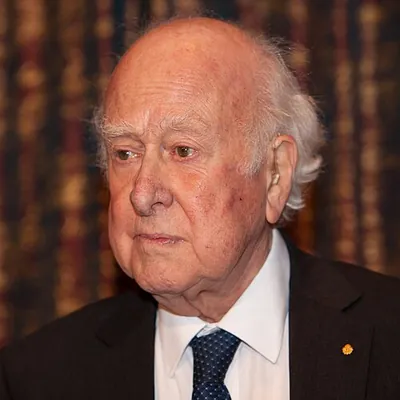 Peter Higgs1929–2024 · Physics
