
François Englert
Belgian theoretical physicist, co-author of the mechanism that explains the origin of mass of elementary particles and 2013 Nobel Prize in Physics laureate · 1932–2026
- Born
- November 6, 1932
- Died
- June 18, 2026
- Country
- Belgium, France
- Section
- Physics
- Awards
- Nobel Prize in Physics
Biography
François Englert (Brussels, 6 November 1932 – 18 June 2026) was a Belgian theoretical physicist whose work on the origin of mass in elementary particles earned him, together with Peter Higgs, the 2013 Nobel Prize in Physics. His research belongs to the second half of the twentieth century, when physicists were searching for a single description of the fundamental forces of nature. His importance lies in a 1964 proposal that explains why some particles have mass without breaking the mathematical consistency of the theories that describe them.
He was born in Brussels into a Belgian Jewish family. During the German occupation of Belgium in the Second World War, he had to conceal his Jewish identity and lived in orphanages and children's homes in several towns: Dinant, Lustin, Stoumont and, finally, Annevoie-Rouillon, where the U.S. Army liberated him. He survived the Holocaust, and the reference sources treat this period as the starting point of a life later devoted almost entirely to science.
In 1955 he graduated as an electromechanical engineer from the Free University of Brussels (ULB), and in 1959 he earned his doctorate in physical sciences at the same institution. Theoretical physics consists of building mathematical models that describe natural phenomena, which are then tested against experiments. Between 1959 and 1961 he worked at Cornell University, first as a research associate of Robert Brout and then as an assistant professor. Brout became his closest collaborator. Englert returned to the ULB with him, where he became a university professor, and in 1980 the two of them jointly headed the university's theoretical physics group.
His best-known work grew out of a problem in gauge field theories, a family of mathematical frameworks that describe forces such as electromagnetism very well. In their simplest form, these theories did not allow the particles that carry some forces to have mass, and adding mass by hand destroyed the consistency of the theory. In 1964 Brout and Englert showed that gauge vector fields, both abelian and non-abelian, could acquire mass if empty space had a particular structure, similar to one found in certain materials. A ferromagnet offers a helpful picture: the tiny magnets inside its atoms line up, and the material takes on an internal organization that affects how disturbances travel through it. In the same way, fields that respond to this structure of the vacuum can only travel a finite distance, so they mediate short-range interactions and become massive, while fields that do not respond stay massless and produce long-range interactions. The mechanism therefore holds both kinds of interaction inside one theory.
Peter Higgs reached essentially the same result by a different route, and later that year Gerald Guralnik, C. R. Hagen and Tom Kibble published a third paper on the subject. All three introduced a scalar field as the agent of this vacuum structure. Physicists now often call it the Higgs field, and many regard it as the source of the masses of fundamental particles. Brout and Englert also found that the mechanism could survive if the scalar field were replaced by a more complex agent, such as a fermion condensate, and they conjectured that the theory was renormalizable, meaning that its calculations could be carried out consistently. The definitive proof came later through Gerardus 't Hooft and Martinus Veltman, who received the 1999 Nobel Prize for that work. The name of the mechanism lists several authors because the contribution was collective, although the 2013 Nobel went only to Higgs and Englert.
Throughout his career Englert also worked on statistical physics, quantum field theory, cosmology, string theory and supergravity. In 1978, together with Brout and E. Gunzig, he won the first prize in an international gravity essay contest run by the Gravity Research Foundation. In 1982 he received the Francqui Prize, and in 1984 he was first appointed Sackler Professor by Special Appointment at Tel Aviv University. In 1997 he shared the High Energy and Particle Physics Prize of the European Physical Society with Brout and Higgs, and in 2004 the Wolf Prize in Physics. In 2010 he received the Sakurai Prize for Theoretical Particle Physics together with five other physicists. He joined the Institute for Quantum Studies at Chapman University in California in 2011. In 2013 he shared the Prince of Asturias Award for Technical and Scientific Research with Higgs and CERN, and that same year the Nobel Prize, after the ATLAS and CMS experiments at CERN's Large Hadron Collider confirmed the particle the mechanism had predicted. By royal decree of 8 July 2013, King Albert II of Belgium granted him the title of baron.
Englert died on 18 June 2026 in Uccle, a municipality of Brussels, at the age of 93. His legacy is the mechanism that bears the names of Brout, Englert and Higgs. It forms the basis of the electroweak theory of elementary particles, which unifies electromagnetism and the weak nuclear force, and it laid the foundation for a unified view of the basic laws of nature.
Quotes
“The simplest example is the black hole, where after all nobody knows really if the problem lies in the singularity or if it lies really already in the horizon.”
“There we introduced the idea of a primordial exponential expansion of the universe, later called inflation, which we related to the origin of the universe itself, a scenario, which I still think may possibly be conceptually the correct one.”
“With our group and many other collaborators I analysed fractal structures, supergravity, string theory, infinite Kac-Moody algebras and more generally all tentative approaches to what I consider as the most important problem in fundamental interactions: the solution to the conflict between the classical Einsteinian theory of gravitation, namely general relativity, and the framework of our present understanding of the world, quantum theory.”
Main contributions
- 1964Brout-Englert-Higgs mechanism: proposal that gauge fields can acquire mass through a structure of empty space.
- 1978First prize, with Brout and Gunzig, in the international gravity contest for the essay «The Causal Universe».
- 1982Francqui Prize in exact sciences for his contribution to the theoretical understanding of spontaneous symmetry breaking.
- 1997High Energy and Particle Physics Prize of the European Physical Society, shared with Brout and Higgs, for the first self-consistent theory of charged massive vector bosons.
- 2004Wolf Prize in Physics, shared with Brout and Higgs, for work leading to mass generation under local gauge symmetry.
- 2010Sakurai Prize for Theoretical Particle Physics, awarded by the American Physical Society to six researchers behind the mechanism.
- 2013Nobel Prize in Physics, shared with Higgs, for the theoretical discovery of the mechanism that explains the origin of mass of subatomic particles.
Trivia and anecdotes
A hidden childhood
During the German occupation he lived in hiding in orphanages and children's homes in several Belgian towns, until the U.S. Army liberated him.
Three nearly simultaneous papers
In 1964 three independent papers with very similar ideas appeared, by Brout and Englert, by Higgs, and by Guralnik, Hagen and Kibble. That is why the mechanism carries several names.
A Belgian baron
In 2013, the same year as the Nobel Prize, King Albert II granted him the title of baron by royal decree.
Related discoveries and inventions
- 1964Higgs mechanismThe mechanism by which elementary particles of the weak interaction acquire mass through interaction with a field that fills all of space.
Their contemporaries
While François Englert was alive (1932–2026)…
Alive at the same time
Discovered or invented in those years
- 1932NeutronA subatomic particle with no net electric charge, found in the nucleus of almost every atom alongside protons.
- 1945ComputerA programmable machine that takes in data, processes it by following stored instructions, and produces results, able to switch tasks simply by running different software.
- 1969InternetA global network of interconnected computer networks that communicate using the TCP/IP protocol suite.
- 1971EmailA network service that lets users send and receive digital messages through addressed mailboxes, much like postal mail but electronic.
- 1973Mobile phoneA handheld wireless phone that lets people make and receive calls while moving across a cellular network area.
- 1989World Wide WebA system of linked documents and resources, connected by hyperlinks and accessed over the Internet with web browsers.
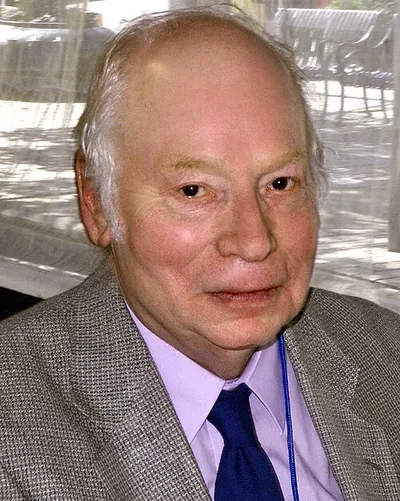 Steven Weinberg1933–2021 · Physics
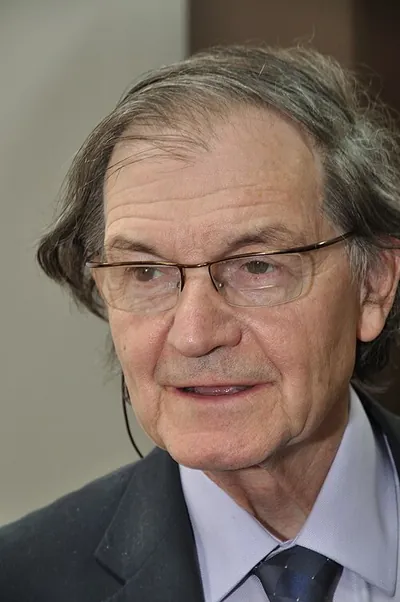 Roger Penrose1931 · Physics
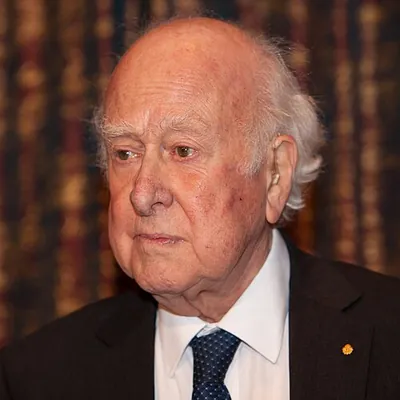 Peter Higgs1929–2024 · Physics
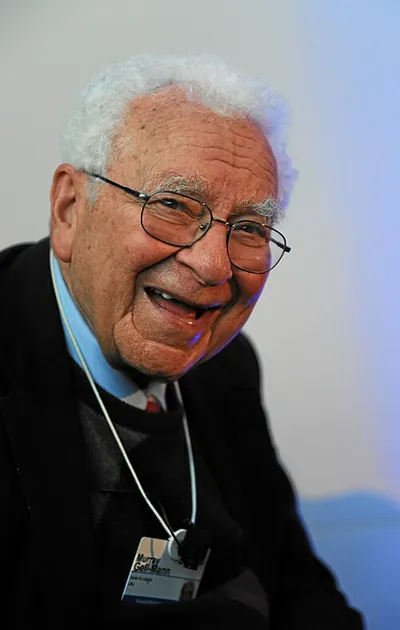 Murray Gell-Mann1929–2019 · Physics
 John Stewart Bell1928–1990 · Physics
 Stephen Hawking1942–2018 · Physics
