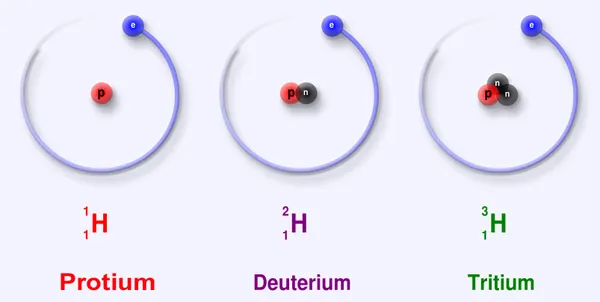

Isotope
Variants of the same chemical element whose atoms share the same number of protons but differ in their number of neutrons, and therefore in mass.
- Year
- 1913
- Section
- Chemistry
History
An isotope is a version of a chemical element. All of its atoms have the same number of protons in the nucleus, which is what makes them that element, but each version carries a different number of neutrons, particles with no electric charge and nearly the same weight as protons. The atom's mass therefore changes while its chemical identity stays the same. The word comes from Greek roots meaning equal and place, so the idea is that all isotopes of an element occupy the same spot in the periodic table. It may sound like a matter of naming, but the concept explained why the atomic masses of many elements are not whole numbers, and it opened the way to understanding the structure of the nucleus and radioactivity.
Before 1913, chemists had no reason to think that one spot on the periodic table could hold different kinds of atoms. The puzzle came from radioactivity. The British radiochemist Frederick Soddy studied chains of radioactive decay and identified around forty distinct species between uranium and lead, although the periodic table seemed to have room for only eleven elements in that range. Several attempts to separate these substances by chemical means had failed. Soddy showed, for instance, that mesothorium, radium and thorium X could not be told apart chemically. In 1913 Soddy and the Polish chemist Kazimierz Fajans independently proposed the radioactive displacement law: after emitting an alpha particle an atom moves two places to the left in the table, and after emitting a beta particle it moves one place to the right. Soddy noticed that some of these species were chemically identical to others yet differed in mass and radioactive behaviour. The name came from Margaret Todd, a Scottish doctor and family friend, who suggested the term during a conversation in which Soddy was explaining his ideas to her. Soddy received the 1921 Nobel Prize in Chemistry, partly for this work.
The first evidence of several isotopes of a non-radioactive element came soon after, from J. J. Thomson. In 1912 and 1913 he sent streams of positive ions through magnetic and electric fields and recorded how far they bent onto a photographic plate, which let him work out the ratio of mass to charge of each particle. Studying neon, he saw two parabolic traces, pointing to two kinds of atoms with masses near 20 and 22, the heavier one much fainter. Later F. W. Aston built a mass spectrograph based on Thomson's method and found stable isotopes for many elements. In 1919 he showed that the masses of neon came close to the whole numbers 20 and 22, and that chlorine behaved as a weighted average of two isotopes. This gave rise to Aston's whole number rule, which has no known exceptions: an element whose atomic mass is not a whole number is a mixture of isotopes. In 1932 James Chadwick discovered the neutron, which clarified the ultimate cause of isotopes, since all of them share the same number of protons but differ in neutrons.
Isotopes of an element behave almost identically in chemistry because they have the same number of electrons, which governs how an atom reacts. Mass differences do matter in hydrogen, where deuterium weighs twice as much as protium and tritium three times as much, slightly changing reaction speeds. As for stability, neutrons help hold the nucleus together and offset the repulsion between protons, so heavier nuclei need proportionally more neutrons. Today about 339 naturally occurring nuclides are known on Earth, of which 286 are primordial, and 80 elements have at least one stable isotope. Tin holds the record with ten stable isotopes. Unstable isotopes have practical uses: carbon-14, with a half-life of 5730 years, dates organic remains; certain radioisotopes serve in medical diagnosis and treatment; labelled isotopes act as tracers in chemistry, farming and hydrology; and uranium-235 fuels nuclear power stations. The concept is now essential in geology, medicine, archaeology and energy.
Timeline
- 1912J. J. Thomson begins studying ions with magnetic and electric fields and finds signs of two kinds of neon.
- 1913Soddy and Fajans propose the radioactive displacement law, and Margaret Todd suggests the term isotope.
- 1914T. W. Richards observes that lead from different mineral sources has different atomic weights.
- 1919F. W. Aston shows with his mass spectrograph that neon's masses come close to the whole numbers 20 and 22.
- 1920Aston shows that the atomic mass of chlorine is an average of two isotopes.
- 1921Soddy receives the Nobel Prize in Chemistry, partly for his work on isotopes.
- 1932James Chadwick discovers the neutron, the particle that explains the difference in neutron numbers between isotopes.
Trivia and anecdotes
A name suggested by a doctor
The term isotope was proposed by Margaret Todd, a Scottish doctor and friend of Soddy's family, during a conversation about his ideas.
Tin, the isotope champion
No element has nine or eight stable isotopes, but tin has ten, the highest number known.
Hydrogen, the extreme case
In hydrogen the mass difference is large enough to affect reactions: deuterium weighs twice as much as protium and tritium three times as much.