
Ohm's law
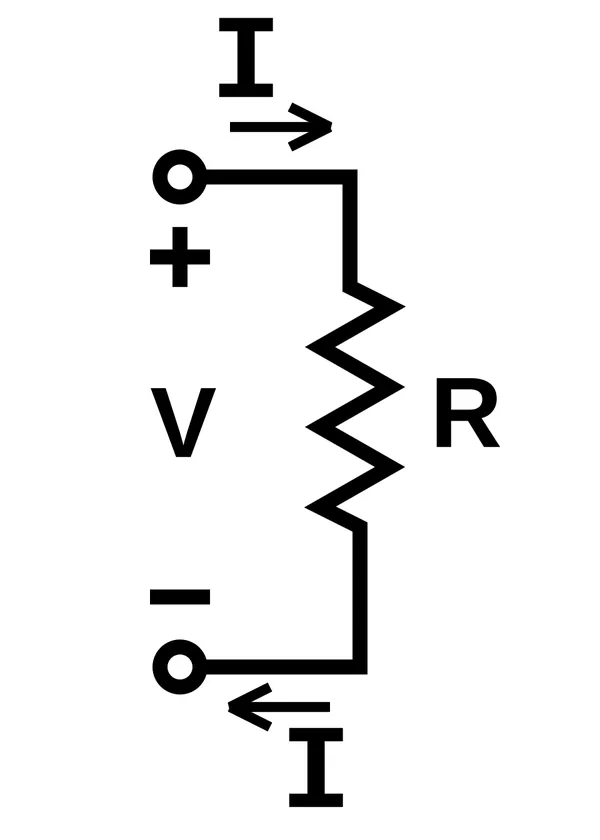
A relation stating that, in an ordinary conductor, the current is proportional to the voltage applied across its ends, with resistance as the constant of proportionality (V = I·R).
- Year
- 1827
- Section
- Physics
History
Ohm's law says that, in a well-behaved conductor, the current flowing through it is proportional to the potential difference applied across its ends. That potential difference can be pictured as the push that drives electric charges to move. The constant linking the two is the resistance, which measures how strongly a material opposes the flow of current. Its best-known form, V = I·R, is used today to calculate almost any circuit, from a light bulb to the grid that delivers electricity to homes.
Before Ohm, the study of electricity lacked reliable measurements. In 1781, Henry Cavendish experimented with Leyden jars and glass tubes filled with salt solution, judging the current by how strong a shock he felt when he closed the circuit through his own body. He concluded that the current's strength varied directly with the degree of electrification, but he never shared his results, and they remained unknown until James Clerk Maxwell published them in 1879. In 1814, Francis Ronalds used a gold-leaf electrometer to study a dry pile, a high-voltage source, and found that under certain weather conditions the two quantities were not proportional. Instruments were crude, and voltaic piles changed their voltage as they were used, which made general conclusions difficult.
Georg Simon Ohm, a mathematics teacher in Cologne, worked during 1825 and 1826 by adapting equipment that already existed. He started from Coulomb's torsion balance and added a magnetic needle to it. His idea drew on Hans Christian Ørsted, who had found in 1819 that a current flowing through a wire deflected a nearby compass needle. Ohm used that effect to measure current indirectly. He replaced the voltaic piles with a thermocouple, a steadier voltage source whose output depended on the temperature of its junction. He then added test wires of different lengths, thicknesses and materials, and fitted his readings to an expression depending on the wire's length and two constants. From that expression he derived the proportionality between current and voltage, with resistance as the factor linking them.
He published his findings in 1827 in a book titled Die galvanische Kette, mathematisch bearbeitet. His original formulation was slightly more elaborate than the modern version, and he drew inspiration from Joseph Fourier's work on heat conduction. The reception was cold, even hostile. Critics dismissed the work as a web of naked fancies, and the minister of education reportedly declared that a professor who preached such heresies was unfit to teach science. German philosophy of the time held that reasoning alone could reveal nature's truths, without experiments, and Ohm's brother Martin, also a mathematician, was fighting the education system himself. Ohm left his post in Cologne and in 1833 accepted a position at the Nuremberg Polytechnic. Recognition came slowly. The Royal Society of London awarded him the Copley Medal in 1841, and by the 1850s the law was considered established. Ohm died in 1854.
The microscopic explanation arrived with the Drude model, proposed by Paul Drude in 1900, shortly after J. J. Thomson discovered the electron in 1897. In this picture, the electrons in a metal move like billiard balls among fixed ions. The electric field accelerates them, but collisions knock them off course constantly, so they drift together at an average speed proportional to the field. Since the current depends on that drift, it is also proportional to the field. This gives the local form of the law, in which current density equals conductivity times the electric field. Quantum mechanics, developed in the 1920s, refined the picture, but kept the proportionality for most materials.
Today the law is understood as an empirical rule, a generalization drawn from experiments rather than a fundamental law like Maxwell's equations. It holds for many materials and across a wide range of currents, but not for all of them. So-called non-ohmic materials break it, and any material will fail under a sufficiently strong field. In practice, engineers use it to estimate losses in installations, power and energy consumption, and the resistance that lets a circuit work efficiently. For alternating current it is extended through impedance. The ohm, the unit of resistance, honors its discoverer, while the siemens, adopted in 1971 in honor of Ernst Werner von Siemens, replaced the older mho as the unit of conductance in formal writing.
Timeline
- 1781Henry Cavendish experiments with Leyden jars and salt-solution tubes, but never publishes his results.
- 1814Francis Ronalds finds that, in a dry pile, voltage and current are not always proportional.
- 1825Ohm describes in a preliminary paper his method for comparing conductors, using a setup based on Coulomb's balance.
- 1827Ohm publishes his book on the galvanic circuit, where the relation between current, voltage and resistance appears.
- 1841The Royal Society of London awards Ohm the Copley Medal.
- 1879James Clerk Maxwell publishes Cavendish's results, almost a century after he obtained them.
- 1900Paul Drude proposes his conduction model, which explains Ohm's law through the motion of electrons.
- 1971The siemens is adopted as the unit of conductance, in honor of Ernst Werner von Siemens.
Trivia and anecdotes
A measurement with his own body
Cavendish judged the current by how strong a shock he felt when he closed the circuit through his body. It was a crude method, yet it recorded a proportionality he never published.
A hostile welcome
Some critics called his work a web of naked fancies, and the minister of education reportedly judged such teachings heretical and unworthy of a science professor. The episode shows the clash between speculation and experiment in Germany at the time.
Two units with personal names
The ohm honors Georg Ohm and the siemens honors Ernst Werner von Siemens. Before the siemens, the mho was used, which is the ohm spelled backwards, a name for conductance that still appears in older texts.