
Virgo
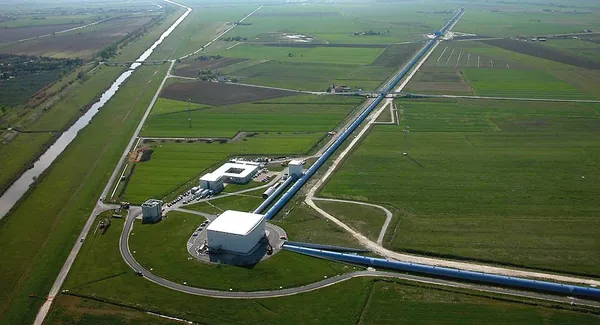
A giant interferometer near Pisa, Italy, built to detect gravitational waves, the tiny distortions of spacetime caused by violent cosmic events.
- Year
- 2003
- Section
- Physics
History
Virgo is a gravitational-wave detector located in Cascina, near Pisa. It matters because gravitational waves, predicted by Albert Einstein in 1916 as part of general relativity, can only be observed by measuring changes in distance far smaller than an atomic nucleus. Virgo is one of the instruments that make direct observation possible, and together with the LIGO detectors in the United States and KAGRA in Japan it forms a network that can confirm and locate each signal.
Before Virgo, the first serious attempts began in the late 1960s with the Weber bars, devised by Joseph Weber. Although they could in theory detect gravitational waves, none of the experiments succeeded, but they encouraged many research groups to work on the problem. In the early 1980s the idea of a large interferometer, which compares two beams of light travelling along perpendicular paths, gained credibility. The Virgo project took shape in 1985, when the Italian physicist Adalberto Giazotto and the French physicist Alain Brillet developed the concept after meeting in Rome, and it was first proposed in 1987.
What set Virgo apart was its focus on low frequencies, around 10 hertz, while most projects aimed at frequencies near 500 hertz. Many researchers at the time doubted that such observations were feasible, and only France and Italy committed to the plan. The French CNRS approved the project in 1992 and the Italian INFN followed the next year. Construction began in 1996 in Cascina and was completed in 2003. The name comes from the Virgo galaxy cluster and reflects the goal of catching waves from beyond our own galaxy.
The initial detector ran through the 2000s and reached its expected sensitivity, but it recorded no gravitational waves. It was shut down in 2011 so that Advanced Virgo could be installed, with the aim of increasing its sensitivity tenfold and thus the volume of the universe it can survey. Meanwhile, in 2015, the LIGO detectors made the first direct observation of these waves. Virgo resumed observations in August 2017 and has since taken part in joint runs within the LVK collaboration. That same year, the signal GW170817, from the merger of two neutron stars, was also seen by telescopes observing visible light, gamma rays and X-rays, opening a new way to study the cosmos.
The principle is a laser split into two beams that travel along arms several kilometres long and bounce off mirrors. When a gravitational wave passes, the arms stretch and shrink by an almost unimaginably small amount, and this change shows up in the interference pattern where the beams recombine. To shield the instrument from outside noise, the mirrors hang from complex pendulum systems and the interior is kept at ultra-high vacuum.
The European Gravitational Observatory consortium manages the site, while the Virgo Collaboration brings together about 940 researchers from 165 institutions in 20 countries. Today Virgo is part of an international network that has opened gravitational-wave astronomy, with applications in the study of black holes, neutron stars and gravity itself. Its future plans include further upgrades, although the timetable for the fifth observing run is under review.
Timeline
- 1916Albert Einstein presents the concept of gravitational waves within general relativity.
- 1985Giazotto and Brillet conceive the project after meeting in Rome.
- 1992The French CNRS approves the Virgo project.
- 1996Construction of the interferometer begins in Cascina, near Pisa.
- 2003Construction of the initial Virgo detector is completed.
- 2011Virgo is shut down to install the advanced version.
- 2017Virgo resumes observations and takes part in the detection of GW170817.
Trivia and anecdotes
Origin of the name
Virgo takes its name from the Virgo galaxy cluster, alluding to its aim of catching waves from beyond our own galaxy.
A signal seen by other means
GW170817 was the first gravitational wave also confirmed by telescope observations of light and gamma rays.