
Abraham Pineo Gesner
Canadian physician and geologist, pioneer of kerosene and the modern petroleum industry · 1797–1864
- Born
- May 2, 1797
- Died
- April 29, 1864
- Country
- Canada
- Section
- Energy
Biography
Abraham Pineo Gesner (Cornwallis, Nova Scotia, 1797 - Halifax, 1864) was a Canadian physician and geologist who devised a method for turning coal and bitumen into a lamp fuel he called kerosene. He lived in the first half of the nineteenth century, when whale oil and vegetable oils lit most homes, and his name is tied to the birth of the modern oil industry.
He was born on 2 May 1797 at Chipmans Corner, near Kentville, one of twelve children. His father was a Loyalist who had moved to Nova Scotia after the American Revolution. Gesner was an avid reader from childhood. In his early twenties he tried selling horses to plantations in the Caribbean and the United States, but the venture collapsed when two ships carrying most of his animals were wrecked. Penniless, he returned to the family farm and in 1824 married Harriet Webster, daughter of a doctor in Kentville. According to a common account, her father offered to clear his debts if he studied medicine.
In 1825 he travelled to London to train at St Bartholomew's Hospital under Astley Cooper and at Guy's Hospital under John Abernethy. While studying medicine he attended lectures on mineralogy and geology and formed a lasting friendship with Charles Lyell, one of the most influential geologists of the day. In 1827 he settled in Parrsboro as a travelling physician, riding from patient to patient and collecting any rocks that caught his eye.
In 1836 he published his first book, Remarks on the Geology and Mineralogy of Nova Scotia, notable for explaining complex ideas in plain language. Two years later the government of New Brunswick appointed him Provincial Geologist. For five years he spent summers in the field and winters classifying specimens and writing reports. His surveys were of good quality for their time, but he had no mining experience and his estimates of the province's mineral wealth were too hopeful. Investors who opened coal and iron mines were disappointed, doubted his findings, and the government dismissed him in 1843. During one of those summers in the field he found a bituminous substance in Albert County, which he named albertite to distinguish it from coal or asphalt.
In Saint John he assembled a large collection of minerals and animal specimens and opened the Gesner Museum in 1842, one of the first public museums of its kind in Canada. It was a financial failure, and its holdings eventually passed to local institutions and now form part of the New Brunswick Museum. In 1846 the Nova Scotia government made him Commissioner of Indian Affairs, and the following year he reported on the hard living conditions of the Mi'kmaq people.
His move into kerosene came around 1846. He had brought a sample of bitumen from Trinidad's Pitch Lake, and he began extracting oils and gas from bituminous materials. The first product smelled unpleasant, the raw material was expensive, and by his own estimate one ton of Trinidad bitumen yielded only 42 gallons of oil. He switched to albertite, which burned with a brighter, cleaner flame than whale oil lamps. He is said to have given the first public demonstration of the fuel in Charlottetown in August 1846. He first named it keroselain, from Greek words for wax and oil, and later shortened the name to kerosene.
After his father died in 1850 the family moved to Halifax. There he planned a lighting company with the Earl of Dundonald, but the Earl returned to England in 1851, and the city's gas licence went to a rival group. A businessman, William Cairns, also held rights to coal in the area and had Gesner's workers removed from the bitumen site. Gesner sued, but the jury sided with Cairns, and albertite was classed as Albert coal for about thirty years. In 1853 Gesner moved to New York City.
There, with the support of shipbroker Horatio Eagle, he helped set up what became the North American Kerosene Company. In 1854 he obtained US patents and described three grades of kerosene: A, the most volatile, which we today call gasoline; B, less volatile and mainly used for blending; and C, the lamp fuel. At Newtown Creek on Long Island the company built what was the first such refinery in North America. Demand grew so fast that production capacity became the bottleneck, and the discovery of crude oil, which could also yield kerosene, solved the supply problem. The company was later absorbed by Standard Oil.
Gesner returned to Halifax and became professor of natural history at Dalhousie University. In 1933 Imperial Oil, a Standard Oil subsidiary, erected a monument to him in Camp Hill Cemetery, and in 2000 Canada Post issued a stamp in his honour. His legacy is twofold: that of a geologist who gave Canada some of its earliest museums and surveys, and that of a chemist who transformed night lighting and paved the way for the petroleum industry.
Main contributions
- 1836Remarks on the Geology and Mineralogy of Nova Scotia, his first book, a geological study of the region.
- 1842The Gesner Museum in Saint John, one of Canada's first public museums, with over two thousand catalogued items.
- 1846A method for producing kerosene, a lamp fuel cleaner and cheaper than whale oil.
- 1854US patents on kerosene and the division of its products into three grades, A, B and C.
- 1854The first kerosene refinery in North America, built at Newtown Creek, Long Island.
- 1861A practical treatise on coal, petroleum and other distilled oils, a reference work in its field.
Trivia and anecdotes
A decisive lawsuit
Gesner lost his suit against William Cairns, and albertite was classed as coal for about thirty years.
A name with Greek roots
His first name for the fuel, keroselain, joined the Greek words for wax and oil before being shortened to kerosene.
Their contemporaries
While Abraham Pineo Gesner was alive (1797–1864)…
Alive at the same time
Discovered or invented in those years
- 1803AtomThe basic unit of a chemical element: a nucleus of protons and usually neutrons surrounded by a cloud of electrons.
- 1811MoleculeAn electrically neutral group of at least two atoms held together by chemical bonds in a defined arrangement.
- 1821ElectricityThe set of physical phenomena linked to the presence and movement of electric charge, and one of the most versatile forms of energy in modern life.
- 1839PhotographyA technique for creating lasting images by recording light, either on a light-sensitive material or with an electronic sensor.
- 1846NeptuneThe eighth and most distant planet of the Solar System, an ice giant found through mathematical prediction before any direct sighting.
- 1859EvolutionThe process by which the heritable traits of living populations change over generations, explaining the diversity of life from common ancestors.
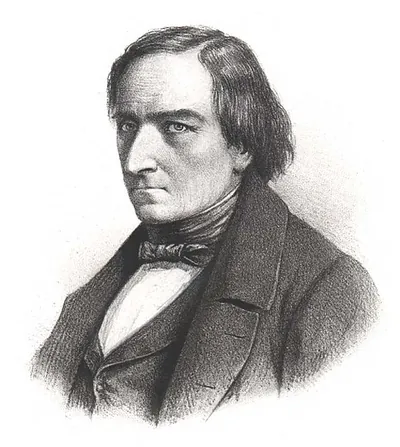 Josef Ressel1793–1857 · Energy
 Benoît Fourneyron1802–1867 · Energy
 John Ericsson1803–1889 · Energy
 Robert Stirling1790–1878 · Energy
 Alphonse Beau de Rochas1815–1893 · Energy
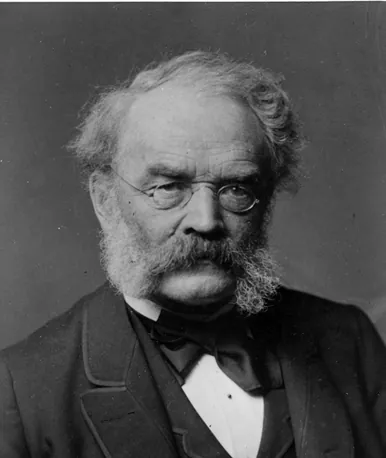 Werner von Siemens1816–1892 · Energy
