
Alphonse Beau de Rochas
French engineer who first gave a complete and correct theoretical description of the four-stroke cycle · 1815–1893
- Born
- April 9, 1815
- Died
- March 27, 1893
- Country
- France
- Section
- Energy
Biography
Alphonse Eugène Beau de Rochas (born 9 April 1815 in Digne-les-Bains, died 27 March 1893 in Vincennes) was a French engineer of the nineteenth century who described with precision the four-stroke cycle, the sequence of stages followed by many internal combustion engines. He is less well known than the men who built engines based on his ideas, yet his theoretical work holds an important place in the history of energy and the car. The sources do not agree on one detail: one dates his patent to 16 January 1861, while another gives 1862. The 1861 date appears in the more detailed account, but it should be treated with some caution.
The sources say very little about his origins and training. Apart from his birthplace, Digne-les-Bains, a small town in the Alpes-de-Haute-Provence, there are no reliable records of his teachers or of the influences that shaped his thinking, so any further detail would be unsupported.
In his working life Beau de Rochas belonged to the Compagnie du Midi, but he chose to leave that post so that he could test his ideas and carry out experiments himself. To do this he accepted an unpaid arrangement in the workshop of Erouard, a maker of scientific instruments, in exchange for access to its equipment. The four-stroke cycle described in his patent has four phases: intake of the mixture of gas and air, compression of that mixture, ignition and expansion, when the burning gases push the piston, and exhaust of the spent gases. Repeating these four stages makes the engine's shaft turn. His patent was never commercially exploited. He could not pay the annual fee that kept it in force, so it passed into the public domain and anyone could use the idea.
In other memoirs, less well known than the patent, Beau de Rochas anticipated ignition by compressing the mixture, described double-acting engines, in which the piston works in both directions, and explained in theory the two-stroke cycle with compressed gases. He kept friendly ties with Marcel Desprez, a theorist of electrical engineering, and with Professor Cailletet, who extended the laws on liquefying gases. Hirsch, director of the Conservatoire des Arts et Métiers, tried to find him a grant of 3,000 francs that could have spared him destitution, but the sources suggest it did not come through in the amount needed.
His personal life was shaped by financial hardship. He lived in a shack in Vincennes and each morning walked on foot to the Boulevard Voltaire, whatever the weather, because he did not have the small sum needed for a horse-drawn bus ticket. In May 1891 he succumbed to these hardships, in a state of extreme poverty that the sources describe as close to literal starvation.
He received no recognition during his lifetime. His work was later assessed in a monograph by the German writer Gulner in 1911, and at a meeting chaired by André Labarthe in January 1936 for the Société des Ingénieurs de l'Automobile. The person who did most to make him known was Baudry de Saunier, through a widely read popular book. His legacy is twofold: he laid the theoretical foundations of the four-stroke cycle, which Nicolaus Otto and other engineers later developed into working engines, and he is remembered as a thinker who never saw his ideas succeed in his lifetime.
Main contributions
- 1861Patent for the four-stroke cycle: a complete and correct description of the stages that make an internal combustion engine work.
- Ignition by compression: he anticipated that a compressed mixture could ignite without a spark, an idea later exploited by the diesel engine.
- Double-acting engines: he described machines in which the piston works in both directions.
- Two-stroke cycle with compression: he explained in theory how an engine could work with only two stages per revolution, compressing the gases.
Trivia and anecdotes
Walking to work
Each morning he walked the route to the Boulevard Voltaire, because he could not afford the fare for the horse-drawn bus.
A patent that lapsed
He could not pay the annual fee on his patent, so it entered the public domain and anyone could use his ideas.
A grant that came too late
Hirsch, director of the Conservatoire des Arts et Métiers, sought a 3,000-franc grant that could have spared him destitution.
Their contemporaries
While Alphonse Beau de Rochas was alive (1815–1893)…
Alive at the same time
Discovered or invented in those years
- 1846NeptuneThe eighth and most distant planet of the Solar System, an ice giant found through mathematical prediction before any direct sighting.
- 1859EvolutionThe process by which the heritable traits of living populations change over generations, explaining the diversity of life from common ancestors.
- 1869Periodic tableAn arrangement of the chemical elements into rows (periods) and columns (groups), ordered by atomic number, that reveals recurring chemical behaviour and lets scientists predict properties.
- 1869Deoxyribonucleic acidA double-stranded molecule that carries the genetic instructions of nearly all living things and many viruses.
- 1876TelephoneA device that carries the human voice over distance by turning sound into electrical signals and back into sound at the other end of the line.
- 1884CarA road vehicle with four wheels and its own engine, mainly built to carry people.
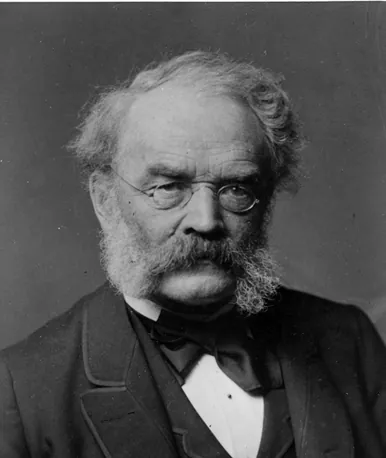 Werner von Siemens1816–1892 · Energy
 George Henry Corliss1817–1888 · Energy
 Ignacy Łukasiewicz1822–1882 · Energy
 Étienne Lenoir1822–1900 · Energy
 Zénobe Gramme1826–1901 · Energy
 John Ericsson1803–1889 · Energy
