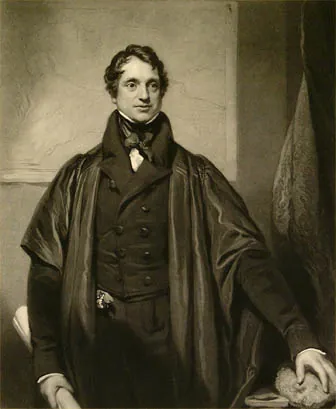
Adam Sedgwick
British geologist and Anglican priest, one of the founders of modern geology · 1785–1873
- Born
- March 22, 1785
- Died
- January 27, 1873
- Country
- Kingdom of Great Britain, United Kingdom of Great Britain and Ireland
- Section
- Earth sciences
Biography
Adam Sedgwick (Dent, 1785 - Cambridge, 1873) was a British geologist and Anglican priest, one of the founders of modern geology. He worked in the first half of the nineteenth century, when scientists were beginning to read the history of the Earth in its rocks. His studies of the oldest rock layers in Wales and Britain helped sort that history into time periods that are still in use.
He was born in Dent, then in Yorkshire, the third child of an Anglican vicar. He studied at Sedbergh School and Trinity College, Cambridge, where he trained in mathematics and theology. He graduated in 1808 as fifth wrangler, a high place in the university's mathematics examinations, and was ordained first as a deacon and then as a priest. His mentors at Cambridge were Thomas Jones and John Dawson. In 1818 he became Woodwardian Professor of Geology, a post he accepted with almost no working knowledge of the subject. He threw himself into it, and within a few years geology had become his main field.
His method was to walk the land, collect fossils and study the order of rock layers. He concentrated on the rocks of Wales and northern England. He was among the first to separate clearly between stratification (the layering of rock), jointing (the cracks that run through it) and slaty cleavage, the tendency of some rocks to split into thin sheets. He also studied metamorphism, the transformation of rock by heat and pressure, and concretions, hardened lumps that form inside sediments. He was elected a Fellow of the Royal Society in 1821.
His largest contributions came in the 1830s, working with his friend and collaborator Roderick Murchison. In 1835 they published a joint work in which Sedgwick proposed the Cambrian period for the oldest rocks of Wales, while Murchison proposed the Silurian. Murchison later objected that some strata Sedgwick placed in the Cambrian belonged to the Silurian. In 1840 the two men proposed the Devonian period to settle another dispute, the Great Devonian Controversy, over rocks lying between the Silurian and Carboniferous periods. The Cambrian quarrel was finally resolved in 1879, when Charles Lapworth created the Ordovician period for part of the disputed strata.
Sedgwick guided the young Charles Darwin in his first geological studies and took him on a field trip to Wales in 1831. The two kept up a long correspondence, including while Darwin was away on the Beagle. Sedgwick, however, never accepted evolution by natural selection. He saw selection as a secondary effect of more basic facts, and he believed species had arisen through a series of divine acts of creation. When he read On the Origin of Species (1859) he wrote to Darwin a harsh but courteous criticism. The friendship survived until Sedgwick's death.
His faith shaped some of his public stances. In the 1820s he backed William Buckland's flood explanation for certain gravel deposits, but after visiting Paris and the Scottish Highlands he gave it up. In 1844, at the British Association meeting in York, he defended geology against the dean of the cathedral, who considered it contrary to Scripture. The chapter refused to sit with him, but much of the liberal press supported his position. He also opposed admitting women to the University of Cambridge.
His legacy lies in the order he gave to the earliest ages of life on Earth. Names he helped establish remain part of the geological time scale. His fieldwork, based on careful observation of layers, fossils and the relations between them, shaped how rocks were studied in the nineteenth century.
Main contributions
- 1835Proposal of the Cambrian period, for the oldest rocks of Wales, in a joint work with Roderick Murchison.
- 1840Proposal of the Devonian period, with Murchison, to settle the controversy over rocks between the Silurian and Carboniferous.
- 1850Fifth edition of his Discourse on the Studies of the University of Cambridge, with a long preface criticising theories of development.
Teachers and students
Trivia and anecdotes
An uncomfortable pupil
Sedgwick taught Darwin geology but never accepted his ideas on evolution, though the two remained friends until Sedgwick's death.
A debate in York
In 1844 the chapter of York Minster refused to sit down beside Sedgwick after his clash with the dean over geology.
A professor without prior experience
When he accepted the geology chair in 1818, Sedgwick admitted he knew almost nothing about the subject and had to learn it from scratch.
Their contemporaries
While Adam Sedgwick was alive (1785–1873)…
Alive at the same time
Discovered or invented in those years
- 1803AtomThe basic unit of a chemical element: a nucleus of protons and usually neutrons surrounded by a cloud of electrons.
- 1839PhotographyA technique for creating lasting images by recording light, either on a light-sensitive material or with an electronic sensor.
- 1846NeptuneThe eighth and most distant planet of the Solar System, an ice giant found through mathematical prediction before any direct sighting.
- 1859EvolutionThe process by which the heritable traits of living populations change over generations, explaining the diversity of life from common ancestors.
- 1869Periodic tableAn arrangement of the chemical elements into rows (periods) and columns (groups), ordered by atomic number, that reveals recurring chemical behaviour and lets scientists predict properties.
- 1869Deoxyribonucleic acidA double-stranded molecule that carries the genetic instructions of nearly all living things and many viruses.
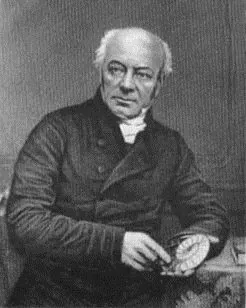 William Buckland1784–1856 · Earth sciences
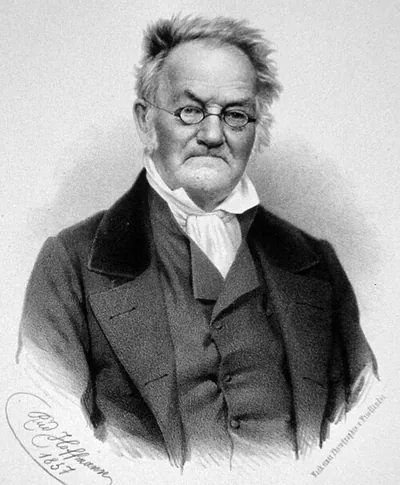 Carl Ritter1779–1859 · Earth sciences
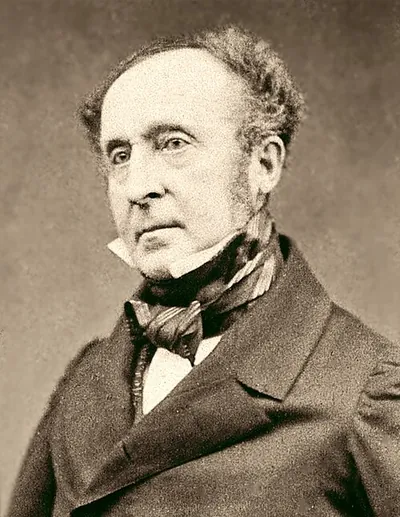 Roderick Murchison, 1st Baronet1792–1871 · Earth sciences
 Francis Beaufort1774–1857 · Earth sciences
 Christian Leopold von Buch1774–1853 · Earth sciences
 Charles Lyell1797–1875 · Earth sciences
