
Alfred North Whitehead
English mathematician and philosopher, founder of process philosophy and co-author of Principia Mathematica · 1861–1947
- Born
- February 15, 1861
- Died
- December 30, 1947
- Country
- United Kingdom
- Section
- Mathematics
Extended biography
Childhood and education
Alfred North Whitehead was born in Ramsgate, in the English county of Kent, on 15 February 1861. His father, also called Alfred, was an Anglican minister who had been headmaster of Chatham House Academy, a boys' school previously run by the boy's grandfather, Thomas Whitehead. Those who knew both men described them as successful schoolmasters, and the grandfather was regarded as the more remarkable of the two.
His relationship with his mother, Maria Sarah Buckmaster, seems to have been cool. Whitehead rarely mentioned her in his writings, and his wife Evelyn held a poor opinion of her. His childhood is described as overprotected, yet when he entered Sherborne, a prominent English public school, he excelled at sport and mathematics and became head of his class.
In 1880 he began studying mathematics at Trinity College, Cambridge. He took his degree in 1884, writing a dissertation on James Clerk Maxwell's treatise on electricity and magnetism, and graduated as fourth wrangler, the title given to high-placed students in Cambridge's mathematics examinations. That same year he was elected a fellow of Trinity, where he taught until 1910.
Early mathematical work
During the 1890s Whitehead wrote A Treatise on Universal Algebra, published in 1898. In this context, universal algebra meant what it means today: the study of algebraic structures in themselves, rather than of particular examples of them. The background was that by the late nineteenth century some new number systems, such as the quaternions of William Rowan Hamilton, no longer obeyed familiar rules of arithmetic, such as the order in which factors are multiplied.
The book set out to compare several of these systems, including Hermann Grassmann's theory of extension, George Boole's algebra of logic and Hamilton's quaternions. Whitehead did not reach a general result, and his hope of a single unified method went largely unfulfilled. Even so, the work served as a starting point, and the subject developed only slowly until the early 1930s, when Garrett Birkhoff and Øystein Ore began publishing on it.
He also wrote many articles on mathematics and physics in these early years, but his best-known work in the field came from his collaboration with Bertrand Russell, a former pupil who would become one of the leading philosophers of the twentieth century.
Principia Mathematica
Principia Mathematica, published in three volumes between 1910 and 1913, is Whitehead's most famous mathematical work. Its aim was to build mathematics from a small set of axioms, which are basic statements accepted without proof, and rules of inference, the permitted logical steps for deriving new statements. Everything was written in a precise symbolic language so that each step could be checked.
The project was so foundational that it took a long time to reach results that look obvious. It is often told that the authors had to reach page 86 of the second volume before proving that 1+1=2, and that the proof was accompanied by a dry remark that the proposition was "occasionally useful". Whitehead and Russell first thought the task would take a year; it took about ten.
Publication was a financial problem. At more than two thousand pages, and with an audience limited to professional mathematicians, the book was issued at a loss of about 600 pounds, shared between Cambridge University Press, the Royal Society of London and the authors themselves. Over time it became a standard reference, and almost every major academic library holds a copy.
Its legacy is mixed. In 1931 Kurt Gödel showed that, for any system of axioms rich enough to contain arithmetic, there are true statements that cannot be derived within it. This meant the goal of Principia could not be fully achieved. Yet Gödel could not have reached that conclusion without the groundwork laid by Whitehead and Russell. In that ironic sense, the book's most important contribution was to reveal the limits of its own ambition. It also popularised modern mathematical logic and built bridges between logic, epistemology and metaphysics.
An Introduction to Mathematics
In 1911 Whitehead published An Introduction to Mathematics, written for readers who were not specialists. Where his earlier books addressed professional mathematicians, this one surveyed the nature of the subject, its internal unity, its structure and its applications to the natural world. His purpose was not to teach techniques but to help students understand from the outset what exact thinking is for.
The book can be read as an attempt to explain how mathematics has grown more unified and more interconnected over time, and how it influences and is influenced by philosophy, language and physics. Although it is short and little read, it anticipates several ideas that Whitehead would later develop in philosophy.
Related to this, his theory of extensive abstraction, set out in his work on geometry and space, is regarded as foundational for mereotopology, a branch of ontology and computer science that studies relations between wholes, parts and the boundaries between them.
Turning to philosophy
Whitehead did not begin his career as a philosopher. He never had formal training in philosophy beyond his university studies, and he regarded himself as an amateur. In a letter to Bertrand Russell he wrote that a question about whether science seeks to explain or merely describe led him into an ocean of metaphysics that his profound ignorance of the subject forbade him to enter. Ironically, in later life he became one of the major metaphysicians of the twentieth century.
By the 1920s metaphysics, meaning the philosophical study of the ultimate nature of reality, had fallen out of fashion in academia. The success of empirical science had persuaded many that metaphysical systems were a waste of time, since they could not be tested by experiment. Whitehead did not accept this objection. He argued that scientists and philosophers constantly make assumptions about how the universe works, and that these assumptions are hard to see precisely because no one examines them.
In 1920 he published The Concept of Nature, and shortly afterwards he served as president of the Aristotelian Society, from 1922 to 1923. Henri Bergson is reported to have called him the best philosopher writing in English. This reputation led Harvard to invite him in 1924, when he was 63.
Science, the modern world and process
In 1925 he published Science and the Modern World, in which he criticised what he called scientific materialism: the view that matter is an irreducible, brute substance that moves according to external rules and has no meaning or purpose. For Whitehead this picture did not fit the science of his day. His alternative held that reality is not built from small, independent pieces of matter but from processes.
On this view, what we call a stone or a person is not simply identical with itself over time. It is a succession of overlapping events, each a brief moment of experience, linked together in what he called a society of events. Treating things as having an unchanging essence was, in his judgement, confusing a useful abstraction with something concrete, an error he named the fallacy of misplaced concreteness. He also blamed language, which names things as though they did not change, even though everything flows.
Whitehead gave relations a primary role. An object is not only what it is in itself but also the sum of its relations with others and the way it responds to them. For him, creativity, meaning a degree of novelty in response, is a basic principle of existence, so that even an electron is not wholly fixed by causal laws.
Process and Reality
His most ambitious philosophical work is Process and Reality, based on the Gifford lectures he delivered in 1927 and 1928 and published in 1929. The book is famous for its difficulty. One well-known account says that the first lecture left the audience baffled, even those who knew his work well, and that attendance fell sharply afterwards. One critic wrote that reading page after page without understanding a single sentence was exasperating. Even so, the book is regarded as one of the most influential metaphysical texts of the twentieth century.
In it Whitehead built a vocabulary of his own. He used the word experience very broadly, so that even inanimate processes count as a basic form of experience. To describe how entities take hold of one another, he coined the word prehension, from the Latin for seizing. A prehension may be conscious or unconscious, and it is not limited to living things. He also distinguished two modes of perception: causal efficacy, the sense of being affected by one's surroundings, and presentational immediacy, the pure appearance of things. In higher organisms the two combine into what he called symbolic reference. His example of a chair makes this clear: an ordinary person sees a coloured shape and at once infers a chair, and a dog would act similarly, whereas an artist might pause to admire the beauty of the shape.
God, value and religion
Whitehead's idea of God departs from traditional monotheism. He criticised Christianity for giving God attributes that belonged to earthly power, such as the image of a king who imposes his will on the world. In its place he proposed a conception closer to humility and love, one that accompanies rather than rules.
In his system God has two natures. The primordial nature is eternal and unchanging, and it contains the ordered set of possibilities that give things a horizon for realisation. The consequent nature, by contrast, changes, because it receives and holds within itself everything that happens in the world. God and the world thus complete each other: the world receives permanence from God, and God receives actuality and change from the world. This idea has inspired what is called process theology.
On religion, Whitehead understood it chiefly as an individual experience, something each person does with his or her own solitude. He also held that the value of each person can be understood only in relation to the wider community of the universe. He acknowledged that religion can be a good influence but is not always one, and he saw it as an attempt to give general meaning to deeply personal emotions.
Education, later life and legacy
Whitehead maintained a lasting interest in educational reform. In 1921 the prime minister David Lloyd George appointed him to a committee of twenty people charged with studying the British education system and recommending improvements. His most complete work on the subject is The Aims of Education and Other Essays, published in 1929, which gathers pieces written between 1912 and 1927. In it he criticised inert ideas, scraps of information with no connection to real life, and argued for teaching a few important concepts that pupils could apply in many fields. He said that education with inert ideas is not only useless but harmful. He also stressed imagination as a way of seeing facts in the light of general principles.
In the United States, Whitehead and his wife Evelyn settled permanently. He retired from Harvard in 1937 and remained in Cambridge, Massachusetts, until his death on 30 December 1947. Their children did not follow their father into academic life, and one son, Eric, died in the First World War while serving with the Royal Flying Corps at the age of nineteen.
The most detailed account of his life is Victor Lowe's two-volume biography, generally regarded as the fullest source. Whitehead left no personal archive and asked that his papers be destroyed after his death, so many details of his life remain unclear. There is still no complete critical edition of his writings, although the Center for Process Studies is working towards one.
His legacy is twofold. As a mathematician and logician, his collaboration with Russell produced a foundational work, whose limits were exposed by Gödel. As a philosopher, he founded process philosophy, which has been applied in ecology, theology, education, physics, biology, economics and psychology, and whose most promising recent application lies in environmental ethics and the idea of an ecological civilisation.
Quotes
“The aim of science is to seek the simplest explanations of complex facts. We are apt to fall into the error of thinking that the facts are simple because simplicity is the goal of our quest.”
“Civilization advances by extending the number of important operations which we can perform without thinking about them.”
“The safest general characterization of the European philosophical tradition is that it consists of a series of footnotes to Plato.”
“Knowledge does not keep any better than fish.”
“It is the business of the future to be dangerous; and it is among the merits of science that it equips the future for its duties.”
Main contributions
- 1898A Treatise on Universal Algebra: a study of algebraic structures in themselves rather than of their concrete examples.
- 1910Principia Mathematica (with Bertrand Russell, 1910-1913): an attempt to derive all mathematical truths from a set of axioms and logical rules of inference.
- 1911An Introduction to Mathematics: a book for a general audience explaining the nature, unity and applications of mathematics.
- 1925Science and the Modern World: a work proposing an alternative to Cartesian dualism and to the view of matter as something fixed.
- 1929Process and Reality: his main philosophical work, which lays the foundations of process philosophy.
Teachers and students
Studied under:
Taught:
Trivia and anecdotes
A proof that 1+1=2
In Principia Mathematica the proof that 1+1=2 only appears on page 86 of the second volume, accompanied by a humorous remark about its usefulness.
A book that lost money
The work was published at a loss of 600 pounds, shared between Cambridge University Press, the Royal Society and the two authors.
A lecture hard to follow
It is said that even professional philosophers struggled to follow his Gifford lectures, which became Process and Reality.
Their contemporaries
While Alfred North Whitehead was alive (1861–1947)…
Alive at the same time
Discovered or invented in those years
- 1869Periodic tableAn arrangement of the chemical elements into rows (periods) and columns (groups), ordered by atomic number, that reveals recurring chemical behaviour and lets scientists predict properties.
- 1876TelephoneA device that carries the human voice over distance by turning sound into electrical signals and back into sound at the other end of the line.
- 1884CarA road vehicle with four wheels and its own engine, mainly built to carry people.
- 1903AirplaneA fixed-wing aircraft, heavier than air, powered by engines or rockets, that stays aloft because its wings generate lift.
- 1925TelevisionA system that sends moving pictures and sound over distance and shows them on a receiver, the television set.
- 1945ComputerA programmable machine that takes in data, processes it by following stored instructions, and produces results, able to switch tasks simply by running different software.
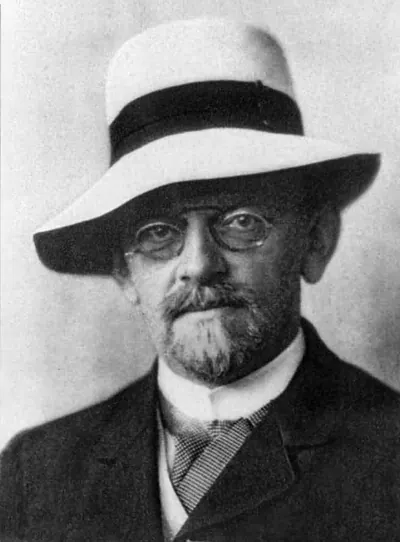 David Hilbert1862–1943 · Mathematics
 Hermann Minkowski1864–1909 · Mathematics
 Giuseppe Peano1858–1932 · Mathematics
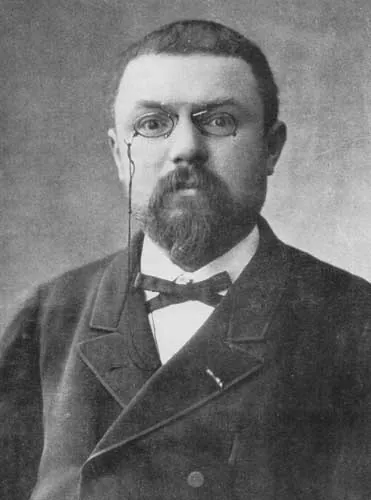 Henri Poincaré1854–1912 · Mathematics
 Bertrand Russell1872–1970 · Mathematics
 Felix Klein1849–1925 · Mathematics
