Andrey Kursanov
Soviet plant physiologist and biochemist, academician of the Soviet Academy of Sciences · 1902–1999
- Born
- November 8, 1902
- Died
- September 20, 1999
- Country
- Russia, Soviet Union, Russian Empire
- Section
- Biology
- Awards
- Abel Prize
Biography
Andrey Kursanov was a Soviet physiologist and biochemist who studied how plants work at the level of their internal chemistry and physical processes, such as how they move water and nutrients and how they use light. He lived from 1902 to 1999, a span that covered the Russian revolution, the Second World War and the Cold War, and his research made him one of the best-known plant scientists in the Soviet Union.
He was born in Moscow on 8 November 1902. He graduated from Moscow State University in 1926 and stayed there for most of his career. The sources available do not detail his teachers or the specific influences on his work, so it would be speculative to assign him to a particular school. His field, plant physiology, asks how a plant grows, absorbs water and minerals and turns sunlight into energy.
In 1940 he earned the degree of Doctor of Sciences in biology, and in 1944 he became a professor at his alma mater. In 1953 he was elected to the Soviet Academy of Sciences, and the same year he joined the Russian Academy, a membership that continued after the Soviet Union broke up. From 1957 to 1963 he sat on the Presidium of the Soviet Academy, the body that steered the country's research. In 1954 he represented the Academy at Columbia University's bicentennial in New York City, alongside Boris Rybakov, an example of the scientific contacts the Soviet Union kept up despite the tensions of the period.
Kursanov received a number of honorary doctorates and was a honorary member of several foreign scientific societies and academies. In 1962 he was elected a foreign fellow of the American Academy of Arts and Sciences, and in 1965 a member of the Polish Academy of Sciences. Within the Soviet system he collected high distinctions: he was named Hero of Socialist Labour in 1969, received the Order of Lenin four times and the Lomonosov Gold Medal in 1983.
His legacy lies in Soviet plant physiology and in the training of generations of researchers at the university where he studied and taught. He died in Moscow on 20 September 1999, aged 96.
Main contributions
- 1926Graduation from Moscow State University, the start of his career in plant physiology.
- 1940Earned the degree of Doctor of Sciences in biology.
- 1953Elected academician of the Soviet Academy of Sciences and of the Russian Academy of Sciences.
- 1962Elected foreign fellow of the American Academy of Arts and Sciences.
Teachers and students
Their contemporaries
While Andrey Kursanov was alive (1902–1999)…
Alive at the same time
Discovered or invented in those years
- 1903AirplaneA fixed-wing aircraft, heavier than air, powered by engines or rockets, that stays aloft because its wings generate lift.
- 1925TelevisionA system that sends moving pictures and sound over distance and shows them on a receiver, the television set.
- 1925Quantum mechanicsPhysical theory describing how matter and light behave at atomic and subatomic scales, where energy is exchanged in minimal packets and results are expressed as probabilities.
- 1931Big BangA cosmological model describing how the universe expanded from an early state of extreme density and temperature, about 13.8 billion years ago.
- 1945ComputerA programmable machine that takes in data, processes it by following stored instructions, and produces results, able to switch tasks simply by running different software.
- 1969InternetA global network of interconnected computer networks that communicate using the TCP/IP protocol suite.
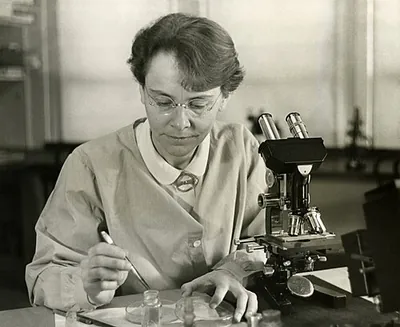 Barbara McClintock1902–1992 · Biology
 Konrad Lorenz1903–1989 · Biology
 Ernst Mayr1904–2005 · Biology
 Hans Krebs1900–1981 · Biology
 Ernst Chain1906–1979 · Biology
 Gerty Cori1896–1957 · Biology