
Anna Atkins
English botanist and pioneer of scientific photography, author of what is often considered the first book illustrated only with photographs · 1799–1871
- Born
- March 16, 1799
- Died
- June 9, 1871
- Country
- United Kingdom of Great Britain and Ireland
- Section
- Biology
Biography
Anna Atkins (Tonbridge, Kent, 16 March 1799 – Halstead, 9 June 1871) was an English botanist who is often considered the first person to publish a book illustrated solely with photographs. She worked in the earliest years of photography, barely a decade after the first practical methods were announced, and her work matters both for its scientific value and as an early example of the new medium being used to record the natural world.
She was born in Tonbridge in 1799. Her mother died soon after childbirth, in 1800 according to some accounts, and Anna grew up close to her father, John George Children, a chemist, mineralogist and zoologist who gave her an unusually scientific education for a woman of her time. Her detailed engravings of shells illustrated her father's translation of Lamarck's work on shell genera. In 1825 she married John Pelly Atkins, a London merchant trading with the West Indies who later became High Sheriff of Kent, and they moved to Halstead Place, the Atkins family home near Sevenoaks. They had no children. Meanwhile she pursued botany by collecting dried plants, and in 1839 she was elected a member of the London Botanical Society.
Her path into photography came through her circle. Her father and her husband were friends of William Henry Fox Talbot, who taught her directly about two of his inventions: photogenic drawing, in which an object is laid on light-sensitive paper and exposed to the sun to make an image, and the calotype, a process based on paper negatives. By 1841 she had access to a camera. Some sources call her the first female photographer, while others give that title to Constance Fox Talbot. Since no camera photographs by either woman survive, the question may never be settled.
The process that shaped her best-known work was cyanotype, invented in 1842 by John Herschel, a friend of hers and of her father. It produces blue images: paper coated with iron salts is exposed to light, and when it is washed, the areas shielded by an object remain white. Atkins applied it to algae. She laid dried specimens directly on the sensitised paper, without mounting them, and obtained precise silhouettes that worked as botanical illustrations. In October 1843 she self-published the first instalment of Photographs of British Algae: Cyanotype Impressions, in a very small print run with handwritten text. The work eventually ran to three volumes between 1843 and 1853. Only around seventeen copies are known today, in varying states of completeness, held by libraries and museums. Eight months later, Talbot's The Pencil of Nature began to appear, and it is usually cited as the first commercially published book illustrated with photographs.
In the 1850s she collaborated with Anne Dixon, whom she regarded as a sister, on several albums of cyanotypes of ferns and flowering plants, and in 1861 on another containing seventy-four images of plants, feathers and textiles. Around 1865 she donated her specimens and collection to the British Museum. She died at Halstead Place in 1871, aged 72, of what was described as paralysis, rheumatism and exhaustion. She was also once credited with writing some anonymous novels, but that attribution has since been disproved.
Her legacy is twofold. As a botanist she left a careful record of species in a new medium, and as a photographer she showed that photography could serve science with precision. Her name has been rediscovered in recent decades. In 2015 the search engine Google marked her birthday with a Google Doodle, and in 2018 the New York Public Library opened an exhibition on her life and work.
Main contributions
- 1843Photographs of British Algae: Cyanotype Impressions. A book of seaweeds illustrated with cyanotypes, considered the first book illustrated solely with photographs.
- 1853Cyanotypes of British and Foreign Ferns. An album of ferns made with Anne Dixon using the cyanotype process.
- 1854Cyanotypes of British and Foreign Flowering Plants and Ferns. An album of plants laid directly on sensitised paper.
- 1861An album of seventy-four cyanotypes of plants, feathers and textiles, dedicated to a nephew of Anne Dixon.
Trivia and anecdotes
A very small print run
The book was issued in a tiny edition with handwritten text. About seventeen copies survive, and some have sold at auction for large sums.
Auction prices
According to the sources, a three-volume copy sold in 1996 for £133,500, and a two-volume copy sold in 2004 for £229,250.
A Google Doodle
In 2015, for her birthday, the search engine showed a design of bluish leaf shapes on its homepage, referring to her cyanotypes.
Their contemporaries
While Anna Atkins was alive (1799–1871)…
Alive at the same time
Discovered or invented in those years
- 1803AtomThe basic unit of a chemical element: a nucleus of protons and usually neutrons surrounded by a cloud of electrons.
- 1839PhotographyA technique for creating lasting images by recording light, either on a light-sensitive material or with an electronic sensor.
- 1846NeptuneThe eighth and most distant planet of the Solar System, an ice giant found through mathematical prediction before any direct sighting.
- 1859EvolutionThe process by which the heritable traits of living populations change over generations, explaining the diversity of life from common ancestors.
- 1869Periodic tableAn arrangement of the chemical elements into rows (periods) and columns (groups), ordered by atomic number, that reveals recurring chemical behaviour and lets scientists predict properties.
- 1869Deoxyribonucleic acidA double-stranded molecule that carries the genetic instructions of nearly all living things and many viruses.
 Charles Darwin1809–1882 · Biology
 Theodor Schwann1810–1882 · Biology
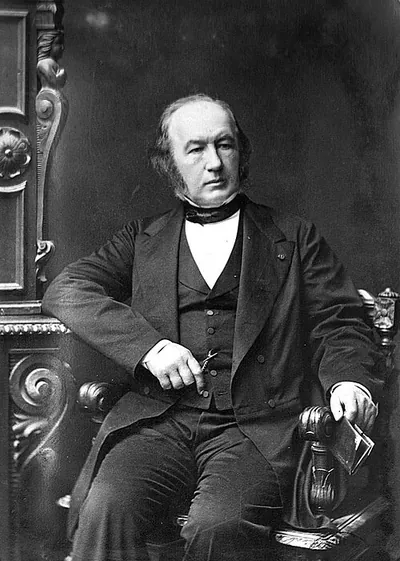 Claude Bernard1813–1878 · Biology
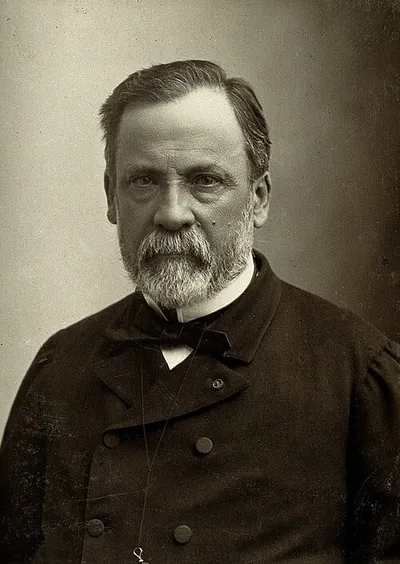 Louis Pasteur1822–1895 · Biology
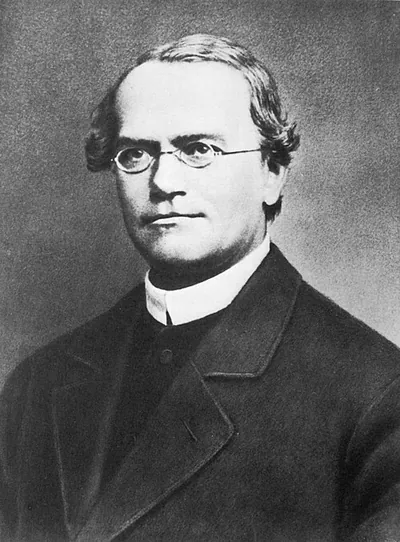 Gregor Mendel1822–1884 · Biology
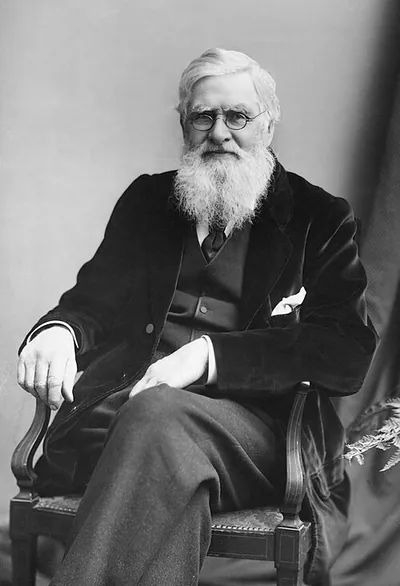 Alfred Russel Wallace1823–1913 · Biology
