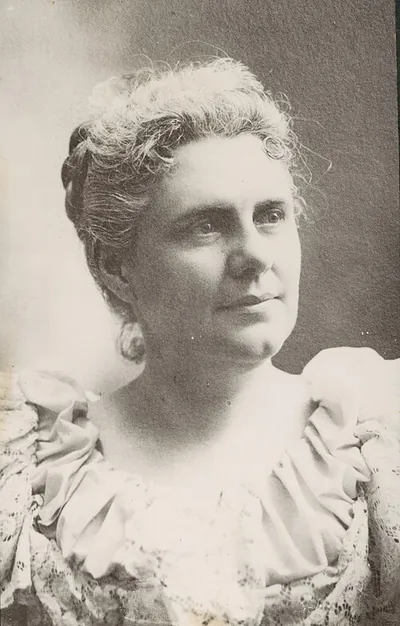
Anna Botsford Comstock
American artist, wood engraver, educator and promoter of nature study · 1854–1930
- Born
- September 1, 1854
- Died
- August 24, 1930
- Country
- United States
- Section
- Biology
Biography
Anna Botsford Comstock (1854-1930) was an American artist, wood engraver, educator and conservationist, and one of the leading figures in the nature study movement in the United States. Her work helped bring the careful observation of plants, birds and insects into schools, and she became the first female professor at Cornell University.
She was born on September 1, 1854, in a log house in Otto, New York, the daughter of Marvin and Phebe Irish Botsford. The family lived off their farm, and her mother, a Quaker, spent long afternoons with her looking at wildflowers, birds and trees. After attending the Chamberlain Institute, a Methodist school in Randolph, she taught for a year in Otto. In 1874 she entered Cornell University in Ithaca, where she had to catch up on some subjects, German among them, and studied both botany and zoology. In 1878 she married John Henry Comstock, a young entomologist on the faculty. Marriage pulled her away from student life, but she returned to her studies and graduated in natural history in 1885.
Her partnership with her husband shaped her career. She drew the insects in his lectures and publications even though she had no formal training in illustration. Her method was simple: she examined each specimen under a microscope and then drew it. While he worked for the United States Department of Agriculture from 1879 to 1881, she prepared the drawings for a report on citrus scale insects. To sharpen her craft she studied wood engraving at the Cooper Union in New York City, which allowed her to illustrate the introduction to entomology he published in 1888. That same year she became one of the first four women admitted to Sigma Xi, an honor society for scientists. Her engravings appeared in more than six hundred plates across several insect books, and her work was shown at international expositions, including the 1893 World's Columbian Exposition in Chicago.
Her best-known contribution was bringing nature study into the classroom. In 1895 she was named to the New York State Committee for the Promotion of Agriculture, where she designed an experimental nature course for public schools. Through Cornell's extension service the program reached schools across the state, and she wrote, lectured, trained teachers and prepared classroom materials. She began teaching nature study at Cornell in 1897, but her academic progress was slow: she was demoted to lecturer after an assistant professorship, and she did not become a full professor until 1920, while two other women had reached that rank in 1911. Her book The Handbook of Nature Study, published in 1911, became a standard teachers' manual, was translated into several languages and is still in print.
Comstock retired from Cornell as professor emerita in 1922 but kept teaching summer courses. In 1923 the League of Women Voters named her, with her colleague Martha Van Rensselaer, among the twelve greatest living American women. She died in Ithaca on August 24, 1930. Her legacy lives on in environmental education and in the habit of looking closely at the natural world. Her memoir, published posthumously in 1953 with significant cuts, was reissued in 2020 in a version closer to her original manuscript.
Main contributions
- 1888Illustrations for John Henry Comstock's introduction to entomology, made with wood engravings after her training at Cooper Union.
- 1895Design of an experimental nature study course for New York's public schools, later extended statewide.
- 1903Ways of the Six-Footed, a book on insect life that she wrote and illustrated.
- 1911The Handbook of Nature Study, a teachers' manual that became a standard textbook and remains in print.
- 1914The Pet Book, a work she wrote and illustrated on keeping pets.
Trivia and anecdotes
A book expected to lose money
Liberty Hyde Bailey and her husband expected The Handbook of Nature Study to lose money, but it became a standard textbook for teachers.
A memoir cut down
Her memoir published in 1953 removed parts of the original manuscript and gave more prominence to John Henry; the 2020 edition restored a closer version of her text.
Their contemporaries
While Anna Botsford Comstock was alive (1854–1930)…
Alive at the same time
Discovered or invented in those years
- 1859EvolutionThe process by which the heritable traits of living populations change over generations, explaining the diversity of life from common ancestors.
- 1869Periodic tableAn arrangement of the chemical elements into rows (periods) and columns (groups), ordered by atomic number, that reveals recurring chemical behaviour and lets scientists predict properties.
- 1876TelephoneA device that carries the human voice over distance by turning sound into electrical signals and back into sound at the other end of the line.
- 1884CarA road vehicle with four wheels and its own engine, mainly built to carry people.
- 1903AirplaneA fixed-wing aircraft, heavier than air, powered by engines or rockets, that stays aloft because its wings generate lift.
- 1925TelevisionA system that sends moving pictures and sound over distance and shows them on a receiver, the television set.
 Santiago Ramón y Cajal1852–1934 · Biology
 Ivan Pavlov1849–1936 · Biology
 Élie Metchnikoff1845–1916 · Biology
 Robert Koch1843–1910 · Biology
 Camillo Golgi1843–1926 · Biology
 Thomas Hunt Morgan1866–1945 · Biology
