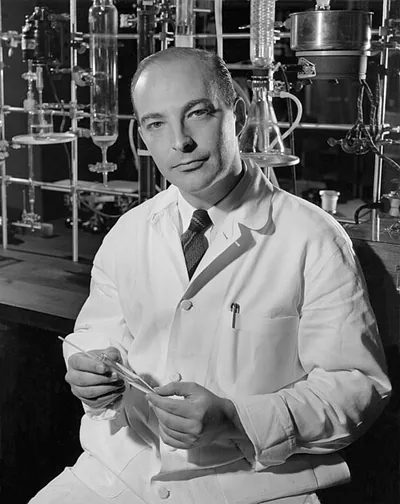
Arthur Kornberg
American biochemist who co-discovered DNA polymerase and shared the 1959 Nobel Prize in Physiology or Medicine · 1918–2007
- Born
- March 3, 1918
- Died
- October 26, 2007
- Country
- United States
- Section
- Biology
- Awards
- Nobel Prize in Physiology or Medicine
Biography
Arthur Kornberg (1918-2007) was an American biochemist whose work helped explain how cells copy their genetic material. In 1959 he shared the Nobel Prize in Physiology or Medicine with the Spanish biochemist Severo Ochoa for studies on the biological synthesis of ribonucleic acid and deoxyribonucleic acid. His most productive years came in the decade after James Watson and Francis Crick had described the double helix structure of DNA, when researchers were searching for the molecular machinery that made the molecule work.
He was born in New York City to Jewish parents who had emigrated from Austrian Galicia, now part of Poland. His father spent almost thirty years as a sewing machine operator in the sweatshops of the Lower East Side before opening a small hardware store in Brooklyn, where young Arthur, at the age of nine, already helped customers. Kornberg studied at the City College of New York, earning a bachelor's degree in 1937, and then trained as a doctor at the University of Rochester, graduating in 1941. While still a medical student he surveyed his classmates to find out how common a mild rise in blood bilirubin was, a trait caused by an inherited condition called Gilbert's syndrome. The results appeared in 1942 in his first research paper.
After completing his internship in Rochester, he served as a ship's doctor in the Caribbean with the United States Coast Guard. Rolla Dyer, director of the National Institutes of Health, noticed the paper and invited him to join the nutrition laboratory there. From 1942 to 1945 his job was to feed rats specialised diets in the search for new vitamins, work he later found dull. What drew him away from it was a fascination with enzymes, the biological catalysts that speed up chemical reactions inside cells. In 1946 he moved to Severo Ochoa's laboratory at New York University, where he learned how to purify enzymes, and he filled gaps in his knowledge of organic and physical chemistry with summer courses at Columbia University.
Back at the NIH, he led the enzyme and metabolism section from 1947. There he studied how cells produce ATP, the molecule that stores energy, using compounds such as NAD and NADP. That work led him to ask how DNA itself is assembled from simpler building blocks. He also spent time in the laboratories of Carl and Gerty Cori at Washington University in St. Louis and of Horace Barker at Berkeley. In 1953 he became professor and head of the microbiology department at Washington University, a post he held until 1959. There he worked with the gut bacterium Escherichia coli, which is easy to grow in the laboratory. In the mid-1950s he isolated the first enzyme able to add nucleotides to an existing DNA strand to build a new one, now known as DNA polymerase I.
The enzyme did more than copy DNA in a test tube: the new material turned out to be biologically active, meaning it carried the complete genetic information. Its exact role inside living cells remains debated, however. Some bacterial strains lacking this activity still copied their DNA, yet they were more vulnerable to damage from ultraviolet light, which suggests that the enzyme works mainly to repair genetic material. In 1957 he also proposed that pyrophosphate, a by-product of metabolism, must be broken down to keep the cell's building reactions moving in one direction. In 1959 he moved to Stanford University as professor and chair of biochemistry, working alongside colleagues including Robert Baldwin, Paul Berg, David Hogness, Dale Kaiser and Robert Lehman. That same year he shared the Nobel Prize with Ochoa.
His personal life was closely tied to science. In 1943 he married Sylvy Ruth Levy, herself a biochemist, who worked side by side with him on the discovery of DNA polymerase. They had three sons; the eldest, Roger David Kornberg, won the Nobel Prize in Chemistry in 2006. Kornberg became the central figure of what is called the Kornberg school of biochemistry, made up of his students, their students and so on. He married twice more after Sylvy's death. Even in his eighties he continued research full-time at Stanford, studying the metabolism of inorganic polyphosphate, and he died in 2007 at Stanford Hospital from respiratory failure. His legacy lies in a set of laboratory methods for studying DNA replication and in a generation of biochemists who carried his approach forward for decades.
Main contributions
- 1956DNA polymerase I: an enzyme that builds a new DNA strand using an existing strand as a template.
- 1957Pyrophosphate proposal: he suggested that this metabolic by-product must be broken down so that the cell's building reactions run in one direction.
- 1959Nobel Prize in Physiology or Medicine, shared with Severo Ochoa, for the biological synthesis of RNA and DNA.
- 1989For the Love of Enzymes: an autobiographical book reviewing his career as a biochemist.
Teachers and students
Studied under:
Taught:
Trivia and anecdotes
A student survey
While studying medicine, he collected data from his classmates on Gilbert's syndrome, and this simple project became his first scientific paper.
A passion born from tragedy
His mother died in 1939 of gas gangrene, caused by a spore infection after a routine gallbladder operation. The loss sparked a lasting interest in spores, which he studied for part of his research in St. Louis.
The family joke about the prize
According to his son Thomas, Sylvy joked that she had been robbed of the Nobel Prize. It was only a joke, but it reflects how much of the work they shared.
Their contemporaries
While Arthur Kornberg was alive (1918–2007)…
Alive at the same time
Discovered or invented in those years
- 1925TelevisionA system that sends moving pictures and sound over distance and shows them on a receiver, the television set.
- 1925Quantum mechanicsPhysical theory describing how matter and light behave at atomic and subatomic scales, where energy is exchanged in minimal packets and results are expressed as probabilities.
- 1931Big BangA cosmological model describing how the universe expanded from an early state of extreme density and temperature, about 13.8 billion years ago.
- 1945ComputerA programmable machine that takes in data, processes it by following stored instructions, and produces results, able to switch tasks simply by running different software.
- 1969InternetA global network of interconnected computer networks that communicate using the TCP/IP protocol suite.
- 1989World Wide WebA system of linked documents and resources, connected by hyperlinks and accessed over the Internet with web browsers.
 Frederick Sanger1918–2013 · Biology
 Francis Crick1916–2004 · Biology
 François Jacob1920–2013 · Biology
 Peter Medawar1915–1987 · Biology
 Norman Borlaug1914–2009 · Biology
 Har Gobind Khorana1922–2011 · Biology
