
Brian David Josephson
British physicist, 1973 Nobel laureate for predicting the Josephson effect · 1940
- Born
- January 4, 1940
- Country
- United Kingdom
- Section
- Physics
- Awards
- Nobel Prize in Physics
Biography
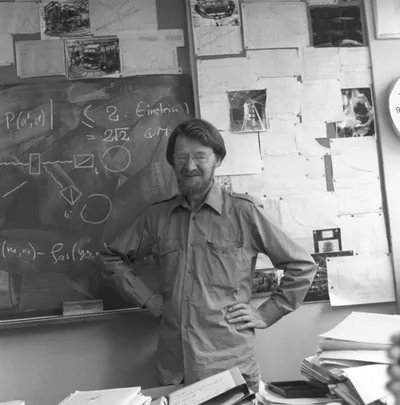
Brian David Josephson (born 4 January 1940 in Cardiff) is a British physicist who won the 1973 Nobel Prize in Physics for his theoretical predictions about the electric current that can pass through a very thin barrier between two superconductors, a phenomenon now known as the Josephson effect. His work belongs to condensed matter physics of the 1960s, when quantum mechanics was beginning to explain how solids and metals behave at extremely low temperatures. His discovery matters because it led to extremely sensitive magnetic field detectors and to a precise way of defining the volt.
Josephson was born to Jewish parents, Mimi Weisbard and Abraham Josephson. At Cardiff High School he was helped by several masters, particularly the physics teacher Emrys Jones, who introduced him to theoretical physics. In 1957 he went up to Trinity College, Cambridge, to read mathematics. After completing Part II of the course in two years, he found the subject somewhat sterile and switched to physics. He was remembered as brilliant but shy. The physicist John Waldram recalled overhearing an examiner from Oxford, Nicholas Kurti, ask who this student was, since he seemed to be going through the theory like a knife through butter. While still an undergraduate Josephson published a paper on the Mössbauer effect, a way in which solids absorb gamma rays, pointing out a crucial issue that other researchers had missed. He graduated in 1960 and became a research student at the Mond Laboratory, on the old Cavendish site, supervised by Brian Pippard.
The discovery came during his doctoral work. Josephson studied quantum tunnelling, a phenomenon in which a particle can pass through a barrier that classical physics says it could never cross. Applied to superconductors, materials that carry electricity without resistance when cooled very far, he proposed that a supercurrent could flow through a very thin insulating layer placed between two superconductors, even with no voltage drop across it. If a voltage did exist, he predicted that the current would oscillate at a frequency related to that voltage, and that a magnetic field would alter the flow. His calculations appeared in Physics Letters, a journal Pippard chose because it was new, under the title «Possible new effects in superconductive tunnelling». The paper was received on 8 June 1962 and published on 1 July. Philip Anderson and John Rowell, at Bell Labs, confirmed the effects experimentally in 1963. The device made of two superconducting layers separated by an insulator is known as a Josephson junction.
The prediction was not accepted at once. John Bardeen, who had already shared the Nobel Prize in Physics in 1956 and would share it again in 1972, objected to the idea and sent a paper to Physical Review Letters in July 1962 arguing that such a superfluid flow could not exist. The disagreement led to a confrontation that September at Queen Mary College in London, during an international conference on low temperature physics. According to accounts, when Bardeen began to speak, Josephson, still a student, stood up and interrupted him, and the two exchanged views in a civil, quiet manner. The effect proved to be one of the most useful phenomena of twentieth-century physics. It underpins SQUIDs, superconducting quantum interference devices that measure very weak magnetic fields and are used in geology, medicine and computing. In 1980 IBM used Josephson's work to build a prototype computer that might run up to a hundred times faster than its own 3033 mainframe.
After his prediction Josephson built an academic career in Cambridge. He became a Fellow of Trinity College in 1962, spent a postdoctoral year as Research Assistant Professor at the University of Illinois in 1965 and 1966, and returned to Cambridge as Assistant Director of Research at the Cavendish in 1967. He was elected a Fellow of the Royal Society in 1970, became Reader in Physics in 1972 and Professor of Physics in 1974, a post he held until his retirement in 2007. In 1973 he received the Nobel Prize, worth 122,000 dollars, which he shared with Leo Esaki of IBM in Yorktown and Ivar Giaever of General Electric. Josephson received half the prize, and the other half was divided equally between his two colleagues. His work did not end with the effect that bears his name, and in later decades he published papers on superconductivity, critical phenomena and field equations in metals.
In the early 1970s Josephson took up Transcendental Meditation and his interests moved toward areas on the margins of mainstream science, such as parapsychology, water memory and cold fusion. He became involved with the Fundamental Fysiks Group, a loose circle of physicists linked to the University of California, Berkeley, who investigated paranormal claims, and in 1978 he co-organised a symposium on consciousness at Cambridge. He later set up the Mind–Matter Unification Project at the Cavendish, which explored links between quantum mechanics and consciousness. His positions have attracted sharp criticism from fellow scientists, including Philip Anderson. Josephson regards much of that criticism as prejudice. In 2004 he argued that an experiment testing a Russian schoolgirl who claimed she could see inside people's bodies had been badly designed. Most researchers did not accept his reasoning. His stance has made him a divisive figure in physics.
Josephson's legacy is twofold. On one side, his prediction is one of the foundations of modern quantum electronics and of the metrology of the volt, and his role is marked by a plaque on the Mond Building in Cambridge, unveiled in 2012 to commemorate the discovery. On the other, his career shows the tension between recognition from the scientific community and a willingness to explore ideas that most of his colleagues consider unfounded. His original calculation remains a clear example of how a theoretical argument, made before any experiment, can open an entire field of research.
Main contributions
- 1962Josephson effect: prediction of a supercurrent with no resistance crossing a very thin insulating layer between two superconductors.
- 1963Experimental confirmation of the prediction by Philip Anderson and John Rowell at Bell Labs.
- 1965«Supercurrents through Barriers», a review published in Advances in Physics on currents passing through barriers.
- 1966«Macroscopic Field Equations for Metals in Equilibrium», a theoretical study of field equations in metals at equilibrium.
- 1973Nobel Prize in Physics, shared with Leo Esaki and Ivar Giaever, with half the prize going to Josephson.
- SQUID magnetometers, devices based on the Josephson effect that measure very weak magnetic fields.
Teachers and students
Trivia and anecdotes
An much-discussed exam
According to physicist John Waldram, an Oxford examiner remarked that Josephson went through the theory like a knife through butter. The story comes from a personal recollection and cannot be fully verified.
A debate in London
In September 1962, at a conference in London, Josephson, still a student, interrupted John Bardeen, already a Nobel laureate, to argue his case. Accounts describe the exchange as polite and quietly spoken.
A plaque in Cambridge
In November 2012 the Cavendish Laboratory unveiled a plaque on the Mond Building dedicated to the discovery, the place where Josephson did the work for his doctorate.
Their contemporaries
While Brian David Josephson was alive (1940–)…
Alive at the same time
Discovered or invented in those years
- 1945ComputerA programmable machine that takes in data, processes it by following stored instructions, and produces results, able to switch tasks simply by running different software.
- 1957Artificial satelliteAn artificial satellite is a human-made object placed in orbit around a celestial body, usually Earth, to collect information, relay signals, or carry out a specific task.
- 1969InternetA global network of interconnected computer networks that communicate using the TCP/IP protocol suite.
- 1971EmailA network service that lets users send and receive digital messages through addressed mailboxes, much like postal mail but electronic.
- 1973Mobile phoneA handheld wireless phone that lets people make and receive calls while moving across a cellular network area.
- 1989World Wide WebA system of linked documents and resources, connected by hyperlinks and accessed over the Internet with web browsers.
 Stephen Hawking1942–2018 · Physics
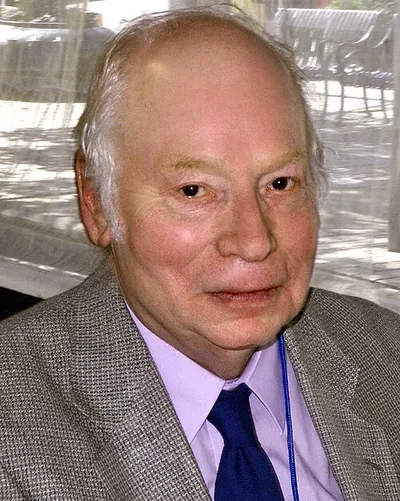 Steven Weinberg1933–2021 · Physics
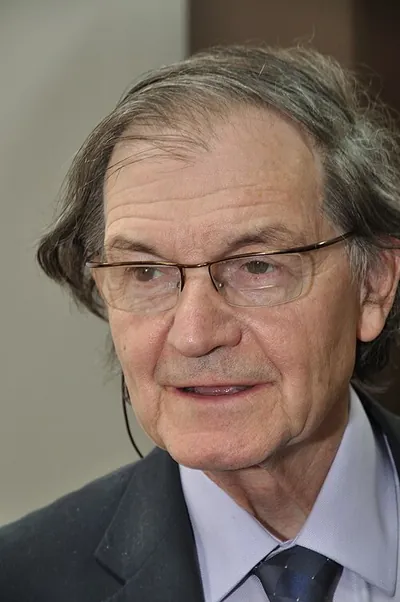 Roger Penrose1931 · Physics
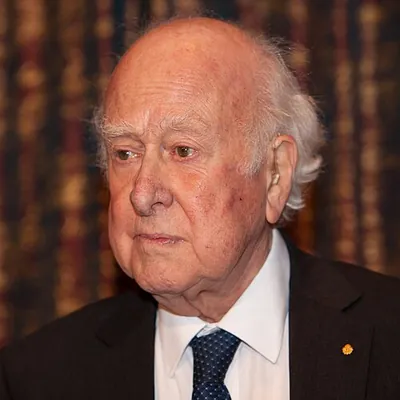 Peter Higgs1929–2024 · Physics
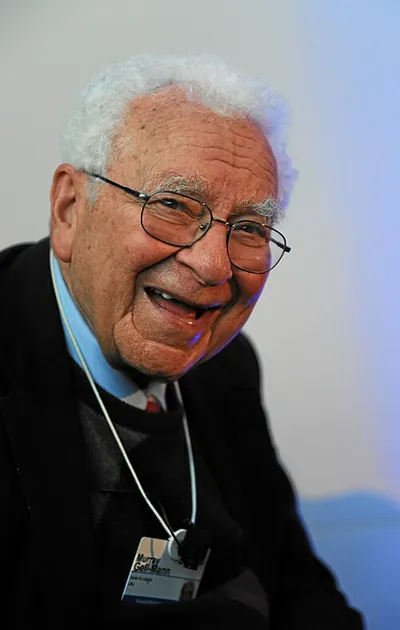 Murray Gell-Mann1929–2019 · Physics
 John Stewart Bell1928–1990 · Physics
