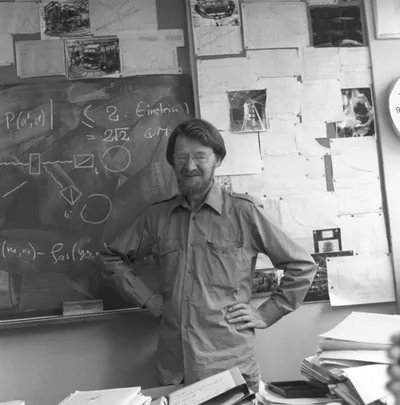
John Stewart Bell
Northern Irish physicist, author of Bell's theorem on local causality in quantum mechanics · 1928–1990
- Born
- July 28, 1928
- Died
- October 1, 1990
- Country
- United Kingdom
- Section
- Physics
Biography
John Stewart Bell (Belfast, 28 July 1928 - Geneva, 1 October 1990) was a physicist from Northern Ireland whose name became attached to one of the deepest debates about quantum mechanics, the theory that describes how atoms and particles behave. He worked mostly on theoretical particle physics and accelerator design, but spent much of his spare time on the foundations of the theory. His theorem, published in 1964, turned a question that had seemed the business of philosophers, whether nature can be explained by purely local causes, into an experimental test that is still being carried out.
Bell was born in Belfast into a working-class family. Money was tight, and neither of his parents nor any of his three older siblings completed secondary school, as they usually left around the age of fourteen to earn a wage. At eleven he decided he wanted to become a scientist, and with his mother's encouragement he finished at Belfast Technical High School at sixteen. It was unusual for someone from his background to go on to university, but he enrolled at Queen's University Belfast, where he took a degree in experimental physics in 1948 and another in mathematical physics a year later. He completed his doctorate in 1956, with a thesis on nuclear physics and quantum field theory, the framework that combines quantum mechanics with relativity to describe particles. In 1954 he married Mary Ross, also a physicist, whom he had met while working on accelerator physics at Malvern. As a teenager he became a vegetarian, and according to his wife he was an atheist.
His career began in 1949 at the UK Atomic Energy Research Establishment near Harwell in Oxfordshire, where he worked on problems linked to particle accelerators. In 1960 he moved to Geneva to join the European Organization for Nuclear Research, CERN. There he worked almost entirely on theoretical particle physics and accelerator design, yet still found time for his great passion, the foundations of quantum theory. He was elected a Fellow of the Royal Society and, in 1987, a Foreign Honorary Member of the American Academy of Arts and Sciences. Alongside colleagues he also translated several volumes of the ten-volume Course of Theoretical Physics by Lev Landau and Evgeny Lifshitz, translations that remain in print.
The foundational questions led him to scrutinise the arguments against hidden variables, the idea that quantum theory could be completed by unobserved quantities that fix the results of measurements. Around 1966 he published a paper examining a proof by John von Neumann that had been widely accepted as ruling out such variables. Bell showed that the proof relied on an assumption quantum mechanics does not satisfy: that the average of a sum of observable quantities equals the sum of their separate averages. Grete Hermann had spotted this flaw in 1935, but it became common knowledge only after Bell rediscovered it. Bell was attracted to David Bohm's pilot wave theory, which gives particles definite positions, and in 1987 he also backed collapse theories inspired by the work of Ghirardi, Rimini and Weber. In 2010 Jeffrey Bub argued that Bell had misread von Neumann, a claim that is still debated.
His best-known work appeared in 1964, after a year's leave from CERN spent at Stanford, the University of Wisconsin-Madison and Brandeis University. In the 1935 paper on the Einstein-Podolsky-Rosen paradox, the authors argued that quantum mechanics was incomplete, because it seemed to imply effects at a distance that looked impossible. Bell carried that reasoning further and derived an inequality: if the outcomes of measurements on two separated particles were fixed in advance by local variables, the correlations between them would have to obey it. Quantum mechanics predicts that they can break it. The question moved into the laboratory, and in 1972 the first experiment that, when extrapolated to ideal detectors, showed such a violation was carried out, with many more to follow. Bell concluded that non-locality seemed deeply rooted in quantum mechanics itself. He regretted that nature did not back Einstein, whom he admired, though he accepted the results. Some researchers still look for loopholes, such as the fair sampling loophole, but most physicists believe the inequality is indeed violated.
Bell also wrote about how special relativity should be taught, particularly the Lorentz-FitzGerald contraction, the idea that moving bodies shorten along their direction of motion. He thought the usual wording invited misunderstanding, and to correct it he popularised a thought experiment known as the spaceship paradox. He died unexpectedly of a cerebral haemorrhage in Geneva in 1990. Unknown to him, he had reportedly been nominated for a Nobel Prize that year. His ashes were placed in the columbarium of the Saint-Georges cemetery in Geneva.
His legacy is twofold. The theorem turned the debate about quantum foundations into an experimental field, and in 2022 the Nobel Prize in Physics was awarded to Alain Aspect, John Clauser and Anton Zeilinger for work on these tests. In 2008 the Centre for Quantum Information and Quantum Control at the University of Toronto created the John Stewart Bell Prize, awarded since 2009 for advances in the foundations of quantum mechanics and their applications. His name also appears on streets, buildings and plaques in Belfast and Geneva, and CERN has a road named after him.
Main contributions
- 1964Bell inequality: a mathematical condition that correlations between measurements must satisfy if outcomes are fixed by local causes.
- 1966Critique of von Neumann's proof against hidden variables, which rested on an assumption invalid for quantum mechanics.
- 1972The first experiment that, extrapolated to ideal detectors, showed the violation of Bell's inequality predicted by quantum theory.
- 1987Support for collapse theories, inspired by the work of Ghirardi, Rimini and Weber, as an alternative to the standard interpretation.
- 1989Writings on the Lorentz-FitzGerald contraction and how to explain it, using the spaceship paradox as a teaching tool.
- English translation of several volumes of Landau and Lifshitz's Course of Theoretical Physics, still in print.
Teachers and students
Trivia and anecdotes
Bertlmann's socks
Bell compared the EPR paradox with the socks of his colleague Reinhold Bertlmann, who always wore mismatched pairs. Bertlmann recalled the comparison in a 2016 text.
A Nobel he never knew about
He was reportedly nominated for the Nobel Prize in 1990, the year of his death, without knowing it.
A road at CERN
On the CERN campus near Geneva there is a road called Route Bell in his honour.
Their contemporaries
While John Stewart Bell was alive (1928–1990)…
Alive at the same time
Discovered or invented in those years
- 1931Big BangA cosmological model describing how the universe expanded from an early state of extreme density and temperature, about 13.8 billion years ago.
- 1932NeutronA subatomic particle with no net electric charge, found in the nucleus of almost every atom alongside protons.
- 1945ComputerA programmable machine that takes in data, processes it by following stored instructions, and produces results, able to switch tasks simply by running different software.
- 1969InternetA global network of interconnected computer networks that communicate using the TCP/IP protocol suite.
- 1973Mobile phoneA handheld wireless phone that lets people make and receive calls while moving across a cellular network area.
- 1989World Wide WebA system of linked documents and resources, connected by hyperlinks and accessed over the Internet with web browsers.
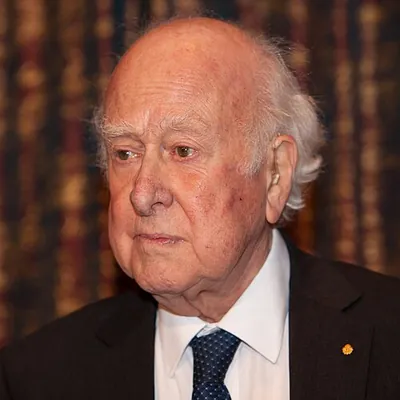 Peter Higgs1929–2024 · Physics
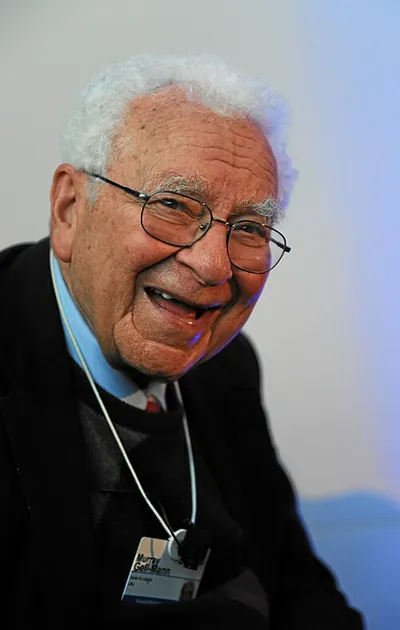 Murray Gell-Mann1929–2019 · Physics
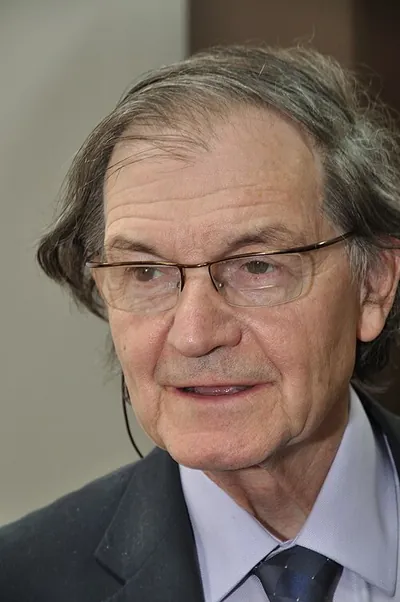 Roger Penrose1931 · Physics
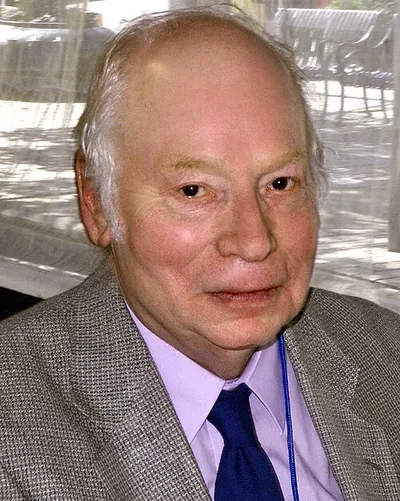 Steven Weinberg1933–2021 · Physics
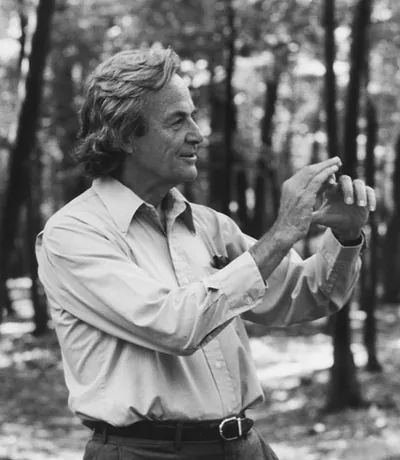 Richard Feynman1918–1988 · Physics
 Stephen Hawking1942–2018 · Physics
