
Carl August von Steinheil
German physicist, astronomer and inventor, a pioneer of telegraphy and photography in Germany · 1801–1870
- Born
- October 12, 1801
- Died
- September 12, 1870
- Country
- Kingdom of Bavaria
- Section
- Technology and communications
Biography
Karl August von Steinheil (1801-1870) was a German physicist, astronomer and inventor born in Alsace. Active in the first half of the nineteenth century, he worked at once on telegraphy, photography and astronomical optics, three fields that were then only beginning to become practical.
He was born in Ribeauvillé. He enrolled to study law at Erlangen in 1821, but soon turned to astronomy, which he studied at Göttingen and Königsberg. He then settled at his father's estate in Perlachseck, near Munich, where he carried on his work in astronomy and physics.
From 1832 to 1849 he taught mathematics and physics at the University of Munich. In 1836 he devised a dot-based code for printing telegraph messages on paper, known as the Steinheil script, which was eventually displaced by the simpler Morse code. In 1838, during tests on the Bavarian railway between Munich and Fürth, he found that the current could be completed through the ground, so no return wire was needed. This earth return greatly simplified telegraph lines.
In 1839 he produced photographs using silver chloride, first a negative and then a positive image. For a long time the method was credited to him alone, but a study published in 2024 argues that the earliest paper negatives were made by Wolfgang Franz von Kobell in 1837, without Steinheil's involvement. He is still regarded as one of the first to use the daguerreotype in Germany, and by late 1839 he had built a portable metal camera, about nineteen times smaller than the one sold by Daguerre.
Between 1842 and 1846 he worked on standardising weights and measures: in Bavaria he improved the scales used for beer and alcohol, and in Naples he installed a new system. In 1849 he joined the Telegraph Board of the Austrian Trade Ministry to design a network covering the whole empire, and in 1850 he helped found the German-Austrian Telegraph Society. The Swiss network followed in 1851.
Back in Munich, in 1854 he founded the firm C. A. Steinheil & Söhne, which made telescopes, spectrographs and photometers, the last of them his own invention and used to measure brightness. Its reflecting telescopes used glass mirrors coated with silver, using a silvering process developed by his friend Justus Liebig. His sons ran the company from 1862.
He died in Munich in September 1870. His telegraph codes were eventually set aside, but his optical work, including the Steinheil doublet lens, remained influential. A lunar crater and an asteroid now bear his name.
Main contributions
- 1836Steinheil script: a dot code for printing telegraph messages on paper, which never caught on.
- 1838Earth return: using the ground as the return path for the current, so a second wire is unnecessary.
- 1839Silver chloride photographic method, producing a negative first and then a positive image.
- 1839Portable metal camera, of which at least ten were made.
- 1854Founding of the astronomical optics firm C. A. Steinheil & Söhne.
- Steinheil doublet: an achromatic glass lens that largely corrects colour distortion.
- Electric clock, one of his inventions, whose exact date is not recorded.
Teachers and students
Trivia and anecdotes
A mineral with a doubtful name
The mineral steinheilite is often linked to him, but the name was already in use in 1811, when he was a child. It most likely honours another Steinheil, Fabian, the Russian military governor of Finland.
Their contemporaries
While Carl August von Steinheil was alive (1801–1870)…
Alive at the same time
Discovered or invented in those years
- 1803AtomThe basic unit of a chemical element: a nucleus of protons and usually neutrons surrounded by a cloud of electrons.
- 1839PhotographyA technique for creating lasting images by recording light, either on a light-sensitive material or with an electronic sensor.
- 1846NeptuneThe eighth and most distant planet of the Solar System, an ice giant found through mathematical prediction before any direct sighting.
- 1859EvolutionThe process by which the heritable traits of living populations change over generations, explaining the diversity of life from common ancestors.
- 1869Periodic tableAn arrangement of the chemical elements into rows (periods) and columns (groups), ordered by atomic number, that reveals recurring chemical behaviour and lets scientists predict properties.
- 1869Deoxyribonucleic acidA double-stranded molecule that carries the genetic instructions of nearly all living things and many viruses.
 William Henry Fox Talbot1800–1877 · Technology and communications
 William Fothergill Cooke1806–1879 · Technology and communications
 Louis Braille1809–1852 · Technology and communications
 Samuel Finley Breese Morse1791–1872 · Technology and communications
 Isaac Singer1811–1875 · Technology and communications
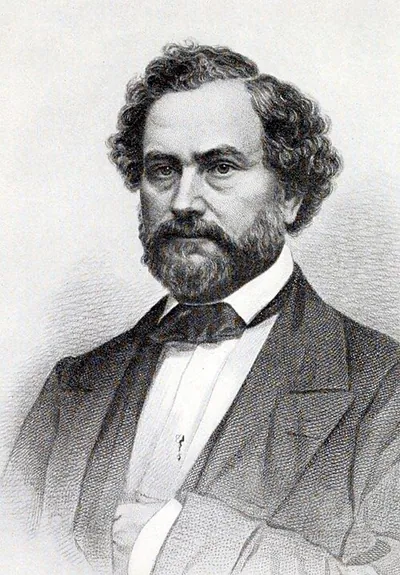 Samuel Colt1814–1862 · Technology and communications
