
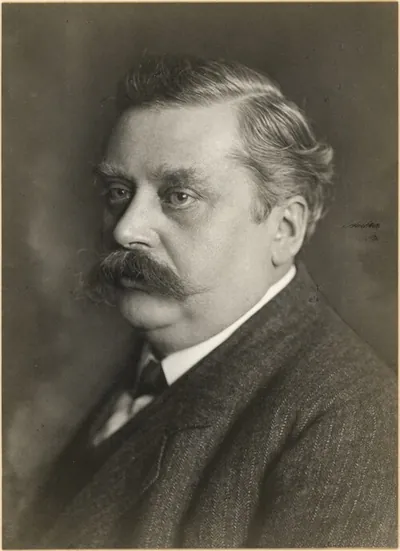
Carl Duisberg
German chemist and industrialist, co-founder of IG Farben · 1861–1935
- Born
- September 29, 1861
- Died
- March 19, 1935
- Country
- Germany
- Section
- Chemistry
Biography
Friedrich Carl Duisberg (Barmen, 1861 – Leverkusen, 1935) was a German chemist, industrialist and one of the driving forces behind IG Farben, the vast chemical conglomerate. He lived at a time when organic chemistry was becoming the foundation of the dye industry and, later, of medicines. His significance lies in bringing laboratory research together with the management of very large chemical companies.
He was born in Barmen, an industrial town in Germany. Between 1879 and 1882 he studied at the universities of Göttingen and Jena, where he earned his doctorate in chemistry. While doing his military service in Munich, he also worked in the laboratory of Adolf von Baeyer, a respected chemist of his day. This combination of academic training and hands-on laboratory work shaped his whole career.
In 1883 he joined Friedr. Bayer & Co., a dye manufacturer that later became Bayer AG. He rose through the ranks, first as a confidential clerk, an authorised signatory who could act on the firm's behalf, and then as head of research. In 1900 he became chief executive of the company. On a tour of the United States he was impressed by Standard Oil, the oil giant that brought many activities under one central direction, and the experience influenced his view of how a German chemical firm should be run. Bayer eventually became part of IG Farben, whose supervisory board Duisberg came to lead.
During the First World War, Germany faced a serious shortage of ammunition. Nitrates, nitrogen salts needed to make gunpowder and explosives, could no longer be imported because of the British naval blockade. German chemical firms, including BASF and Bayer, managed to synthesise them, meaning they produced them in large quantities from other substances. The war also left the country short of workers, and Duisberg advised Max Bauer on ways of dealing with the problem.
His wartime role is also controversial. In November 1916 he advised the Kaiser's forces to deport around 60,000 people from occupied Belgium to work in German mines and factories. Protests from influential neutral countries, above all the United States, brought the plan to an end. That same year, General Wilhelm Groener was given the task of curbing inflation and proposed that rising costs be absorbed by the chemical industry. According to historical accounts, Duisberg lobbied the government successfully for Groener's removal. He is also said to have pushed for the use of chemical weapons during the war, a claim that should be treated with caution.
In the 1920s, Duisberg and Carl Bosch of BASF led the push to merge the dye makers into a single company. In 1925 IG Farben was formed, a conglomerate that soon took in explosives and synthetic fibres as well. It became the largest enterprise in Europe and the fourth largest in the world, behind General Motors, United States Steel and Standard Oil of New Jersey.
One of Duisberg's major achievements was steering Bayer into pharmaceuticals. He backed the work of Gerhard Domagk, whose team developed Prontosil, regarded as the first broadly effective antibacterial drug, meaning one able to fight infections caused by many kinds of bacteria.
His legacy also includes training. The Carl Duisberg Society, founded in 1949, ran education programmes linked to development aid, mainly for people from developing countries. Until it merged in 2002 with the German Foundation for International Development to form InWEnt, around 300,000 people took part in its programmes. Duisberg is remembered as an industrialist who turned chemistry into big business, with real scientific and commercial achievements, but also with episodes that remain hotly debated.
Main contributions
- 1925Founding of IG Farben: the merger of dye makers into a large conglomerate that later included explosives and fibres.
- 1949Creation of the Carl Duisberg Society, devoted to education programmes linked to development aid.
- Industrial synthesis of nitrates: German chemical firms learn to produce nitrates, needed for gunpowder, when the blockade cut off imports.
- Bayer's move into pharmaceuticals: the company expands into medicines, a shift Duisberg drove forward.
- Backing for Prontosil: the first broadly effective antibacterial drug, developed by Gerhard Domagk's team with Duisberg's support.
Teachers and students
Trivia and anecdotes
From the lab to the boardroom
Duisberg started as a research chemist and ended up running the company. A trip to the United States gave him the organisational model he later applied at Bayer.
300,000 people trained
The Carl Duisberg Society hosted around 300,000 people in its programmes before merging in 2002 to form InWEnt.
Their contemporaries
While Carl Duisberg was alive (1861–1935)…
Alive at the same time
Discovered or invented in those years
- 1869Periodic tableAn arrangement of the chemical elements into rows (periods) and columns (groups), ordered by atomic number, that reveals recurring chemical behaviour and lets scientists predict properties.
- 1869Deoxyribonucleic acidA double-stranded molecule that carries the genetic instructions of nearly all living things and many viruses.
- 1876TelephoneA device that carries the human voice over distance by turning sound into electrical signals and back into sound at the other end of the line.
- 1884CarA road vehicle with four wheels and its own engine, mainly built to carry people.
- 1903AirplaneA fixed-wing aircraft, heavier than air, powered by engines or rockets, that stays aloft because its wings generate lift.
- 1925TelevisionA system that sends moving pictures and sound over distance and shows them on a receiver, the television set.
 Svante August Arrhenius1859–1927 · Chemistry
 Walther Hermann Nernst1864–1941 · Chemistry
 Alfred Werner1866–1919 · Chemistry
 Marie Curie1867–1934 · Chemistry
 Fritz Haber1868–1934 · Chemistry
 Wilhelm Ostwald1853–1932 · Chemistry
