
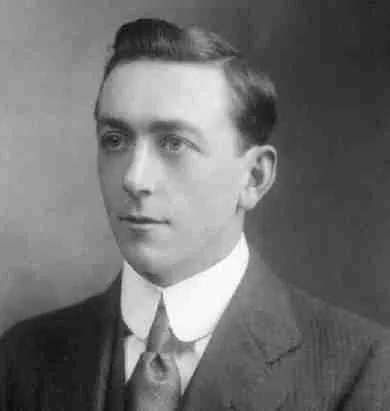
Carl-Gustaf Rossby
Swedish-born American meteorologist who explained large-scale atmospheric motion using fluid mechanics and gave his name to Rossby waves · 1898–1957
- Born
- December 28, 1898
- Died
- August 19, 1957
- Country
- United States, Sweden
- Section
- Earth sciences
Biography
Carl-Gustaf Rossby (Stockholm, 1898 – 1957) was a Swedish-born American meteorologist who, working in the United States, first explained the large-scale motions of the atmosphere as a problem of fluid mechanics. He worked in the first decades of the twentieth century, when meteorology was beginning to rely on mathematics, and he is remembered today above all for the waves that bear his name.
Born in Stockholm, he was the first of five children of Arvid and Alma Charlotta Rossby. He studied at Stockholm University, where he developed a taste for mathematical physics, the use of equations to describe physical phenomena. His direction changed in 1919, when he studied geophysics under Vilhelm Bjerknes in Bergen, Norway. There Bjerknes's group was developing ideas that became known as the Bergen School of Meteorology, including the theory of the polar front, the boundary where cold and warm air masses meet. He continued his training at Leipzig and at the Lindenberg Observatory near Berlin, where the upper atmosphere was studied with kites and balloons.
In 1921 he went back to Stockholm to join the national meteorological and hydrographic office, serving as a meteorologist on several oceanographic expeditions. Between voyages he kept studying mathematical physics and earned his licentiate in 1925. That year a fellowship from the Sweden-America Foundation sent him to Washington to apply the polar front theory to American weather, and he worked at the U.S. Weather Bureau.
In Washington he paired theoretical work on atmospheric turbulence, the irregular swirling of air, with setting up the first weather service for civil aviation. In 1928 he became associate professor in the aeronautics department of the Massachusetts Institute of Technology, and shortly afterwards MIT opened the first meteorology department in the country. In 1931 he also became a research associate at the Woods Hole Oceanographic Institution. His interests covered atmospheric thermodynamics, turbulent mixing and the exchange between oceans and atmosphere.
He became an American citizen in 1939, and that same year was made assistant director of research at the Weather Bureau. In 1940 he took over the meteorology department at the University of Chicago, and it was there that he turned to large-scale atmospheric motions, which span thousands of kilometres. He identified and described the jet stream, fast winds high in the atmosphere at middle latitudes, and gave a mathematical account of the long waves in the westerlies that later became known as Rossby waves. He published key texts on this work in 1942.
During the Second World War he organised the training of many military meteorologists. After the war several of them joined him in Chicago, where he began turning his equations of atmospheric dynamics into numerical models that could run on the first electronic computers. He had already started that work in Sweden, using the BESK machine.
In 1947 he became the founding director of the Swedish Meteorological and Hydrological Institute in Stockholm, dividing his time between that city, Chicago and Woods Hole. After the war he visited his old friend Hans Ertel in Berlin, and their collaboration led to the mathematical formulation of Rossby waves. From 1954 until his death he championed the new field of atmospheric chemistry and considered the role of carbon dioxide in warming the planet. In December 1956 his portrait appeared on the cover of Time magazine, the first meteorologist to receive that honour.
He died in Stockholm in August 1957. His legacy lives on in modern meteorology: the waves named after him, the Rossby number, which compares the inertia of a moving fluid with the influence of Earth's rotation, and the principle that the Coriolis forces linked to that rotation are central to how air circulates.
Main contributions
- 1926The first weather service for civil aviation, set up in Washington during his time at the Weather Bureau.
- 1928The first meteorology department at MIT, which was launched shortly after he joined the institute.
- 1935A study of the frictional layer in wind and ocean currents, showing how friction slows the flow of fluids near a surface.
- 1942A kinematic and hydrostatic description of certain long waves in the westerlies, laying the groundwork for what became known as Rossby waves.
- 1942Rossby waves, large undulations in the high-altitude westerly winds that shape the weather in each region.
- 1947The founding of the Swedish Meteorological and Hydrological Institute, where he served as founding director.
- 1954Championing of atmospheric chemistry, a field he developed until his death.
- The jet stream, fast high-altitude winds at middle latitudes, identified and described during his years in Chicago.
Teachers and students
Studied under:
Taught:
Trivia and anecdotes
A Time cover
In December 1956 he appeared on the cover of Time magazine for his contributions to meteorology. He was the first meteorologist to be featured on the cover of a major magazine.
Waves named later
The waves that now bear his name were given that name later, after their features had been described and recognised by other scientists.
Their contemporaries
While Carl-Gustaf Rossby was alive (1898–1957)…
Alive at the same time
Discovered or invented in those years
- 1903AirplaneA fixed-wing aircraft, heavier than air, powered by engines or rockets, that stays aloft because its wings generate lift.
- 1916Black holeA region of space where gravity is so strong that nothing, not even light, can escape once it crosses a certain boundary.
- 1925TelevisionA system that sends moving pictures and sound over distance and shows them on a receiver, the television set.
- 1925Quantum mechanicsPhysical theory describing how matter and light behave at atomic and subatomic scales, where energy is exchanged in minimal packets and results are expressed as probabilities.
- 1931Big BangA cosmological model describing how the universe expanded from an early state of extreme density and temperature, about 13.8 billion years ago.
- 1945ComputerA programmable machine that takes in data, processes it by following stored instructions, and produces results, able to switch tasks simply by running different software.
 Charles Francis Richter1900–1985 · Earth sciences
 Arthur Holmes1890–1965 · Earth sciences
 Beno Gutenberg1889–1960 · Earth sciences
 Inge Lehmann1888–1993 · Earth sciences
