
Carl Ludwig Willdenow
German botanist, pharmacist and plant taxonomist, one of the founders of phytogeography · 1765–1812
- Born
- August 22, 1765
- Died
- July 10, 1812
- Country
- Kingdom of Prussia
- Section
- Biology
Biography
Carl Ludwig Willdenow (Berlin, 1765 - Berlin, 1812) was a German botanist, pharmacist and plant taxonomist who is considered one of the founders of phytogeography, the study of how plants are spread across the planet. He worked at a time when botany was moving from describing individual species to trying to order them and understand their relationships. His name matters above all because he mentored Alexander von Humboldt, one of the earliest and best-known phytogeographers.
He was born in Berlin into a family of pharmacists. His father, Johann Carl, owned the Zum Rothen Adler pharmacy on Unter den Linden, and his mother, Dorothea Louise Budde, was the daughter of the royal physician August Budde. After attending a Latin school and the Werder Gymnasium, he trained as an apprentice in his father's pharmacy. His interest in plants was sparked by his uncle J. G. Gleditsch, and as a teenager he had already started a herbarium, a collection of pressed and labelled plants. He sometimes joined Kurt Sprengel on excursions, and he took chemistry lessons from Martin Heinrich Klaproth.
He studied pharmacy at Wieglieb College in Langensalza and, from 1785, medicine at the University of Halle. In 1789 he earned his doctorate with a dissertation on medicinal plants, supervised by Philipp Friedrich Theodor Meckel. He went back to Berlin to run the family pharmacy after his father's death, and kept it going until 1793. In 1790 he married Henriette Luise Habermus. Working behind the pharmacy counter gave him a hands-on knowledge of plants that he later brought to his classification work.
His publications were wide-ranging. The Florae Berolinensis prodromus appeared in 1787, followed by the Historia Amaranthorum, the Phytographia and the Grundriß der Kräuterkunde in 1792. In that last book he offered an explanation for why some plants grow only in restricted areas. In his view, certain species had started on mountain peaks surrounded by sea and spread downward as the water receded. It was a theory grounded in the Earth's past, and he linked it to the biblical idea of floods. It ran against the view of Eberhard August Wilhelm von Zimmermann, who held that plants were distributed as they always had been and that little had changed. His most ambitious project was the six-volume edition of Linnaei species plantarum, issued between 1798 and 1826, which updated Linnaeus's work. He also wrote a self-study botany textbook in 1804 and the Berlinische Baumzucht in 1796, a work on trees that helped establish dendrology, the study of trees.
He joined the Berlin Academy of Sciences in 1794. In 1801 he became a professor of botany at the newly founded University of Berlin and took charge of the royal botanical garden, which was then in the Kleistpark. In 1807 Humboldt helped to enlarge it. There Willdenow studied many South American plants that Humboldt had brought back from his travels. He was interested in how plants adapt to their climate, and he showed that the same climate tended to produce plants with shared traits. In 1810 he travelled to Paris, but poor health forced him back in 1811.
His herbarium, with more than 20,000 specimens, is still kept at the Berlin Botanical Garden, and a few are in St. Petersburg. Humboldt recalled that as a young man he could not identify plants using Willdenow's Flora Berolinensis, published between 1803 and 1812 with hand-coloured copper engravings. Willdenow died in Berlin in 1812, and the botanists Ernst Ludwig Heim and Diederich Friedrich Carl von Schlechtendal were at his bedside. Johann Christoph Andreas Mayer succeeded him at the garden. His legacy lives on in the genus Willdenowia, named after him, and in streets in Berlin that bear his name.
Main contributions
- 1787Florae Berolinensis prodromus: a preliminary catalogue of the plants of the Berlin flora.
- 1792Grundriß der Kräuterkunde: a work proposing that the restricted distribution of some plants was shaped by the past history of seas and mountains.
- 1796Berlinische Baumzucht: a treatise on trees that helped found dendrology, the study of trees.
- 1798Linnaei species plantarum: a six-volume edition, completed in 1826, that updated Linnaeus's plant classification.
- 1804Anleitung zum Selbststudium der Botanik: a manual for learning botany on one's own.
Teachers and students
Trivia and anecdotes
A famous pupil
Humboldt often visited him without an appointment and regarded him as a kindred spirit, only four years his senior. Within weeks he had become an enthusiastic botanist.
A tombstone that moved
His gravestone was moved in 1965 to the botanical garden in Berlin-Dahlem, after the churchyard where it stood was levelled.
Their contemporaries
While Carl Ludwig Willdenow was alive (1765–1812)…
Alive at the same time
Discovered or invented in those years
- 1766HydrogenThe lightest and most abundant chemical element in the universe, atomic number 1, which under normal conditions is a colourless, odourless and highly flammable gas.
- 1772NitrogenChemical element with atomic number 7, a colourless, odourless gas that makes up about 78% of Earth's air and is an essential part of proteins and nucleic acids.
- 1774OxygenA colorless, odorless gas, symbol O and atomic number 8, that forms the dioxygen in air and is essential for respiration in most living things.
- 1781UranusThe seventh planet from the Sun, an ice giant discovered by William Herschel in 1781, the first planet found with a telescope.
- 1803AtomThe basic unit of a chemical element: a nucleus of protons and usually neutrons surrounded by a cloud of electrons.
- 1811MoleculeAn electrically neutral group of at least two atoms held together by chemical bonds in a defined arrangement.
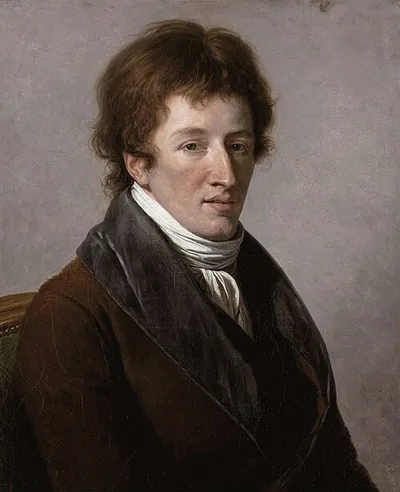 Georges Cuvier1769–1832 · Biology
 Edward Jenner1749–1823 · Biology
 Jean-Baptiste de Lamarck1744–1829 · Biology
 Charles Darwin1809–1882 · Biology
 Theodor Schwann1810–1882 · Biology
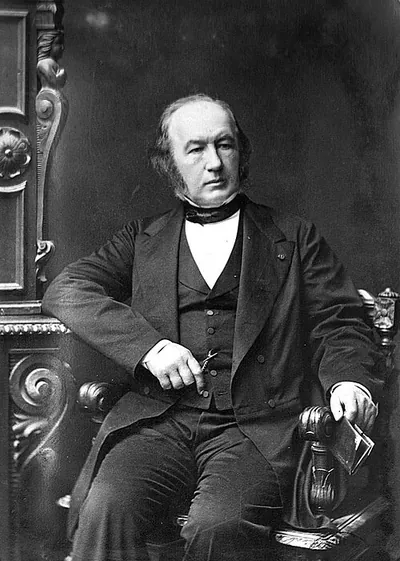 Claude Bernard1813–1878 · Biology
