
Carl Zeiss
German optician and industrialist, founder of the Carl Zeiss company · 1816–1888
- Born
- September 11, 1816
- Died
- December 3, 1888
- Country
- Duchy of Saxe-Weimar-Eisenach
- Section
- Physics
Biography
Carl Zeiss (Weimar, 11 September 1816 – Jena, 3 December 1888) was a German optician and businessman whose name still identifies one of the best-known makers of optical instruments in the world. He lived in a period when microscopes were being refined and the camera was beginning to spread. His lasting importance lies in joining the hands-on skill of the precision mechanic with theoretical calculation, so that lenses could be designed on paper and then reproduced reliably.
Zeiss came from a family of craftsmen. His father, Johann Gottfried August Zeiss, turned mother-of-pearl, amber and ivory into luxury objects for wealthy customers, and he had close ties to the court of the grand duchy of Saxe-Weimar-Eisenach. His mother came from a family of lawyers. Carl was the fifth of the children who survived to adulthood. His brothers were sent to the Gymnasium and went on into teaching, but Carl suffered from an inguinal hernia that required a truss, and the desk-bound life of a scholar seemed a poor fit. He left school early, attended technical lectures in Weimar, and chose to train as a master machinist.
In 1834 he moved to Jena to apprentice with Friedrich Körner, a court mechanic who also taught at the university. Körner had a good reputation and had built and repaired instruments for Goethe. For four years Zeiss combined workshop practice with university courses in mathematics and the sciences, which gave him a theoretical grounding unusual for a craftsman. He finished his apprenticeship in 1838 and set out on the journeyman years customary in his trade. Between 1838 and 1845 he worked in Stuttgart, Darmstadt, Vienna and Berlin. In Darmstadt he came into contact with the instrument maker Hektor Rössler; in Vienna, the centre of heavy machinery in central Europe, he worked for the firm Rollé und Schwilqué and attended popular lectures on mechanics at the Polytechnic Institute. Few details survive of these years, but they gave him a broad knowledge of steam and precision engineering.
He returned to Jena in 1845 intending to set up on his own. To live there he had to enrol at the university, which he did that November. The permission to open a workshop was slow to arrive because of the bureaucracy in Weimar. After a written examination and payment of fees, he opened his workshop on 17 November 1846 with an initial capital of 100 thalers, borrowed from his brother Eduard. At first he worked alone, repairing instruments and making magnifying lenses, and he sold spectacles, thermometers and barometers in shops. In 1847 he began making simple microscopes, which sold well because they were cheaper and better than those of rivals. One improvement was focusing by moving the optical tube with a rack, rather than moving the stage as many competitors did. That same year he took on his first apprentice, August Löber, aged seventeen, who would become one of the most important figures in the workshop.
The business grew with the help of Matthias Jacob Schleiden, a botanist who had encouraged Zeiss's interest in optics and argued that cell biology needed high-quality microscopes. On his advice the workshop refined its simple microscopes and had them tested by specialists such as the botanist Leopold Dippel. The simple microscope, however, had a clear limit: higher magnification required compound microscopes, built from several lenses working together. Until then, objectives were made by trial and error, combining lenses, altering their spacing and adjusting each piece until the result was acceptable, without any reliable way to repeat it exactly. Zeiss regarded himself as a mechanic rather than an optician and wanted to replace this practice with calculation. He studied the theory on his own and worked with the mathematician Friedrich Wilhelm Barfuss, although that partnership did not solve the problem.
In 1866 Zeiss turned to the physicist Ernst Abbe, a university lecturer in Jena, who was 26 to Zeiss's 50. Abbe supplied the missing method: a mathematical way to calculate each lens of an objective from the properties of its glass, its curvature and the distances between its elements. For the calculations to work, each lens also had to be measured precisely, and for this they used Newton's rings, a pattern of interference fringes that shows tiny differences in curvature. Fraunhofer had used the same technique long before, but his workshop had kept it secret. Resistance from some workers, Löber among them, to changing established methods slowed the project, which was not complete until 1872. By then the firm offered a series of calculated objectives, including three water-immersion objectives that matched those of its competitors. Prices for the best microscopes rose sharply, and orders continued to grow.
Their partnership was not always easy. In 1875 Zeiss made Abbe a partner and gave him a share of the firm, but the optical calculations were treated as company property and were not published, which Abbe had intended to do. Zeiss ran the business in a paternalistic way: strict working hours, good wages for the time, and welfare measures such as a clinic for employees, founded in 1875, that anticipated in part Bismarck's social insurance laws of 1883. After Zeiss died in 1888 the firm passed to Abbe, and later the chemist Otto Schott joined, bringing special glass research that widened the firm's optical possibilities.
Zeiss's legacy is the company that bears his name, today Carl Zeiss AG, which remains a leading maker of microscope lenses, measuring instruments and cameras. His greatest contribution was a change of method: moving from trial and error to theoretical calculation and to organised, step-by-step production, which transformed the European optical industry.
Main contributions
- 1846Opening of his workshop in Jena, the origin of the company that bears his name.
- 1847First simple microscopes made in series, focused by a rack instead of moving the stage.
- 1866Start of the collaboration with Ernst Abbe to calculate optical objectives mathematically instead of fitting them by trial and error.
- 1872A series of objectives calculated by Abbe, including three water-immersion lenses that matched the best competitors.
- 1875Founding of a clinic for employees and Abbe's admission as a partner in the firm.
Trivia and anecdotes
A workshop with strict rules
Accounts of his workshop say Zeiss personally destroyed microscopes that failed to meet his standards of precision.
An older spelling of the name
Before 1885 the family name was spelled Zeiß, with the letter eszett.
Their contemporaries
While Carl Zeiss was alive (1816–1888)…
Alive at the same time
Discovered or invented in those years
- 1846NeptuneThe eighth and most distant planet of the Solar System, an ice giant found through mathematical prediction before any direct sighting.
- 1859EvolutionThe process by which the heritable traits of living populations change over generations, explaining the diversity of life from common ancestors.
- 1869Periodic tableAn arrangement of the chemical elements into rows (periods) and columns (groups), ordered by atomic number, that reveals recurring chemical behaviour and lets scientists predict properties.
- 1869Deoxyribonucleic acidA double-stranded molecule that carries the genetic instructions of nearly all living things and many viruses.
- 1876TelephoneA device that carries the human voice over distance by turning sound into electrical signals and back into sound at the other end of the line.
- 1884CarA road vehicle with four wheels and its own engine, mainly built to carry people.
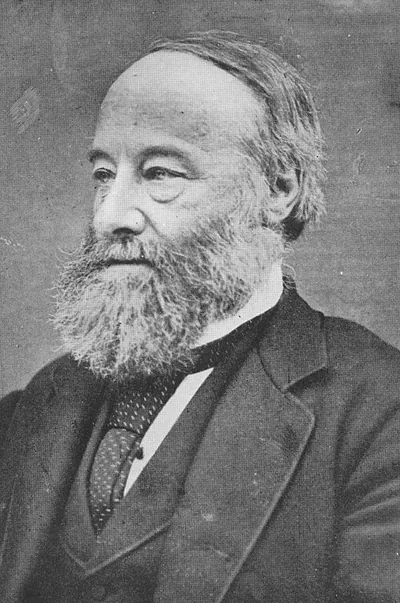 James Prescott Joule1818–1889 · Physics
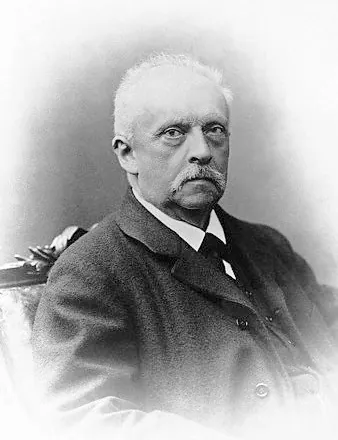 Hermann von Helmholtz1821–1894 · Physics
 Gustav Kirchhoff1824–1887 · Physics
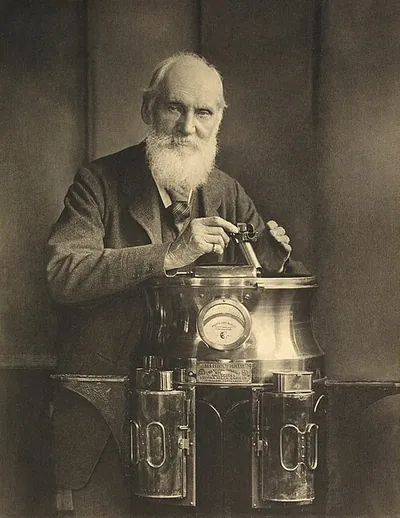 William Thomson, 1st Baron Kelvin1825–1907 · Physics
 James Clerk Maxwell1831–1879 · Physics
 Johannes Diderik van der Waals1837–1923 · Physics
