
Catherine Wolfe Bruce
American philanthropist and patron of astronomy · 1816–1900
- Born
- January 22, 1816
- Died
- March 13, 1900
- Country
- United States
- Section
- Astronomy and space
Biography
Catherine Wolfe Bruce (New York, 1816 – 1900) was an American philanthropist who devoted a large part of her fortune to astronomy in the second half of the nineteenth century. She never worked as a professional researcher, but her money paid for telescopes and supported observatories in several countries, and her name is now attached to one of the field's most respected honors.
She was born on January 22, 1816, in New York. Her father, George Bruce, was a type founder born in Edinburgh, and her mother, Catherine Wolfe, came from a well-off New York family. She was one of five children. Her brother David Wolfe Bruce, together with David Wolfe Bishop, inherited the fortune of their cousin Catharine Lorillard Wolfe. Bruce studied painting and learned Latin, German, French and Italian, reading fluently in the literature of those languages. In 1890 she published a translation of the Dies irae, the famous Latin hymn on the Last Judgment.
Her link to astronomy came late. At around the age of 72 she read an article by Simon Newcomb, who argued that most of the major discoveries in the field had already been made. Bruce answered him with a protest. In her view, astronomy was only beginning, and photography, spectroscopy (the study of light split into colours to learn what stars are made of) and chemistry still had much to offer. To turn opinion into action, she sought advice from the telescope maker Alvan Graham Clark about how she could help.
Between 1889 and 1899 she made 54 gifts to astronomical projects, totalling more than 275,000 dollars. She funded new telescopes at the Harvard College Observatory, the Yerkes Observatory and the Heidelberg-Königstuhl observatory, then run by Max Wolf. Her philanthropy had started earlier. In 1877 she gave 50,000 dollars, in memory of her father, for a free lending library in Manhattan, which was completed in 1888. When that building was sold in 1913, the proceeds helped build the George Bruce Library in Harlem.
In 1898, together with the Astronomical Society of the Pacific, she set up the Bruce Medal. It was first meant for the year's most important work, but she asked for a broader scope, since some years would bring no outstanding achievement, and she wanted the medal to be international. Over time it became a recognition of a whole career.
A worsening illness confined her to her home on Fifth Avenue, at number 810, where she died on March 13, 1900, aged 84. Her legacy lives on in the medal that bears her name, in asteroid 323 Brucia and in the lunar crater Bruce.
Main contributions
- 1877Donation of 50,000 dollars for a free lending library in memory of her father.
- 1888Completion of the George Bruce Library in Manhattan, which later led to the Harlem library.
- 1889Start of her 54 gifts to astronomy, up to 1899, to buy telescopes for several observatories.
- 1890Translation and publication of the Dies irae, the Latin hymn on the Last Judgment.
- 1898Creation of the Bruce Medal, with the Astronomical Society of the Pacific, to honor achievement in astrophysics.
Trivia and anecdotes
A reply to Newcomb
After reading that astronomy was nearly complete, Bruce answered that the world was young and the work had only begun.
A name in the sky
Asteroid 323 Brucia, discovered by Max Wolf, and the lunar crater Bruce keep her memory alive.
An asteroid with her mark
Astronomer Johann Palisa gave her the honor of naming asteroid 313 Chaldaea, as a token of the astronomers' gratitude.
Their contemporaries
While Catherine Wolfe Bruce was alive (1816–1900)…
Alive at the same time
Discovered or invented in those years
- 1846NeptuneThe eighth and most distant planet of the Solar System, an ice giant found through mathematical prediction before any direct sighting.
- 1859EvolutionThe process by which the heritable traits of living populations change over generations, explaining the diversity of life from common ancestors.
- 1869Periodic tableAn arrangement of the chemical elements into rows (periods) and columns (groups), ordered by atomic number, that reveals recurring chemical behaviour and lets scientists predict properties.
- 1869Deoxyribonucleic acidA double-stranded molecule that carries the genetic instructions of nearly all living things and many viruses.
- 1876TelephoneA device that carries the human voice over distance by turning sound into electrical signals and back into sound at the other end of the line.
- 1884CarA road vehicle with four wheels and its own engine, mainly built to carry people.
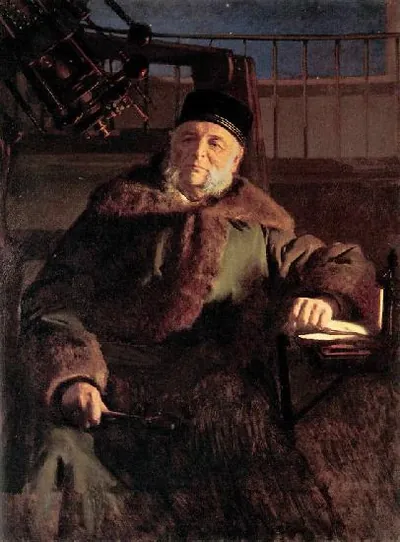 Otto Wilhelm von Struve1819–1905 · Astronomy and space
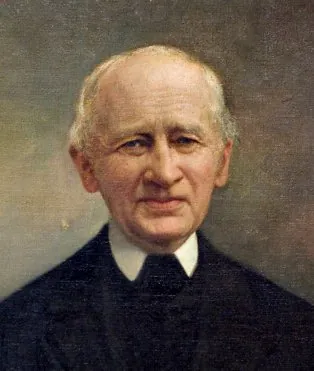 Johann Gottfried Galle1812–1910 · Astronomy and space
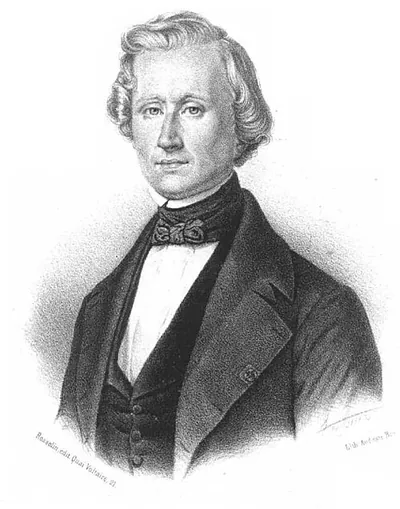 Urbain Le Verrier1811–1877 · Astronomy and space
 John Frederick William Herschel1792–1871 · Astronomy and space
 Annie Jump Cannon1863–1941 · Astronomy and space
 Henrietta Swan Leavitt1868–1921 · Astronomy and space
