
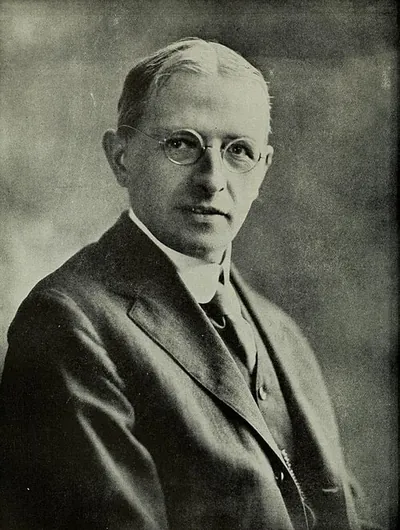
Henrietta Swan Leavitt
American astronomer who discovered the period-luminosity relationship of Cepheid variable stars · 1868–1921
- Born
- July 4, 1868
- Died
- December 12, 1921
- Country
- United States
- Section
- Astronomy and space
Biography
Henrietta Swan Leavitt (July 4, 1868 – December 12, 1921) was an American astronomer whose work on variable stars gave astronomers a reliable way to measure the distance to faraway galaxies. She worked in an era when photography was beginning to be used to survey the sky systematically, and her finding remains one of the foundations of our understanding of the scale of the universe.
She was born in Lancaster, Massachusetts, the daughter of Congregational minister George Roswell Leavitt and Henrietta Swan Kendrick. Her family descended from an English Puritan tailor who settled in the Massachusetts Bay Colony in the seventeenth century. Leavitt studied for two years at Oberlin College before transferring to Harvard's Society for the Collegiate Instruction of Women, later known as Radcliffe College, where she graduated in 1892. Her education covered classical Greek, fine arts, philosophy, analytic geometry and calculus. In her last year she took an astronomy course and earned a high mark. She then began volunteering at the Harvard College Observatory, where a group of women known as the Harvard computers carried out work that looked mechanical: examining photographic plates, measuring the brightness of stars and performing long, repetitive calculations. In 1902 the observatory's director, Edward Charles Pickering, hired her to catalog the brightness of stars recorded on the plate collection. At that time women at the observatory were not allowed to operate telescopes. Their job was to check the data others had collected.
This work was poorly valued. Results were usually published under the names of the observatory's leaders, and Pickering and later Edwin Hubble received much of the public credit. Even so, Leavitt earned a strong reputation among her colleagues, and the astronomer Margaret Harwood called her the best mind in the observatory. She also faced a personal obstacle. She suffered from an illness that caused a gradual loss of hearing. Accounts differ on when it began: some place it around the age of seventeen, others after her trips to Europe and a short spell as an art assistant at Beloit College. Over the years her deafness grew more severe. She never completed the graduate degree in astronomy she had begun, partly because of chronic illness and family duties that repeatedly interrupted her work.
Her breakthrough came while studying plates of the Small Magellanic Cloud, a small galaxy that orbits our own and can be seen from the southern hemisphere. The plates had been taken with a telescope in Arequipa, Peru. Leavitt identified 1,777 variable stars in them, meaning stars whose brightness changes over time. One group, the Cepheids, pulses with a steady rhythm, brightening and fading in cycles of fixed length. Leavitt noticed that the longer the cycle of each star, the brighter it was. She published early results in 1908 in the observatory's annals. In 1912 she presented a more detailed paper on twenty-five Cepheids in that cloud. It was a short document signed by Pickering, although its first sentence said it had been prepared by Miss Leavitt. The key idea was simple. Intrinsic luminosity is how much light a star really emits, while apparent brightness is how bright it looks from Earth, which also depends on distance. Since the stars in the cloud were probably all at about the same distance from us, differences in their apparent brightness reflected real differences in luminosity.
One piece was still missing: the actual distance to the cloud, which nobody knew. A year later the Danish astronomer Ejnar Hertzsprung measured the distance to several nearby Cepheids in our own galaxy using parallax, the tiny shift in a star's position when seen from opposite sides of Earth's orbit. With that calibration, the period-luminosity relationship could be used as a yardstick. Knowing a Cepheid's period gave its true brightness, and comparing that with how bright it appeared revealed how far away it was. Because the method relies on a light source of known brightness, astronomers called such objects standard candles. The relationship is now known as Leavitt's law. Before it, the techniques available could measure distances only out to a few hundred light-years.
The method was then applied to far more distant objects. Between 1923 and 1924 Edwin Hubble identified Cepheids in the Andromeda nebula and, using Leavitt's law, calculated that it lay far too far away to be part of the Milky Way. It was a separate galaxy. This settled the so-called Great Debate about the size of the universe, in which Harlow Shapley had argued for a Milky Way much larger than we now accept. Hubble later combined the same data with the redshift of galaxies to show that the universe is expanding. Leavitt did not live to see these conclusions. Hubble often said she deserved the Nobel Prize for her work. The Swedish mathematician Gösta Mittag-Leffler tried to nominate her, but only then learned that she had died. The Nobel Prize is not awarded after death. Sources differ on whether his attempt took place in 1924 or 1925.
Leavitt also contributed in other ways. In 1913 the International Committee of Photographic Magnitudes accepted the Harvard photographic scale, a logarithmic system for ranking stars by brightness that she built from hundreds of plates taken with thirteen telescopes. That same year she discovered T Pyxidis, a recurrent nova in the constellation Pyxis, which has erupted several times since. In 1921, when Shapley became director, she was placed in charge of stellar photometry, the measurement of starlight. Her official title throughout her life remained assistant, and she never asked to be called anything else.
Her life was shaped by illness. She died of cancer on December 12, 1921, at the age of fifty-three, in Cambridge. Her colleagues saw her early death as a loss that went beyond her scientific achievements. Solon I. Bailey wrote in his obituary that she had a rare gift for appreciating all that was worthy and lovable in others. Shortly before her death she left a will leaving her few possessions to her mother. The inventory, a short list, included a bookcase and books, a table, a bed, two mattresses and some bonds, totaling about 345 dollars. She was buried in the Leavitt family plot in Cambridge Cemetery. Her grave bears no inscription recalling her discoveries.
Her legacy is wide. Cepheids allow astronomers to measure distances of up to about 60 million light-years, and other methods have been built on them for even greater distances. Two objects bear her name: the Moon's Leavitt crater and asteroid 5383 Leavitt. One of the ASAS-SN telescopes, at the McDonald Observatory in Texas, is also named after her. Her story has since reached theatre, children's books and documentaries, which has helped her become better known beyond astronomy. According to the sources, about one in ten of the variable stars known today was first studied by her. Her work, largely done from a subordinate position and with little recognition, changed how humanity measures the universe.
Main contributions
- 1908Publication of her first results on variable stars in the Magellanic Clouds, where she noted that brighter variables had longer periods.
- 1912Period-luminosity relationship of Cepheids: the longer a Cepheid's pulsation cycle, the more luminous it is, which lets astronomers use it as a yardstick for distance.
- 1913Harvard photographic scale, a logarithmic system for ranking stars by brightness, accepted by the International Committee of Photographic Magnitudes.
- 1913Discovery of T Pyxidis, a recurrent nova in the constellation Pyxis that has erupted several times over more than a century.
Trivia and anecdotes
Work without her name
Her first results were signed by Pickering, although the text said she had prepared them. Throughout her life her official title was assistant.
A Nobel that could not be
Hubble said she deserved the Nobel Prize, but the prize is not awarded posthumously, so she was never formally nominated.
A modest will
She left her mother a bookcase, a table, a bed and some bonds, worth about 345 dollars in total.
Related discoveries and inventions
- 1912Period-luminosity relationA relationship linking the true brightness of certain pulsating variable stars to the time they take to complete one cycle of brightness change; in classical Cepheids, the longer the period, the brighter the star.
Their contemporaries
While Henrietta Swan Leavitt was alive (1868–1921)…
Alive at the same time
Discovered or invented in those years
- 1869Periodic tableAn arrangement of the chemical elements into rows (periods) and columns (groups), ordered by atomic number, that reveals recurring chemical behaviour and lets scientists predict properties.
- 1869Deoxyribonucleic acidA double-stranded molecule that carries the genetic instructions of nearly all living things and many viruses.
- 1876TelephoneA device that carries the human voice over distance by turning sound into electrical signals and back into sound at the other end of the line.
- 1884CarA road vehicle with four wheels and its own engine, mainly built to carry people.
- 1897ElectronA negatively charged subatomic particle found in every atom, and key to electricity and chemical bonding.
- 1903AirplaneA fixed-wing aircraft, heavier than air, powered by engines or rockets, that stays aloft because its wings generate lift.
 Annie Jump Cannon1863–1941 · Astronomy and space
 Karl Schwarzschild1873–1916 · Astronomy and space
 Ejnar Hertzsprung1873–1967 · Astronomy and space
 Henry Norris Russell1877–1957 · Astronomy and space
 Milutin Milanković1879–1958 · Astronomy and space
 Arthur Eddington1882–1944 · Astronomy and space
