
Cees Dekker
Dutch physicist, pioneer of carbon nanotube nanotechnology and single-molecule biophysics · 1959
- Born
- April 7, 1959
- Country
- Kingdom of the Netherlands
- Section
- Physics
Biography
Cornelis "Cees" Dekker is a Dutch physicist, born in Haren, Groningen, on 7 April 1959, and Distinguished University Professor at Delft University of Technology. His work sits at the border between physics, nanotechnology and biology, and he is best known for his research on carbon nanotubes, the biophysics of single molecules and nanobiology. His career shows how tools developed for studying materials can end up being used to understand living systems.
Dekker studied at the University of Utrecht, where he earned his PhD in experimental physics in 1988. That same year he began his academic career there as an assistant professor. During these years he also spent time in the United States as a visiting researcher at IBM Research, and it was in this period that he studied magnetic spin systems and electrical noise in superconductors and semiconductors, the random fluctuations in current that appear in such materials.
In 1993 he became an associate professor at Delft University of Technology, and the same year he launched a new research line: measuring how electric current passes through individual organic molecules placed between two nanoelectrodes. In the mid-1990s his team made the breakthrough that made him known. In 1996, working with the group of Nobel laureate Richard Smalley, they used scanning tunnelling microscopy and nanolithography, techniques for imaging and patterning at atomic scales, to show that carbon nanotubes behave as quantum wires at the single-molecule level, with remarkable physical properties. Many new phenomena followed, and in 1998 his group became the first to build a transistor based on a single nanotube molecule, an early step towards molecular electronics.
His academic rise was steady. In 1999 he received the Antoni van Leeuwenhoek Professorship, a chair intended for outstanding young scientists, and in 2000 he became a full professor of molecular biophysics at Delft's Faculty of Applied Sciences. He was named Distinguished University Professor in 2007, and from 2010 to 2012 he was the first chair of the university's new Department of Bionanoscience. Between 2010 and 2018 he directed the Kavli Institute of Nanoscience at Delft, and from 2015 to 2020 he was a Royal Academy Professor at the Royal Netherlands Academy of Arts and Sciences.
From 2000 he shifted much of his work towards biophysics, studying single biomolecules and cells with nanotechnology tools. He has said that he was drawn both by the remarkable workings of biological molecular structures and by the prospect of important discoveries over the long term. His current lines include nanopores for sequencing DNA and proteins, the biophysics of chromatin maintenance, which concerns how DNA is packed and kept in order inside the cell nucleus, and bottom-up biology, which aims at building synthetic cells.
Dekker has published more than 400 papers, among them more than 30 in Nature and Science. In 2001 the journal Science named his group's work Breakthrough of the Year. He has received several national and international prizes, including the 2001 Agilent Europhysics Prize, the 2003 Spinoza Prize, the 2012 Nanoscience Prize and the 2021 Nano Research Award, and an honorary doctorate from Hasselt University in Belgium. He was elected to the Royal Netherlands Academy of Arts and Sciences in 2003, and in 2014 he was made a Knight of the Order of the Netherlands Lion.
Dekker is a Christian and has taken an active part in the debate about how science and religion relate, editing several books on the subject. He argues that the two need not be opposed and can be brought into harmony. In 2005 he became involved in the Dutch public debate over intelligent design, a movement from which he has since clearly distanced himself. He wrote the foreword to the Dutch edition of Francis Collins's The Language of God and, like Collins, supports theistic evolution, the view that biological evolution can be compatible with divine action. He regularly debates creationists in the Netherlands. In 2015 he co-wrote a children's book explaining creation through evolution, published in English as Science Geek Sam and his Secret Logbook, and he also co-wrote Dawn: A Proton's Tale of All That Came to Be, which combines the scientific story of the cosmos's evolution with the Christian account of creation.
Dekker's legacy falls into two areas. His carbon nanotube work helped open the path to molecular electronics, and his turn to biophysics has helped make nanotechnology a tool for reading and building biological systems, from DNA sequencing to synthetic biology.
Main contributions
- 1996Demonstration that carbon nanotubes behave as quantum wires at the single-molecule scale, with remarkable physical properties.
- 1998First transistor built from a single carbon nanotube molecule.
- 2001His group's work named Breakthrough of the Year by the journal Science.
Trivia and anecdotes
From intelligent design to theistic evolution
After taking part in the Dutch debate over intelligent design in 2005, he clearly distanced himself from that movement and supports theistic evolution, which reconciles biological evolution with faith.
A children's book
In 2015 he co-wrote a children's book on creation through evolution, later translated into English as Science Geek Sam and his Secret Logbook.
Their contemporaries
While Cees Dekker was alive (1959–)…
Alive at the same time
Discovered or invented in those years
- 1969InternetA global network of interconnected computer networks that communicate using the TCP/IP protocol suite.
- 1971EmailA network service that lets users send and receive digital messages through addressed mailboxes, much like postal mail but electronic.
- 1973Mobile phoneA handheld wireless phone that lets people make and receive calls while moving across a cellular network area.
- 1975Global warmingThe long-term rise in Earth's average surface temperature, driven mainly by greenhouse gases released through human activity.
- 1989World Wide WebA system of linked documents and resources, connected by hyperlinks and accessed over the Internet with web browsers.
- 1990Web browserA program that lets people access the web by fetching a page's files from a server and displaying them on screen as an interactive page.
 Donna Strickland1959 · Physics
 Stephen Hawking1942–2018 · Physics
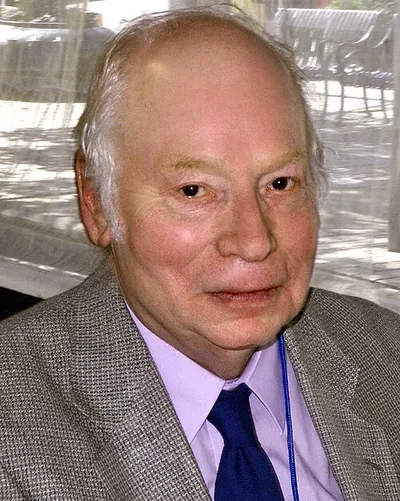 Steven Weinberg1933–2021 · Physics
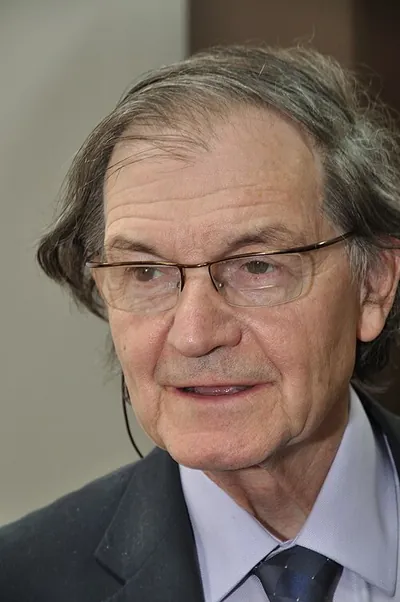 Roger Penrose1931 · Physics
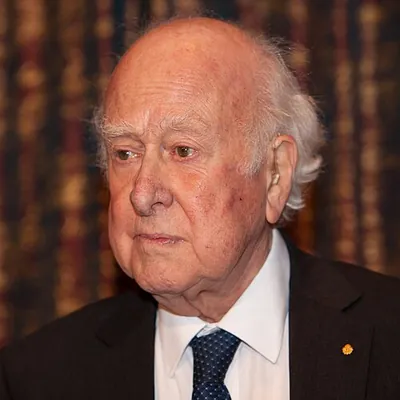 Peter Higgs1929–2024 · Physics
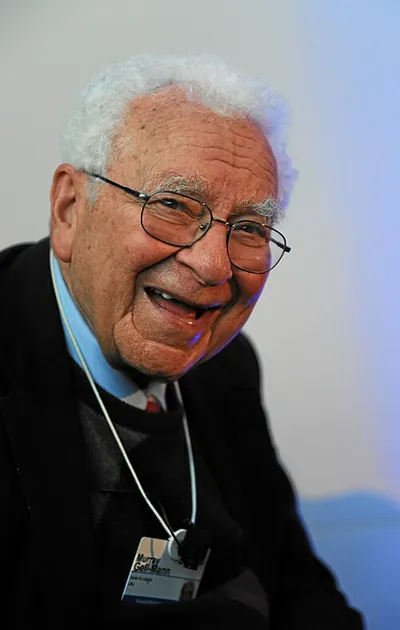 Murray Gell-Mann1929–2019 · Physics
