
Linus Torvalds
Finnish software engineer, creator of the Linux kernel and of Git · 1969
- Born
- December 28, 1969
- Country
- United States, Finland
- Section
- Computing
Extended biography
Childhood and first encounters with computers
Linus Benedict Torvalds was born in Helsinki, Finland, on 28 December 1969. His parents, Anna and Nils Torvalds, were both journalists, and the family belonged to the Swedish-speaking minority of the country. He was named after the American chemist Linus Pauling, a Nobel laureate, though Torvalds later joked that he also owed something to the blanket-carrying cartoon character from the Peanuts strip.
His first real contact with computers came at the age of eleven, in 1981, when his grandfather, the statistician Leo Törnqvist, bought a Commodore VIC-20, a home microcomputer of the period, and asked him for help using it. The first programs were written in BASIC, a simple language many beginners used at the time. Torvalds soon wanted more control over the machine, and began writing machine code for its 6502 processor, the raw instructions the chip understands without any translation layer.
Later he acquired a Sinclair QL, a machine with little software available in Finland. Because of this shortage he wrote his own assembler, a program that converts assembly language, a readable form of machine instructions, into code the processor can run. This habit of building the tools he lacked became a constant feature of his career.
University years and military service
Torvalds studied at the University of Helsinki from 1988 to 1996, earning a master's degree in computer science. During his first year he was introduced to Unix, running on a DEC minicomputer. An operating system is the basic program that manages a computer's resources, such as its processor, memory and disks, and on which all other applications run.
In 1989 he interrupted his studies to complete compulsory military service in the Finnish Navy, within the Nyland Brigade. He chose an eleven-month officer training programme and graduated as a second lieutenant, serving as an artillery observer. The break gave him time away from programming, although his academic life resumed afterwards.
In 1990 he returned to university and began learning the C programming language, which would become his everyday tool. A programming language is a set of rules for writing instructions that a machine can interpret. C was well suited to operating system work because it allows fine control over the hardware.
The birth of Linux
The origins of Linux make more sense against the background of the time. Andrew S. Tanenbaum, a computer science professor, had published MINIX, a small operating system inspired by Unix and designed for teaching how such systems worked. Torvalds studied it, but it did not fully satisfy him, and some of its limitations pushed him toward writing a kernel of his own. The kernel is the central part of a system that shares the processor and memory among programs.
In 1991 he bought a computer built around an Intel 80386 processor, running at 33 MHz with 4 MB of memory, which he used to dial into his university's network over a telephone line. By his own account, he began with small programs written in assembly language, without relying on MINIX. His early experiments managed to run two processes that printed strings of letters, one reading from the modem and writing to the screen, the other writing to the modem and reading from the keyboard. To transfer files he needed a disk driver, which he made compatible with MINIX's file system. At that point he realised he was building something larger than a simple terminal emulator.
On 25 August 1991 he announced in a public forum his intention to continue developing the system. Version 0.01 was uploaded on 17 September to an FTP server at his university, with roughly 10,000 lines of code. He had considered the name Freax, but his friend Ari Lemmke, who ran the server, stored the files in a directory called linux, and that name stuck. Some accounts describe the name as legendary in its details, so it is best seen as a well-documented but partly anecdotal episode.
Free licence and the bazaar model
Torvalds later explained that his reasons for sharing the code were largely practical. He did not want to carry the burden of every part of the system alone, and he needed help. Publishing the kernel opened the door to others fixing bugs and adding features, and within months contributions arrived from programmers in several countries.
At first, the licence Linux was distributed under forbade commercial use, which limited its spread. After encountering the free software movement led by Richard Stallman and the GNU Project, Torvalds switched to the GNU General Public License, GPL, in its version 2, adopted for Linux in January 1992. This kind of licence grants users the right to use, copy, modify and redistribute the program, on the condition that modified versions keep the same freedoms.
The development model that emerged is often described as a bazaar rather than a cathedral. Instead of a closed team designing everything in secret, thousands of people worked in public, reviewing one another's changes. Torvalds argued that the direction of the project should follow user demand and sound technical judgement, avoiding choices that would cause trouble later. This approach helps explain the stability and the broad functionality the system eventually reached.
Git and other projects
For years the Linux kernel was managed with version control tools, programs that record every change to the code, who made it and why, and allow a team to go back when something breaks. The project used a commercial system called BitKeeper, which drew criticism because it was not free software. When that arrangement came under strain, Torvalds decided to build an alternative himself.
On 3 April 2005 he began developing Git. Its design aimed at speed and reliability in projects with very large numbers of files and many collaborators working at once. Git is distributed: every copy of a project holds the full history, so it does not depend on a single central server. Shortly afterwards Torvalds handed its maintenance to Junio Hamano, who became its lead maintainer in mid 2005.
Git spread quickly and is now used across software development of every kind. Torvalds also started smaller projects. Subsurface is a program for logging and planning scuba dives, which he began developing in late 2011 and which is also free software. Sparse is a static analysis tool, meaning one that examines code without running it, designed to flag constructs of interest to kernel developers, such as the improper mixing of user-space and kernel-space memory addresses.
Controversies and temperament
Torvalds has built a reputation as a blunt and sometimes harsh interlocutor. For years he argued openly with other developers on the kernel mailing list, and programmers such as Sage Sharp and Lennart Poettering have criticised his manner. He himself described being a rather unpleasant person and admitted that he found it hard to moderate his language.
One of the most discussed episodes took place in 2012, during a talk at Aalto University. While criticising the company Nvidia, which makes graphics chips, he swore and raised his middle finger. He said that Nvidia was, at that time, the worst company he had dealt with in kernel development. He has also publicly disagreed with Richard Stallman, whose thinking he described as black and white.
In September 2018 the kernel's code of conduct was replaced with a new one based on the Contributor Covenant. Shortly afterwards, in the release notes for version 4.19-rc4, Torvalds apologised for his past behaviour, called his personal attacks unprofessional, and announced a break to learn how to handle emotions better. These events coincided with critical questions that The New Yorker had put to him. After the release of Linux 4.19 in October 2018 he returned to maintaining the kernel.
Family life and citizenship
In late 1993 he met Tove Torvalds, a Finnish karate champion who had won six national titles. A popular account says that Torvalds was running introductory computer lab sessions and asked students to send him a test email; she replied with an email asking him out. They later married and have three daughters, two of them born in the United States. As a curious detail, the Linux kernel's reboot system call accepts the daughters' birth dates, written in hexadecimal, as magic values, a whimsical feature rather than a serious design principle.
Torvalds describes himself as an atheist, though in other remarks he has used the word agnostic. He has said that in Europe religion is mostly a personal matter, whereas in the United States it has become highly politicised. Asked about the separation of church and state, he remarked ironically that many European countries have a legal link between the state and an official religion.
He moved with his family from Silicon Valley to Portland, Oregon, in 2004. In 2010 he became a United States citizen and registered to vote. He said at the time that he did not belong to any political party, since he had too much personal pride to be associated with one. From the early 2000s he developed a strong interest in scuba diving and gained numerous certifications, an interest behind the Subsurface project.
Recognition and legacy
Torvalds has received wide recognition. An asteroide bears his name since 1996, and in 1999 and 2000 he received honorary doctorates from the universities of Stockholm and Helsinki. In 1998 he won the Pioneer Award of the Electronic Frontier Foundation, and in 2001 he shared the Takeda Award with Richard Stallman and Ken Sakamura. Time magazine included him in its poll of the most important people of the century, where he placed seventeenth, and in 2004 named him among the most influential people in the world.
In 2008 he was inducted as a member of the Computer History Museum in Mountain View, California. In 2012 he shared the Millennium Technology Prize with the researcher Shinya Yamanaka, recognising his creation of a free operating system for computers with the Linux kernel at its core. That same year he entered the Internet Hall of Fame. In 2014 the IEEE Computer Society gave him its Computer Pioneer Award, and in 2018 the IEEE Masaru Ibuka Consumer Electronics Award.
Torvalds's legacy is twofold. Linux now runs on servers, phones, embedded devices and supercomputers, and its open development model shaped much of the software industry. Git changed how millions of programmers manage their work. He has acknowledged that his own direct contribution to the current code is small, and that his role consists mainly of integrating changes and deciding what enters the kernel. He still holds the Linux trademark, which he oversees through Linux International.
Quotes
“Talk is cheap. Show me the code.”
“Making Linux GPL'd was definitely the best thing I ever did.”
“Only wimps use tape backup: real men just upload their important stuff on ftp, and let the rest of the world mirror it ;)”
“If it compiles, it is good; if it boots up, it is perfect.”
Main contributions
- 1991First release of the Linux kernel, version 0.01, uploaded to his university server with about 10,000 lines of code; it is the basis of the system that bears his name.
- 1992Adoption of the GNU General Public License for Linux, which allows the software to be used, modified and redistributed under the same freedoms.
- 1994Release of Linux 1.0 on 14 March 1994, the first version regarded as stable.
- 2005Creation of Git, a version control system that records changes to a project's files so earlier versions can be recovered.
- 2011Start of Subsurface, free software for logging and planning scuba dives, begun in late 2011.
Trivia and anecdotes
Freax versus Linux
Torvalds planned to call his system Freax, but his friend Ari Lemmke, who ran the server, stored it in a directory called linux without asking him.
Birthdays in code
According to reports, the kernel's reboot system call accepts the birth dates of his three daughters, written in hexadecimal, as magic values.
A penguin as emblem
Torvalds's personal mascot is Tux, a penguin that the Linux community has widely adopted as the kernel's mascot.
Their contemporaries
While Linus Torvalds was alive (1969–)…
Alive at the same time
Discovered or invented in those years
- 1969InternetA global network of interconnected computer networks that communicate using the TCP/IP protocol suite.
- 1971EmailA network service that lets users send and receive digital messages through addressed mailboxes, much like postal mail but electronic.
- 1973Mobile phoneA handheld wireless phone that lets people make and receive calls while moving across a cellular network area.
- 1975Global warmingThe long-term rise in Earth's average surface temperature, driven mainly by greenhouse gases released through human activity.
- 1989World Wide WebA system of linked documents and resources, connected by hyperlinks and accessed over the Internet with web browsers.
- 1990Web browserA program that lets people access the web by fetching a page's files from a server and displaying them on screen as an interactive page.
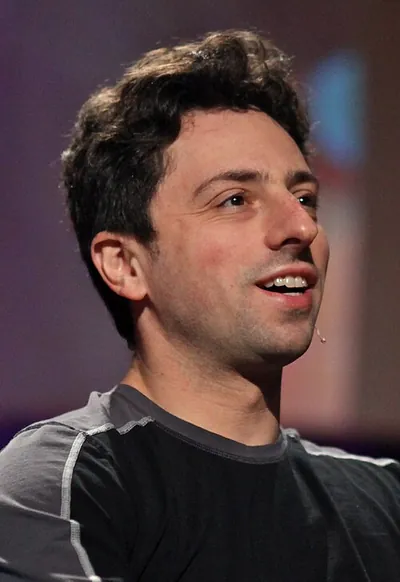 Sergey Brin1973 · Computing
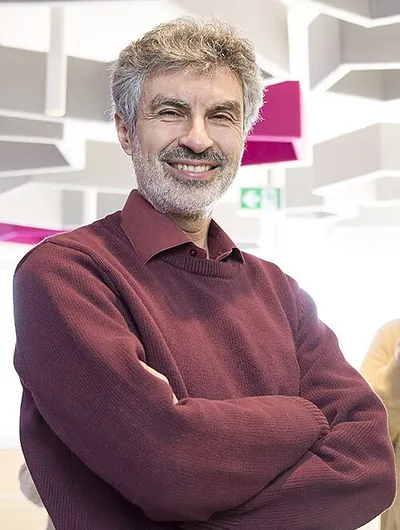 Yoshua Bengio1964 · Computing
 Andrew Y. Ng1976 · Computing
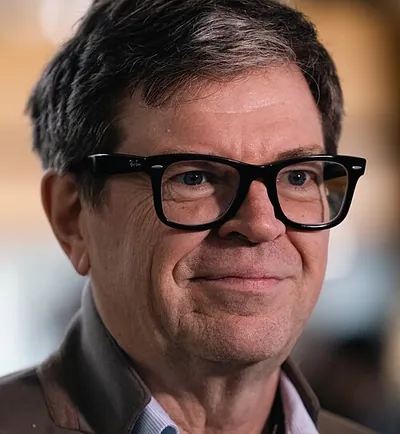 Yann LeCun1959 · Computing
 Shafrira Goldwasser1958 · Computing
 Guido van Rossum1956 · Computing
