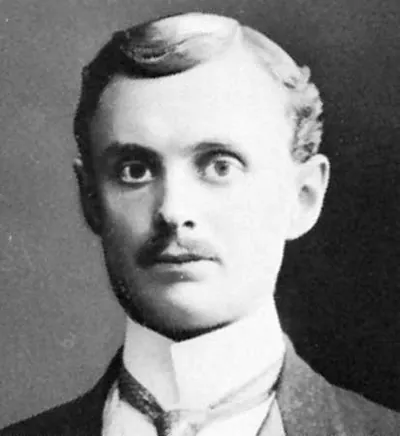
Charles Rolls
British motoring and aviation pioneer, co-founder of Rolls-Royce · 1877–1910
- Born
- August 27, 1877
- Died
- July 12, 1910
- Country
- United Kingdom of Great Britain and Ireland
- Section
- Transport
Biography
Charles Stewart Rolls (London, 1877 - Bournemouth, 1910) was a British pioneer of motoring and aviation. With Henry Royce he founded the Rolls-Royce company, and he became the first Briton killed in an aeronautical accident involving a powered aircraft. His short life fell in the early years of the car and the aeroplane, which is why his story links two fields that were only just taking shape.
He was born in Berkeley Square, London, the third son of John Rolls, 1st Baron Llangattock, and Lady Llangattock. Although he was born in the capital, he kept a strong connection with The Hendre, the family's ancestral house near Monmouth in south-east Wales. He was educated at Eton College, where his growing interest in engines earned him the nickname "dirty Rolls", and then at Trinity College, Cambridge, where he studied mechanical and applied science. His father disapproved of some of these choices, but Rolls kept to his own path.
In 1896 he travelled to Paris to buy his first car, a Peugeot Phaeton, and joined the Automobile Club of France. His Peugeot is thought to have been the first car in Cambridge and one of the first three in Wales. He backed the Self-Propelled Traffic Association, which campaigned against the limits the Locomotive Acts placed on motor vehicles, and he was a founding member of the Automobile Club of Great Britain, with which that association merged in 1897. He was also a keen and tall cyclist, standing 1.95 metres, who won a Half Blue in 1896.
He graduated in 1898 and worked briefly on the steam yacht Santa Maria, then took a post with the London and North Western Railway at Crewe. His real talents, however, lay in selling and in pioneering the motor trade rather than in hands-on engineering. In January 1903, using £6,600 from his father, he opened C. S. Rolls & Co. in Fulham, one of Britain's first car dealerships, importing French Peugeots and Belgian Minervas.
The decisive meeting came through Henry Edmunds, a friend at the Royal Automobile Club who was also a director of Royce Ltd. Rolls and Royce met at the Midland Hotel in Manchester on 4 May 1904. Rolls preferred cars with three or four cylinders, yet he was impressed by Royce's two-cylinder car, and in December 1904 he agreed to take every car Royce could build, sold under the Rolls-Royce name. The first model, the 10 hp, was shown at the Paris Motor Salon that month. Early advertisements gave more prominence to Rolls's name than to Royce's.
In 1906 the two formalised the partnership as Rolls-Royce Limited. Rolls became technical managing director, paid a salary plus a share of profits, and supplied the money and business sense, while Royce provided the engineering. In 1907 the company bought out C. S. Rolls & Co. Rolls put effort into promoting the smoothness and quietness of the cars, and at the end of 1906 he travelled to the United States to market them. By 1909 his interest in the business was fading, and at the year's end he gave up the technical directorship to become a non-executive director.
Flight became his other great passion. He began with balloons, making more than 170 ascents, and in 1903 he won the Gordon Bennett Gold Medal for the longest flight time. A founder member of the Royal Aero Club, he was the second person it licensed to fly in Britain. From 1907 he tried, without success, to persuade Royce to design an aero engine. He bought one of six Wright Flyers built under licence by Short Brothers and made more than 200 flights with it. On 2 June 1910 he became the first man to make a non-stop double crossing of the English Channel by aeroplane, taking 95 minutes, and for this he received the Royal Aero Club's Gold Medal.
On 12 July 1910, aged 32, he died at Hengistbury Airfield in Bournemouth, when the tail of his Wright Flyer broke off during a flying display. He was the eleventh person killed in an aviation accident worldwide. He is buried at the churchyard of Llangattock-Vibon-Avel, where many of his family lie, and there are statues of him in Monmouth and Dover. His most lasting legacy is the Rolls-Royce name, still shared with Royce's, along with the memory of Britain's earliest steps in powered flight.
Main contributions
- 1903Gordon Bennett Gold Medal for the longest flight time, an award for his balloon ascents.
- 1904First Rolls-Royce car, the 10 hp, shown at the Paris Motor Salon, with a two-cylinder engine designed by Royce.
- 1906Founding of Rolls-Royce Limited, which joined Rolls's business management with Royce's engineering.
- 1909Purchase of one of six Wright Flyers built under licence by Short Brothers, which he flew more than 200 times.
- 1910First non-stop double crossing of the English Channel by aeroplane, completed in 95 minutes.
Trivia and anecdotes
An unflattering nickname
At Eton, his interest in engines earned him the nickname "dirty Rolls", a reference to the grease of his mechanical work.
Cambridge's first car
His Peugeot Phaeton, bought in Paris in 1896, is believed to have been the first car in Cambridge, though this claim is not fully confirmed.
A statue in Dover
Besides the statue in Monmouth commemorating his flight, there is another in Dover by the sculptor Kathleen Scott.
A television portrayal
The actor Robert Powell played him in the miniseries The Edwardians, broadcast in 1972 and 1973.
Their contemporaries
While Charles Rolls was alive (1877–1910)…
Alive at the same time
Discovered or invented in those years
- 1884CarA road vehicle with four wheels and its own engine, mainly built to carry people.
- 1885BicycleA two-wheeled vehicle, with the wheels in line, that a person drives with pedals using leg power, and that stays upright through its own motion.
- 1892VirusA microscopic, acellular infectious agent that can only replicate inside the living cells of other organisms.
- 1897ElectronA negatively charged subatomic particle found in every atom, and key to electricity and chemical bonding.
- 1900GeneticsIt is the branch of biology that studies how hereditary traits pass from one generation to the next, through genes carried in DNA.
- 1903AirplaneA fixed-wing aircraft, heavier than air, powered by engines or rockets, that stays aloft because its wings generate lift.
 André Citroën1878–1935 · Transport
 Ferdinand Porsche1875–1951 · Transport
 Walter Hohmann1880–1945 · Transport
 Theodore von Kármán1881–1963 · Transport
 William Boeing1881–1956 · Transport
 Alberto Santos-Dumont1873–1932 · Transport
