Charles Spearman
English psychologist, statistician and pioneer of factor analysis, who coined the term general intelligence factor · 1863–1945
- Born
- September 10, 1863
- Died
- September 17, 1945
- Country
- United Kingdom
- Section
- Biology
Biography
Charles Edward Spearman (London, 1863 – London, 1945) was a British psychologist whose work pushed one of the central questions of his era: is intelligence a single capacity, or a collection of separate skills? He worked at the crossroads of experimental psychology and statistics. Today he is remembered for the rank correlation coefficient that bears his name and for his theory of a general intelligence factor, which still shapes debates about aptitude tests.
Born in London in 1863, Spearman had hoped for an academic career as a young man, but he first joined the British Army as an engineering officer in 1883 and was promoted to captain in 1893, serving with the Munster Fusiliers. After about fifteen years in uniform, he left the army in 1897 to study for a doctorate in experimental psychology. Britain still treated psychology as a branch of philosophy, so he went to Leipzig, a hub of the so-called new psychology, which used the scientific method rather than metaphysical speculation. Wilhelm Wundt, the discipline's leading figure, was often away on his many duties, so Spearman worked mostly with Felix Krueger and Wilhelm Wirth, whom he admired. A recall to the army during the Second Boer War interrupted his studies, and he finally earned his degree in 1906. By then he had already published his pioneering paper on the factor analysis of intelligence, in 1904.
William McDougall, a fellow psychologist who had made a good impression on him, helped Spearman take over McDougall's post at University College London, where Spearman remained until retiring in 1931. He began as reader and head of the small psychology laboratory, became Grote Professor of the Philosophy of Mind and Logic in 1911, and in 1928, when a separate psychology department was founded, became Professor of Psychology. He was elected to the Royal Society in 1924. His long feud with his colleague Karl Pearson, who had little regard for his statistical work, is well documented. Spearman had been shaped by Francis Galton, a pioneer of correlation, the statistical tool he used and extended.
In statistics he developed rank correlation in 1904, a version that does not assume the data follow any particular distribution and works from the order of the values rather than their exact sizes. In 1907 he also proposed a correction for attenuation and an early form of factor analysis. He was best known in his lifetime for this statistical work, yet he saw it as a means to an end: uncovering the fundamental laws of psychology. His central idea was that when many different cognitive tests are given, their scores tend to move together, which hints at a shared factor he called g. Each test also carried a specific factor, s, tied to the particular skill it measured, which gave his two-factor theory its name. Spearman believed g was largely inherited and linked it to a kind of mental energy in the cerebral cortex, though he never managed to demonstrate that physical basis. The specific factors, he thought, could be shaped by education.
His ideas drew criticism. In 1938 Louis Thurstone argued for seven primary abilities, though he eventually accepted that a general factor existed. Raymond Cattell later separated fluid and crystallized intelligence. Over time Spearman split g into two abilities: eduction, the capacity to draw meaning out of confusion, and reproduction. He also argued that schools should focus on drawing out each pupil's talents, and that everyone has some field in which they excel. Godfrey Thomson disputed his methods and reasoning more than his data, and it was Thomson who wrote his obituary for the Royal Society.
He had three daughters and a son, who died in Crete in 1941. Spearman is buried in Highgate Cemetery. His legacy is twofold: correlation and factor analysis, tools that remain central to psychometrics and behavioural research, and a general factor of intelligence that is still debated. He pressed for his work to be applied in psychiatry, though factor analysis took a different route in that field from the one he had hoped for.
Main contributions
- 1904Factor analysis of intelligence: a pioneering paper proposing that scores on different cognitive tests share a general factor.
- 1904Rank correlation: a non-parametric version of Pearson's correlation coefficient, based on the order of the data.
- 1907Correction for attenuation: a statistical adjustment that compensates for measurement error in correlations.
- 1927The Abilities of Man: a book setting out his theory of intelligence based on a general factor and specific factors.
Teachers and students
Trivia and anecdotes
A soldier before a psychologist
Spearman served in the British Army for about fifteen years before turning to psychology.
A long feud
His rivalry with Karl Pearson, a colleague at University College London, lasted for years and was openly fought.
Their contemporaries
While Charles Spearman was alive (1863–1945)…
Alive at the same time
Discovered or invented in those years
- 1869Periodic tableAn arrangement of the chemical elements into rows (periods) and columns (groups), ordered by atomic number, that reveals recurring chemical behaviour and lets scientists predict properties.
- 1876TelephoneA device that carries the human voice over distance by turning sound into electrical signals and back into sound at the other end of the line.
- 1884CarA road vehicle with four wheels and its own engine, mainly built to carry people.
- 1903AirplaneA fixed-wing aircraft, heavier than air, powered by engines or rockets, that stays aloft because its wings generate lift.
- 1925TelevisionA system that sends moving pictures and sound over distance and shows them on a receiver, the television set.
- 1945ComputerA programmable machine that takes in data, processes it by following stored instructions, and produces results, able to switch tasks simply by running different software.
 Thomas Hunt Morgan1866–1945 · Biology
 Hans Spemann1869–1941 · Biology
 Santiago Ramón y Cajal1852–1934 · Biology
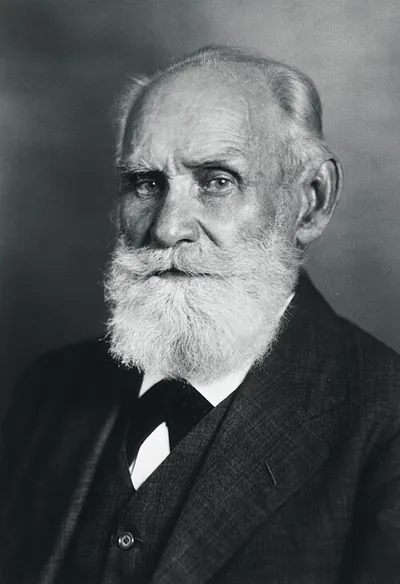 Ivan Pavlov1849–1936 · Biology
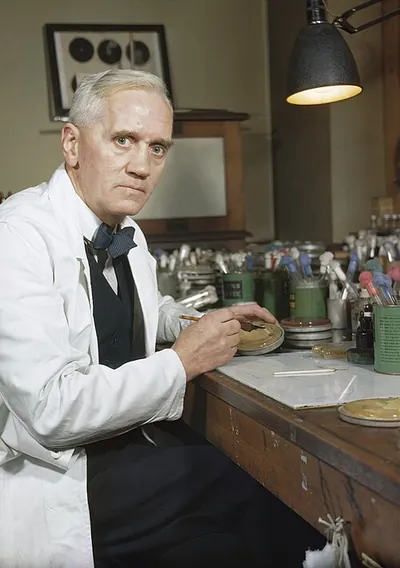 Alexander Fleming1881–1955 · Biology
 Élie Metchnikoff1845–1916 · Biology