
Charles Sumner Tainter
American scientific instrument maker and inventor who worked with Alexander Graham Bell · 1854–1940
- Born
- April 25, 1854
- Died
- April 20, 1940
- Country
- United States
- Section
- Technology and communications
Biography
Charles Sumner Tainter (Watertown, Massachusetts, 1854 - 1940) was an American scientific instrument maker and inventor who worked with Alexander Graham Bell and his family on devices for recording and playing back sound. He lived through the early years of the telephone and sound recording, and his importance lies in turning Thomas Edison's phonograph into a more practical and higher-quality machine.
Tainter received a modest education at the public school in his hometown and learned mostly on his own. In 1873 he began working for the Alvan Clark and Sons Company in Cambridge, a telescope maker under contract with the U.S. Navy to observe the transit of Venus on December 8, 1874. That job took him on one of the observation expeditions to New Zealand.
In 1878 he opened his own shop making scientific instruments in Cambridgeport, where he met Bell. A year later Bell invited him to work at what would become the Volta Laboratory in Washington, D.C. There he collaborated with the Bell family on inventions such as the photophone, which carried speech on a beam of light, and on improving Edison's phonograph, which led to the Graphophone. He received patents with the Bells for this work.
Edison sued the Volta Graphophone Company, of which Tainter was a part owner, for patent infringement. The case was settled by a compromise between the two sides. In 1886 Tainter married Lila R. Munro, and over the following years he tried to market the Graphophone as a dictation machine, an early ancestor of the Dictaphone.
In 1887 he devised a cylinder made of a helically wound paper tube, light and strong, which came to be used for mailing tubes and containers far beyond its original purpose. In 1888 he suffered a severe pneumonia whose after-effects troubled him for the rest of his life, and in 1903 he moved with his wife to San Diego, California, in search of a milder climate. After Lila died in 1924, he married Laura F. Onderdonk in 1928.
He received honors including a gold medal at the Paris Electrical Exhibition for the photophone (1881), the title of Officer of Public Instruction from the French government (1889), and awards at the San Francisco and Panama-Pacific expositions (1915). In 1934 the American Association for the Advancement of Science made him an Emeritus Life Member.
Much of his legacy survives thanks to his widow, who in 1947 donated ten of the thirteen home notebooks in which he recorded his daily work to the Smithsonian. Tainter is remembered as a pioneer of sound recording, though the nickname 'father of the phonograph' is better understood as an admirers' tribute than an official title.
Main contributions
- 1880Photophone: a device, developed with Bell, that carried speech on a beam of light.
- 1886Graphophone: an improved version of Edison's phonograph, patented jointly with the Bells.
- 1887Helically wound paper tube cylinder, light and strong, widely used for containers and mailing tubes.
- 1888Graphophone patent with duplicate transcription, one of his improvements for dictation.
Trivia and anecdotes
A laboratory notebook
Tainter's home notebooks record his day-to-day work at the Volta Laboratory. Some volumes were reportedly lost in a fire.
From telescopes to sound
His first job was at a telescope factory working for the Navy, an unusual starting point for an inventor of sound machines.
Their contemporaries
While Charles Sumner Tainter was alive (1854–1940)…
Alive at the same time
Discovered or invented in those years
- 1859EvolutionThe process by which the heritable traits of living populations change over generations, explaining the diversity of life from common ancestors.
- 1869Periodic tableAn arrangement of the chemical elements into rows (periods) and columns (groups), ordered by atomic number, that reveals recurring chemical behaviour and lets scientists predict properties.
- 1876TelephoneA device that carries the human voice over distance by turning sound into electrical signals and back into sound at the other end of the line.
- 1884CarA road vehicle with four wheels and its own engine, mainly built to carry people.
- 1903AirplaneA fixed-wing aircraft, heavier than air, powered by engines or rockets, that stays aloft because its wings generate lift.
- 1925TelevisionA system that sends moving pictures and sound over distance and shows them on a receiver, the television set.
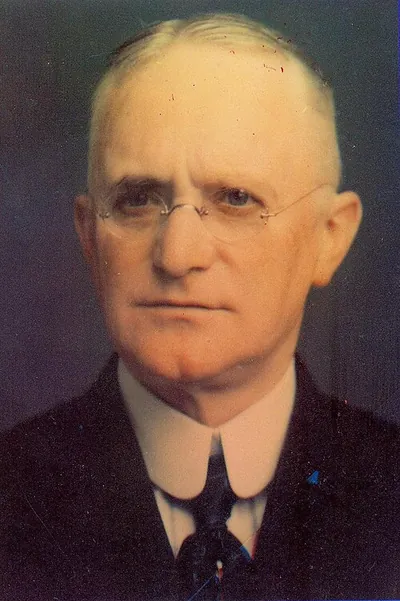 George Eastman1854–1932 · Technology and communications
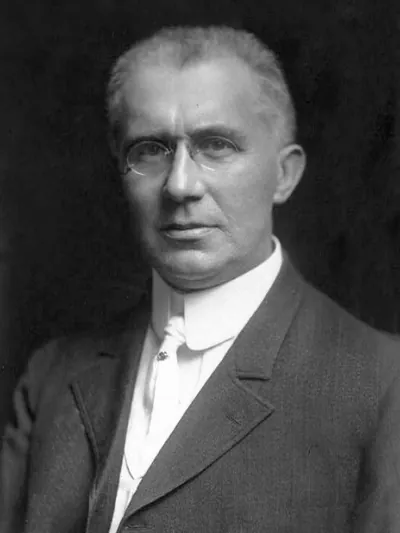 Emile Berliner1851–1929 · Technology and communications
 Karl Ferdinand Braun1850–1918 · Technology and communications
 Aleksandr Popov1859–1906 · Technology and communications
 John Ambrose Fleming1849–1945 · Technology and communications
 Thomas Edison1847–1931 · Technology and communications
