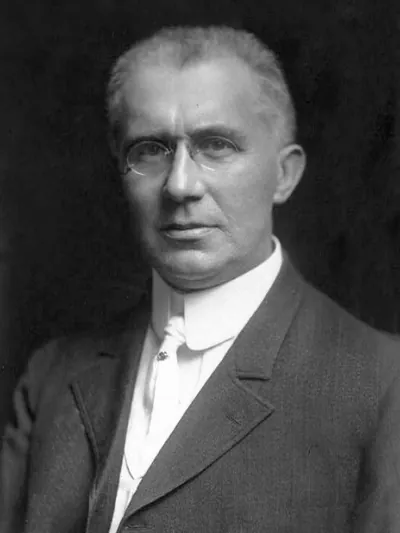
Emile Berliner
German-American inventor who developed the flat disc record and the gramophone · 1851–1929
- Born
- May 20, 1851
- Died
- August 3, 1929
- Country
- United States, Kingdom of Hanover
- Section
- Technology and communications
Biography
Emile Berliner (Hanover, 1851 – Washington, D.C., 1929) was a German-American inventor and businessman whose work helped make the flat disc the standard medium for recorded sound. He lived through the decades in which the telephone, sound recording and aviation took shape, and his inventions touched all three. His gramophone and its disc outlasted Edison's cylinder and laid the groundwork for the modern record industry.
Berliner was born in Hanover into a Jewish family of merchants. He was raised in that tradition, though he later described himself as an agnostic. He trained as a merchant, as the family expected, but invention was his real passion, and to pay the bills he worked as an accountant. To avoid conscription during the Franco-Prussian War, he emigrated to the United States in 1870 with a friend of his father, in whose shop in Washington he worked. He then moved to New York, where he took temporary jobs, such as delivering newspapers and cleaning bottles, while studying physics at night at the Cooper Union Institute. He later went to Boston and worked for Bell Telephone from 1877 to 1883, when he returned to Washington as an independent researcher. He became a U.S. citizen in 1881.
His first major contribution was an improved telephone transmitter, a device that turns the vibrations of the voice into variations in electric current and is considered one of the earliest microphones. The patent passed to Bell, but the use of carbon in the transmitter became the subject of a long legal fight with Thomas Edison. In 1901 a U.S. appeals court voided Berliner's patent and gave Edison full credit for the invention, a defeat that remained a sore point for him.
From 1886 Berliner concentrated on recording sound. His 1887 patent described a stylus that cut side-to-side grooves into a blackened rotating surface, which was then fixed with varnish and used as a mould for a metal copy. He soon saw that a flat disc was more practical than a cylinder, since it allowed many copies to be made by simpler processes such as electroplating or moulding. In 1888 he refined the method: the stylus cut into a thin wax coating on a zinc disc, and an acid bath then turned the groove into a playable one. In 1890 a German licensee made a toy gramophone and hard rubber discs, but because key American patents were still pending, they were sold only in Europe.
In 1894 he persuaded a group of investors to put up $25,000 and launched the United States Gramophone Company. The main obstacle with early machines was keeping the turntable at a steady speed, since it was wound by hand. Eldridge R. Johnson, an engineer with a small machine shop in Camden, New Jersey, built a simple and inexpensive spring motor that solved the problem, and he later founded the Victor Talking Machine Company in 1901. Commercial disputes were constant. Frank Seaman, who had been given exclusive sales rights, began selling his own version of the gramophone along with unauthorised copies of the records, and the courts eventually barred Berliner from selling in the United States. In 1900 he moved part of the business to Montreal, where he founded the Berliner Gram-O-phone Company. In 1924 the company was bought by Victor, which later became part of RCA.
Berliner also pursued aviation. Between 1907 and 1926 he worked on vertical flight, and with Fay Oliver Farwell and R. S. Moore he developed a light rotary engine that replaced the heavier inline engines. That improvement helped bring rotary engines into aviation. In 1909 he set up the Gyro Motor Company in Washington, and by 1910 he was testing a vertical tail rotor to counter the torque of his main rotor, a layout that later fed into the practical helicopters of the 1940s. In 1922 he and his son Henry demonstrated a helicopter to the US military. Henry lost interest in 1925 and founded the Berliner Aircraft Company in 1926. His other inventions included a loom for mass-producing cloth and an acoustic tile.
Berliner's life was also shaped by social concerns. He had a nervous breakdown in 1914, promoted public health and sanitation, argued for women's equality and supported Zionism. In 1908 he created the Sarah Berliner Research Fellowship, a scholarship named after his mother, and he put much of his fortune into reducing infant mortality. He died in Washington on August 3, 1929, of a heart attack.
His legacy is twofold. The flat disc and the gramophone made recorded music as we know it possible. His rotary engines and tail-rotor experiments, meanwhile, anticipated developments in aviation and the modern helicopter.
Main contributions
- 1877Improved telephone transmitter: a device that converts the voice into variations of electric current, one of the earliest microphones.
- 1887Gramophone: a patent for a system that records sound in grooves on a flat disc, the basis of today's records.
- 1888Wax recording: the groove is cut into a thin wax layer on zinc and then etched with acid so it can be played back.
- 1908Lightweight rotary engine: an improvement on aircraft engines that replaced the heavier inline designs.
- 1910Tail rotor: a vertical rotor used to counteract the turning force of a helicopter's main rotor.
- 1920Acoustic tile: a material used to control sound in rooms.
Trivia and anecdotes
A toy in Europe
In 1890 a German licensee made a toy gramophone and hard rubber discs, which could only be sold in Europe because the American patents were still pending.
The dog logo
In 1900 Berliner registered his company's logo: a dog listening to a gramophone.
Related discoveries and inventions
- 1887GramophoneA device that records and plays back sound on a flat disc with a spiral groove, patented by Emile Berliner in 1887.
- 1887Phonograph recordA flat analog sound medium that stores recordings in a spiral groove and is played on a turntable.
Their contemporaries
While Emile Berliner was alive (1851–1929)…
Alive at the same time
Discovered or invented in those years
- 1859EvolutionThe process by which the heritable traits of living populations change over generations, explaining the diversity of life from common ancestors.
- 1869Periodic tableAn arrangement of the chemical elements into rows (periods) and columns (groups), ordered by atomic number, that reveals recurring chemical behaviour and lets scientists predict properties.
- 1876TelephoneA device that carries the human voice over distance by turning sound into electrical signals and back into sound at the other end of the line.
- 1884CarA road vehicle with four wheels and its own engine, mainly built to carry people.
- 1903AirplaneA fixed-wing aircraft, heavier than air, powered by engines or rockets, that stays aloft because its wings generate lift.
- 1925TelevisionA system that sends moving pictures and sound over distance and shows them on a receiver, the television set.
 Karl Ferdinand Braun1850–1918 · Technology and communications
 John Ambrose Fleming1849–1945 · Technology and communications
 George Eastman1854–1932 · Technology and communications
 Thomas Edison1847–1931 · Technology and communications
 Alexander Graham Bell1847–1922 · Technology and communications
 Émile Baudot1845–1903 · Technology and communications
