
Charles Wheatstone
British physicist and inventor, known for the Wheatstone bridge and for pioneering the electric telegraph · 1802–1875
- Born
- February 6, 1802
- Died
- October 19, 1875
- Country
- United Kingdom of Great Britain and Ireland
- Section
- Physics
Biography
Charles Wheatstone (1802-1875) was a British physicist and inventor who worked during the Victorian era. His name is attached to the Wheatstone bridge, a circuit for measuring electrical resistance, and to the electric telegraph he developed with William Fothergill Cooke. He became a Fellow of the Royal Society and was knighted in 1868, making him one of the best-known scientists of his time.
Some details of his early life are uncertain. Sources place his birth in Gloucester, although a later biography moved it to his grandmother's house in nearby Barnwood. His father sold music and worked as a cobbler in the town, and four years later moved the family to London, where he became a flute teacher. Charles, the second son, attended a village school and then several institutions in the capital. As a boy he was shy and sensitive, and he liked to withdraw to an attic with his own thoughts. At about fourteen he was apprenticed to his uncle, a maker of musical instruments on the Strand, but he had little interest in the trade and preferred reading. His father supported him and took him out of the apprenticeship so he could pursue his studies.
His self-taught education shaped his career. At fifteen he translated French poetry and wrote songs, one of which his uncle published without realising it was the work of his nephew. A frequently repeated story tells how he saved his pennies to buy a book on Volta's discoveries in electricity, then bought a dictionary so he could read its French. With his older brother William, he repeated the experiments with a homemade battery in the family's scullery. The tale that they used their own copper coins when they ran out of copper plates is a family story rather than a documented fact.
In 1821 Wheatstone attracted attention with the Enchanted Lyre, also called the Aconcryptophone, shown at a music shop in Pall Mall and at the Adelaide Gallery. It was a dummy lyre hung from the ceiling, which sounded music played out of sight; in fact it was a sound box linked to a steel rod that carried the vibrations. From this he studied how sound travels through solids and liquids, and even proposed sending messages over long distances this way, perhaps between London and Edinburgh. He also devised a simple device for amplifying faint sounds, which he called a microphone, quite unlike the later electric microphone. In 1823, after his uncle died, he and his brother took over the instrument business, though Charles preferred inventing to selling. He designed the Wheatstone concertina, a six-sided instrument with 64 keys, and in 1829 patented an improved version of the German Mundharmonika, the forerunner of the English concertina. He also built the kaleidophone in 1827, which made vibrations visible through a point of light reflected from a metal rod, and the stereoscope, which creates the illusion of three-dimensional images.
In 1834 he was appointed professor of experimental physics at King's College London. His first lectures were a failure because he disliked speaking in public; he felt far more at ease in the laboratory, where he mostly gave demonstrations. That same year he carried out a key experiment to measure the speed of electricity in a wire. He cut the wire in the middle to leave a gap for a spark, then watched the reflections of the sparks in a tiny mirror spinning rapidly. The delay of the middle spark allowed him to calculate the speed. His figure was higher than the speed of light, so it was wrong, but it was a useful approximation. The rotating-mirror method was later used by Foucault and Fizeau to measure the speed of light. In 1835 he also contributed to early spectroscopy by showing that the light of an electric spark, passed through a prism, reveals rays characteristic of the metals that produced it.
His decisive move into telegraphy came in 1837, when William Fothergill Cooke, an officer of the Madras Army who had seen a demonstration in Heidelberg, visited him intending to develop a practical telegraph. Wheatstone already had his own experimental design but was at first reluctant to partner, preferring to publish his results without seeking profit. They eventually agreed to combine forces: Wheatstone supplied the science and Cooke the business skill. Their five-needle system, in which the current deflected two needles to point out a letter, was patented jointly. The first public trial took place in July 1837 between Euston and Camden Town in London, and Wheatstone later recalled the intense excitement he felt on hearing the needles click. The railway company was slow to accept it, but in 1839 the Great Western Railway installed a line of thirteen miles between Paddington and West Drayton, and the telegraph came into regular use. In 1845 it helped catch John Tawell, the first arrest made thanks to a telegraph message.
Wheatstone married Emma West, daughter of a Taunton merchant, in 1847, and they had five children. She died in 1866. He was reserved in public but lively in private when discussing his studies. His last years were tied to submarine cables. In the autumn of 1875 he travelled to Paris to improve a receiving instrument for these cables; there he caught a cold that developed into an inflammation of the lungs, and he died on 19 October 1875. He was buried at Kensal Green Cemetery in London.
His legacy lives on in the bridge that bears his name, still used in laboratories to measure resistance, and in the foundations of modern telegraphy. Wheatstone was not only a maker of devices but a scientist who turned discoveries about sound and electricity into practical instruments.
Main contributions
- 1821Enchanted Lyre, or Aconcryptophone, a fake instrument that carried music played out of sight through a steel rod.
- 1827Kaleidophone, a device that made the vibrations of a sounding body visible as a moving point of light.
- 1829Patent for the Wheatstone concertina, a button-keyed free-reed instrument derived from the German Mundharmonika.
- 1834Measurement of the speed of electricity in a wire using a rotating mirror, with a result above the speed of light but useful as an approximation.
- 1837Five-needle electric telegraph, developed with William Fothergill Cooke.
- 1843Wheatstone bridge, a circuit for measuring unknown electrical resistances.
Teachers and students
Trivia and anecdotes
The copper coins
According to a family story, the brothers used copper coins instead of plates to build their homemade battery. The tale was passed down as an anecdote and is not documented.
A conversation with Palmerston
Sir Henry Taylor recalled that Wheatstone explained the possibilities of his telegraph to Lord Palmerston at an Oxford party, and that the statesman passed him on to another guest. The account is second-hand and has a humorous tone.
Their contemporaries
While Charles Wheatstone was alive (1802–1875)…
Alive at the same time
Discovered or invented in those years
- 1803AtomThe basic unit of a chemical element: a nucleus of protons and usually neutrons surrounded by a cloud of electrons.
- 1839PhotographyA technique for creating lasting images by recording light, either on a light-sensitive material or with an electronic sensor.
- 1846NeptuneThe eighth and most distant planet of the Solar System, an ice giant found through mathematical prediction before any direct sighting.
- 1859EvolutionThe process by which the heritable traits of living populations change over generations, explaining the diversity of life from common ancestors.
- 1869Periodic tableAn arrangement of the chemical elements into rows (periods) and columns (groups), ordered by atomic number, that reveals recurring chemical behaviour and lets scientists predict properties.
- 1869Deoxyribonucleic acidA double-stranded molecule that carries the genetic instructions of nearly all living things and many viruses.
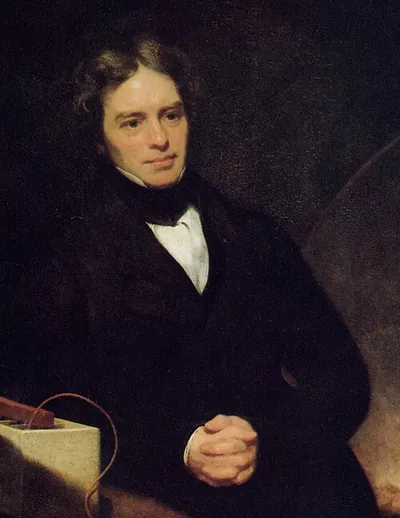 Michael Faraday1791–1867 · Physics
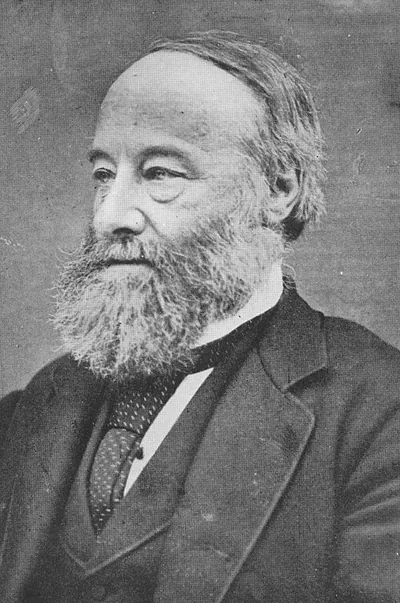 James Prescott Joule1818–1889 · Physics
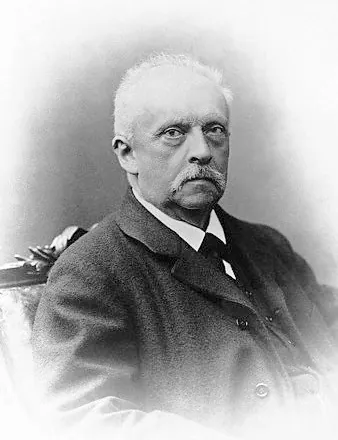 Hermann von Helmholtz1821–1894 · Physics
 Gustav Kirchhoff1824–1887 · Physics
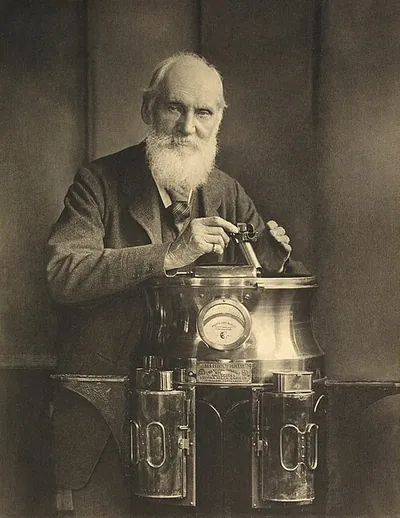 William Thomson, 1st Baron Kelvin1825–1907 · Physics
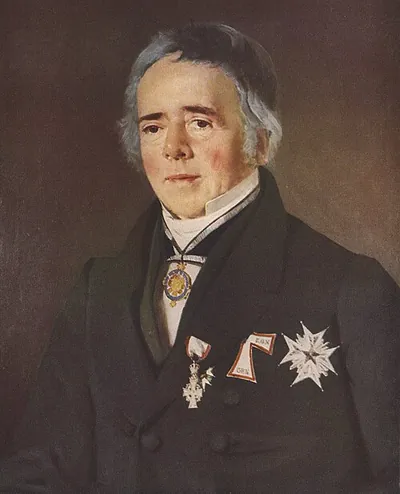 Hans Christian Ørsted1777–1851 · Physics
