
Clara Immerwahr
German chemist, the first woman to earn a doctorate in chemistry at the University of Breslau and wife of Fritz Haber · 1870–1915
- Born
- June 21, 1870
- Died
- May 2, 1915
- Country
- Germany, Kingdom of Prussia
- Section
- Chemistry
Biography
Clara Immerwahr (1870-1915) was a German chemist and the first woman to earn a doctorate in chemistry at the University of Breslau. She lived at a time when women faced severe barriers to research. Today she is remembered mainly for her marriage to the chemist Fritz Haber, for her opposition to chemical weapons, and for a death that still raises many unanswered questions.
She was born on 21 June 1870 on the Polkendorf farm near Breslau, a city then in the Kingdom of Prussia and today Wroclaw in Poland. She was the youngest child of a Jewish family. Her father, Philipp Immerwahr, was a chemist, and her mother, Anna Krohn, died of cancer in 1890. Clara grew up on the farm with her three older siblings, Elli, Rose and Paul. After her mother's death she moved with her father to Breslau.
She studied at the university there and earned her degree and doctorate in chemistry in 1900 under Richard Abegg. It took her eight semesters, two more than was required of men. Her dissertation examined the solubility of poorly soluble salts of mercury, copper, lead, cadmium and zinc, that is, how much of each salt dissolves in water. She received the grade magna cum laude, and her defence, held in the university's main hall, drew many young women from the city. A few months later she gave a public lecture called Chemistry and Physics in the Household.
She met Fritz Haber at a dance class, and they had a brief romance. At first she turned down his marriage proposal because she wanted to remain financially independent. They married in August 1901, four years after she had converted to Christianity. Once married, she was expected to devote herself to the home, and her chances to research were sharply limited. She contributed to her husband's work with little recognition and translated some of his papers into English. Their only child, Hermann, was born on 1 June 1902.
Haber neglected his family. He travelled to the United States to visit scientific institutions when the boy was only a few months old, and he spent long hours at the laboratory. Clara confided to friends her unhappiness with this secondary role. In 1915 she wrote to a Japanese colleague of her husband, complaining that he worked eighteen hours a day. She also criticised his chemical weapons research sharply, calling it a perversion of the ideals of science. She witnessed the accidental death of Otto Sackur, a former university classmate who was handling cacodyl chloride, a highly toxic compound, in Haber's laboratory.
During the First World War, Haber threw himself into the German military effort and played a central role in developing poison gases. On 22 April 1915, at Ypres in Flanders, Belgium, the first large-scale gas attack to succeed in military history took place. Shortly after Haber returned to Berlin, Clara shot herself in the chest with her husband's military pistol. She died on 2 May 1915 in her son's arms. The next morning Haber left for the Eastern Front to oversee a gas attack against Russian troops.
Her death drew little attention. Only a small local newspaper reported it, without giving a reason, and there is no record of an autopsy. Historians still debate her motives. It is thought that she was unhappy with her life and opposed her husband's work on chemical warfare, but none of this can be confirmed. Her ashes were moved to Basel and buried beside Haber's after his death in 1934. Their son emigrated to the United States, where he also took his own life, in 1946.
Today Clara Immerwahr is remembered as a pioneer of women in German chemistry and as a pacifist voice. Her story has inspired novels, films and television series, and it invites reflection on how science became entangled with war and with the expectations placed on women of her time.
Main contributions
- 1900Doctorate in chemistry from the University of Breslau, with a dissertation on the solubility of salts of mercury, copper, lead, cadmium and zinc.
- English translations of several papers by Fritz Haber, which helped make his work known outside Germany.
- Contributions to her husband's research that went largely unrecognised.
- A public lecture, Chemistry and Physics in the Household, given a few months after her doctorate.
Teachers and students
Trivia and anecdotes
A crowded defence
Her thesis defence drew many young women from Breslau, who came to see the university's first female doctorate.
A military pistol
She used her husband's military pistol, a detail often cited by historians discussing her death.
On screen
The couple's life was portrayed in the American television series Genius, and it has inspired films and novels as well.
Their contemporaries
While Clara Immerwahr was alive (1870–1915)…
Alive at the same time
Discovered or invented in those years
- 1876TelephoneA device that carries the human voice over distance by turning sound into electrical signals and back into sound at the other end of the line.
- 1884CarA road vehicle with four wheels and its own engine, mainly built to carry people.
- 1885BicycleA two-wheeled vehicle, with the wheels in line, that a person drives with pedals using leg power, and that stays upright through its own motion.
- 1897ElectronA negatively charged subatomic particle found in every atom, and key to electricity and chemical bonding.
- 1900GeneticsIt is the branch of biology that studies how hereditary traits pass from one generation to the next, through genes carried in DNA.
- 1903AirplaneA fixed-wing aircraft, heavier than air, powered by engines or rockets, that stays aloft because its wings generate lift.
 Fritz Haber1868–1934 · Chemistry
 Marie Curie1867–1934 · Chemistry
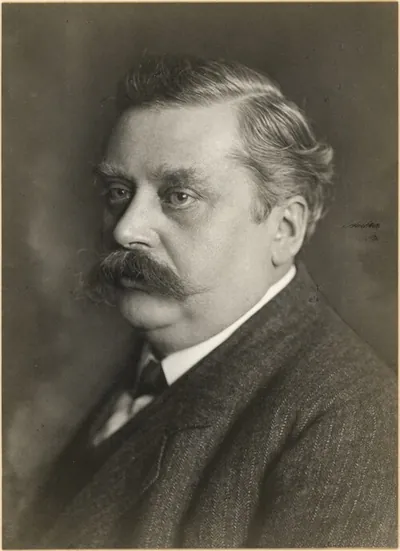 Alfred Werner1866–1919 · Chemistry
 Walther Hermann Nernst1864–1941 · Chemistry
 Otto Hahn1879–1968 · Chemistry
 Johannes Nicolaus Brønsted1879–1947 · Chemistry
