
Clyde Tombaugh
American astronomer who discovered Pluto in 1930 · 1906–1997
- Born
- February 4, 1906
- Died
- January 17, 1997
- Country
- United States
- Section
- Astronomy and space
Biography
Clyde William Tombaugh (1906-1997) was an American astronomer who discovered Pluto in 1930. That discovery was the first detection of an object that would later be recognized as part of the Kuiper belt, a ring of icy bodies beyond Neptune. For more than seven decades Pluto was counted as the ninth planet of the Solar System, so his find changed the map of the solar system and opened the way to the study of its outer region.
Tombaugh was born in Illinois in 1906 to a family of farmers of Pennsylvania Dutch descent. He was the eldest of six children and grew up on farms in Kansas, where the family's income depended on the weather and the harvest. His interest in the sky began in 1918, when he visited the Yerkes Observatory in Wisconsin at the age of twelve. His uncle Lee, an amateur astronomer, lent him books and let him use a small refracting telescope, an instrument that forms images with lenses. Poor harvests in 1921 and a move to a new farm in Burdett, Kansas, in 1922 delayed his schooling, and he left high school for a year to help his father work the fields. He graduated in 1925, but his plans for college fell apart in 1928, when a hailstorm destroyed the family's crops.
His training was largely self-taught. In 1924 he read an article in the magazine Popular Astronomy by the amateur Latimer J. Wilson about the markings on Jupiter, and its sketches of the planet made a deep impression on him. He decided to build his own telescope to see those details. From 1926 he made several instruments with lenses and mirrors, polishing them by hand. To test his mirrors he dug a pit with a pick and shovel, roughly seven metres long, two and a half deep and two wide. The hole gave a steady temperature without air currents, and his family later used it as a root cellar and emergency shelter. His drawings of Jupiter and Mars reached the Lowell Observatory in Flagstaff, Arizona, which offered him a job. He worked there from 1929 to 1945.
His assignment was to search for a still unknown planet beyond Neptune, called Planet X. Percival Lowell, the observatory's founder, had proposed it from calculations made with help from his student Elizabeth Williams and from William Pickering, to explain small irregularities in Neptune's orbit. Starting on April 6, 1929, Tombaugh photographed the same strip of sky with the observatory's astrograph, repeating the exposures several nights apart. To compare the plates he used a blink comparator, a device that flips quickly between two images. A nearby object, such as a planet, seems to jump from one spot to another, while distant stars stay put. The motion of a point of light thus becomes visible to the eye.
In one of these comparisons he spotted an object moving close to the place Lowell had predicted. Later observations showed that its orbit lay beyond Neptune, which ruled out an asteroid. The discovery was announced on February 18, 1930, based on images taken the previous month. Then came the question of a name. Minerva was dropped because it was already used for an asteroid. Cronus was rejected because its chief supporter, the astronomer Thomas Jefferson Jackson See, was widely disliked, and people feared he would claim the credit. Pluto, the Roman god of the underworld who could make himself invisible, was suggested by Venetia Burney, an eleven-year-old English girl. Its first two letters also matched Percival Lowell's initials. The American and Royal Astronomical Societies both approved it unanimously, and the name became official on May 1, 1930.
After the discovery it became clear that Pluto was too small to be the planet that had been expected, and some astronomers began to see it as the first of a new class of objects. Tombaugh kept searching for other bodies beyond Neptune for years without success, and he concluded that Pluto was still a planet. The view that it was not remained a minority one until the late 1990s, when other icy bodies were found in the same region, showing that Pluto did not sit alone. Later it was found that Eris was more massive than Pluto, and in August 2006 the International Astronomical Union reclassified Pluto as a dwarf planet. His widow, Patricia, said he would have accepted the decision, though he had always resisted removing Pluto's planetary status.
Tombaugh's work went well beyond Pluto. His systematic survey let him observe nearly eight hundred asteroids, and he is officially credited with fifteen discoveries, beginning with 2839 Annette in 1929. He is also credited with discovering the periodic comet 274P/Tombaugh–Tenagra. In 1936 he may have identified the Perseus–Pegasus Filament, an enormous chain of galaxies, though that claim is uncertain. In 1931 he received the Jackson-Gwilt Medal from the Royal Astronomical Society. He studied at the University of Kansas, earning bachelor's and master's degrees in astronomy in 1936 and 1938.
During the Second World War he taught navigation to naval personnel at Northern Arizona University. In the early 1950s he worked at the White Sands Missile Range, and from 1955 until he retired in 1973 he taught astronomy at New Mexico State University. There he directed the Planetary Patrol project, which helped establish the rotation period of Mercury and tracked Jupiter's Great Red Spot, and he developed photographic methods for searching for satellites. After retiring he kept building telescopes and supporting observing programs. In 1980 he was inducted into the International Space Hall of Fame.
Tombaugh also took a firm interest in unidentified flying objects. In August 1949 he saw several rectangular lights near Las Cruces. He thought the most likely explanation was an atmospheric optical effect, specifically a temperature inversion, and not a spacecraft, although that interpretation was often attributed to him. He said he saw no serious possibility of intelligent life on the other planets of the Solar System. Between 1953 and 1954 he took part in a search for small natural satellites near Earth, sponsored by the Army. Newspapers exaggerated the results, and both he and Lincoln LaPaz publicly denied that anything had been found. In 1959 he issued a final report that found nothing.
In 1934 he married Patricia Edson, and they had two children, Annette and Alden. He was an active Unitarian Universalist and helped found the congregation in Las Cruces, New Mexico. Through his youngest brother's family, he was the great-uncle of the Los Angeles Dodgers pitcher Clayton Kershaw.
Tombaugh died in Las Cruces on January 17, 1997, at the age of 90, and he was cremated. A small part of his ashes flew aboard the New Horizons probe, launched in 2006, which flew past Pluto on July 14, 2015. His legacy is more than a name on a map. His patient work with photographic plates paved the way for the study of the Kuiper belt. One of the most striking regions on Pluto now bears his name, Tombaugh Regio.
Main contributions
- 1926Construction of his first telescopes, with lenses and mirrors polished by hand.
- 1929Discovery of the asteroid 2839 Annette, the first of the asteroids credited to him.
- 1930Discovery of Pluto, an object beyond Neptune found during the search for Planet X.
- 1936A possible identification of the Perseus–Pegasus Filament, a vast chain of galaxies; the attribution is uncertain.
- Periodic comet 274P/Tombaugh–Tenagra, a comet that returns at regular intervals.
- The Planetary Patrol project, which helped establish the rotation period of Mercury.
Trivia and anecdotes
A pit that became an observatory and shelter
To test his mirrors he dug a pit by hand. His family later used it as a root cellar and emergency shelter.
The name Pluto
The name was suggested by Venetia Burney, an eleven-year-old English girl. Its first two letters matched the initials of Percival Lowell.
A flying object over New Mexico
In August 1949 he saw several rectangular lights near Las Cruces. He suggested an atmospheric effect rather than a spacecraft.
Their contemporaries
While Clyde Tombaugh was alive (1906–1997)…
Alive at the same time
Discovered or invented in those years
- 1916Black holeA region of space where gravity is so strong that nothing, not even light, can escape once it crosses a certain boundary.
- 1925TelevisionA system that sends moving pictures and sound over distance and shows them on a receiver, the television set.
- 1925Quantum mechanicsPhysical theory describing how matter and light behave at atomic and subatomic scales, where energy is exchanged in minimal packets and results are expressed as probabilities.
- 1931Big BangA cosmological model describing how the universe expanded from an early state of extreme density and temperature, about 13.8 billion years ago.
- 1945ComputerA programmable machine that takes in data, processes it by following stored instructions, and produces results, able to switch tasks simply by running different software.
- 1969InternetA global network of interconnected computer networks that communicate using the TCP/IP protocol suite.
 Gerard Kuiper1905–1973 · Astronomy and space
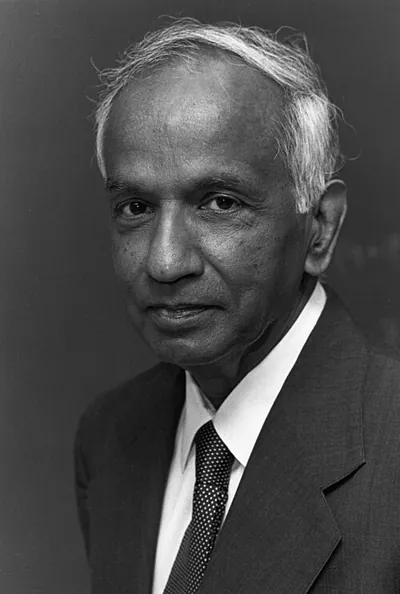 Subrahmanyan Chandrasekhar1910–1995 · Astronomy and space
 Cecilia Helena Payne Gaposchkin1900–1979 · Astronomy and space
 Jan Hendrik Oort1900–1992 · Astronomy and space
 Bernard Lovell1913–2012 · Astronomy and space
 Robert Hanbury Brown1916–2002 · Astronomy and space
